Latest News
Stay updated with the latest news and articles
Top Stories
Trump's NATO Threats and Iran Moves Rattle Global Order, Force Allies to Rethink Strategy
Trump's NATO Threats and Iran Moves Rattle Global Order, Force Allies to Rethink Strategy A series of aggressive foreign policy moves by U.S. President Donald Trump, targeting NATO and Iran, is causing profound alarm among America's closest allies and prompting a global reassessment of security and economic partnerships [57270][57549]. The immediate crisis stems from Trump's renewed threats to withdraw the United States from the North Atlantic Treaty Organization (NATO) if European members do not significantly increase their defense spending [125750]. This warning, delivered amid already strained relations, has forced European leaders to directly challenge the U.S. position. British Prime Minister Keir Starmer explicitly argued that remaining in the 32-nation military alliance is in America's own strategic interest [125750]. Simultaneously, Trump's confrontational approach toward Iran, including threats over the vital Strait of Hormuz shipping route, has created extreme tension and raised the risk of a major Middle East conflict [125786]. Some analysts warn that a miscalculation could precipitate a historic foreign policy failure, damaging U.S. global standing in a manner comparable to Britain's loss of prestige after the 1956 Suez Crisis [125786]. The cumulative effect of these actions has left traditional partners questioning the reliability and predictability of the United States [57549]. At the recent World Economic Forum in Davos, global leaders openly warned of a breaking international system, often directing indirect criticism at Washington while avoiding direct confrontation with China [57270]. This signals a strategic recalibration, as nations begin to hedge against U.S. unpredictability by cautiously engaging other powers [57270]. Experts note that the uncertainty extends beyond security to the foundations of global finance. Trump's demonstrated willingness to use financial tools, like seizing foreign state assets, for political goals has raised fears that he could pressure the politically independent Federal Reserve [46382]. Such a move would shake international trust in the U.S. dollar, the world's primary reserve currency, and upend the rules of the global financial system [46382]. The shifting landscape is accelerating a broader move toward a "multi-polar age," where U.S. leadership is no longer unchallenged [57847]. As the old "Atlanticist" bond weakens, strategic locations like Greenland gain new importance for multiple powers, and nations worldwide are actively building new trade alliances and diversifying partnerships to insulate themselves from the fallout of U.S. policy decisions [121522][103588]. Starmer to Trump: Leaving NATO Hurts America Trump's Iran Crisis: A New "Suez Moment" for America? World Shifts Toward China as Trump Upends Old Order Trump Stuns Davos: Allies Question U.S. Commitment Trump's Trade Threats Could Upend Global Finance The Atlantic Splinters: As U.S. Power Wanes, Greenland Becomes a New Front Global South Slams the Vents on US "Air Conditioner" Policy ASEAN Seeks New Partners as US-China Trade War Rages
Tourist Hotspots Worldwide Hit Breaking Point as Crowds Overwhelm Cities and Nature
Tourist Hotspots Worldwide Hit Breaking Point as Crowds Overwhelm Cities and Nature From the canals of Venice to the favelas of Rio de Janeiro, popular destinations are straining under the weight of massive tourist crowds, a phenomenon experts are calling "overtourism" [80040]. The surge is damaging local environments, reshaping communities, and forcing governments to seek solutions. The problem is no longer confined to iconic landmarks. Social media can suddenly create a viral "must-see" spot, redirecting global tourist traffic overnight [80040]. In Rio de Janeiro, a single rooftop in the Rocinha favela, dubbed the "Gateway to Heaven," now draws international visitors who wait for hours for a photo, bringing new income but also raising questions about sustainability in a densely populated residential area [101397]. Similarly, in Venice, a simple wooden dock used by locals like a bus stop has become a pilgrimage site after Kim Kardashian was photographed there during a celebrity wedding, with fans now seeking out the "Kardashian jetty" and other event locations [51924]. The environmental and cultural impacts are significant. Mass tourism is damaging fragile environments and contributing to higher carbon emissions [86148]. In some cases, the influx commodifies local culture and daily life. In Kalk Bay, South Africa, wild seals begging for scraps at the fish market have become a daily spectacle for tourists, turning a working dock into an unintended wildlife show [55467]. Faced with these pressures, local authorities are experimenting with countermeasures. Proposed solutions include implementing tourist taxes, promoting travel during off-peak seasons, and redirecting visitors to less-crowded areas [80040]. The travel industry is also being pushed to adapt, with suggestions for travelers to choose eco-certified accommodations and be more mindful of their destination's carrying capacity [86148]. The trend highlights a global struggle to balance the economic benefits of tourism with the need to protect local communities, cultures, and ecosystems [80040]. Tourist Destinations Hit Breaking Point: What Causes the Crush? Viral 'Gateway to Heaven' Rooftop Floods Rio Favela with Tourists Venice's New Tourist Hotspot: The 'Kardashian Jetty' The Hidden Cost of Your Vacation Seals Beg at the Fish Market: A South African Village's Daily Show
Climate Crisis Forces First Official Relocation as Tuvaluans Land in Australia
**Climate Crisis Forces First Official Relocation as Tuvaluans Land in Australia** The first citizens of Tuvalu have arrived in Australia, marking a historic moment as the world's first officially recognized climate migrants. They are the initial group to use a new, permanent visa pathway created specifically for the population of the low-lying Pacific island nation, which faces an existential threat from rising seas [25540][10674]. Australia established the special visa program in late 2023, allowing up to 280 Tuvaluans to relocate each year. The policy is a direct response to the environmental devastation in Tuvalu, where sea-level rise is eroding land and increasing destructive flooding. Experts warn that parts of the country could become uninhabitable within decades [25540][10674]. The new arrivals are granted the right to live, work, and study in Australia, with a clear route to citizenship. The migration deal is part of a broader partnership that also includes Australian funding for coastal reclamation and climate adaptation projects in Tuvalu itself [10674]. This organized relocation represents a significant shift in how nations are planning for the long-term impacts of climate change. It moves the discussion from theoretical risk to concrete action, setting a precedent for the planned movement of entire communities displaced by environmental changes [25540]. **Tuvalu Citizens Arrive in Australia as First Official Climate Migrants** Australia Opens Special Visa Pathway for Climate-Affected Tuvaluans


Trump Revives Bid to Buy Greenland, Using Tariff Threats and Pressure Tactics
Trump Revives Bid to Buy Greenland, Using Tariff Threats and Pressure Tactics Former President Donald Trump is renewing his controversial push for the United States to purchase Greenland, employing a mix of economic threats and public pressure that mirrors his real estate deal-making style. The autonomous Danish territory has consistently stated it is not for sale [50444]. Trump raised the issue again during a speech at the World Economic Forum in Davos, Switzerland, calling for immediate negotiations to buy the massive Arctic island [55297][55327]. He has previously suggested using tariffs against Denmark, which handles Greenland's foreign and defense policy, as leverage in the pursuit [50444]. While stating he does not want to use military force, Trump has refused to explicitly rule it out [50444][55327]. The motivation is widely seen as strategic, centered on Greenland's location in an increasingly accessible and resource-rich Arctic. The region is growing in importance for shipping lanes and mineral extraction [50444]. However, experts warn that Trump's transactional approach is fundamentally flawed when applied to international sovereignty [52669][87536]. Analysts note that Greenland's people and government view themselves as a modern nation, not a commodity. Applying economic pressure, they argue, is more likely to strengthen local resistance than to force a sale [52669]. Furthermore, such a move risks destabilizing the Arctic and provoking backlash from other global powers, including China and Russia, who are also active in the region [52669]. The Danish and Greenlandic governments have repeatedly and firmly rejected the idea of a transaction. One expert summarized the consensus, stating, "real estate tactics cannot acquire a sovereign land" [52669]. Trump Eyes Greenland: Cash, Threats, and Military Force Trump at Davos: Questions NATO, Wants to Buy Greenland Trump at Davos: Skips Soft Power, Targets Greenland and NATO Allies Trump's Tariff Plan Fails to "Capture" Greenland

India's Farmers Block Highways, Fearing U.S. Trade Deal Will Crash Crop Prices
**India's Farmers Block Highways, Fearing U.S. Trade Deal Will Crash Crop Prices** Thousands of Indian farmers have taken to the streets, blocking major highways with tractors and trucks to protest a new trade agreement with the United States. The protestors fear the deal will flood the market with cheaper American farm goods, threatening their livelihoods and a crucial government price-support system [75183][73750]. The protests, centered around the capital New Delhi, were sparked by a trade pact announced following a visit by former U.S. President Donald Trump. Farmers and trade unions argue the agreement could force India to lower import taxes on American agricultural products, allowing them to undercut local producers [75183][73750]. At the heart of the dispute is India's Minimum Support Price (MSP) system, under which the government buys key staples like wheat and rice from farmers at guaranteed prices. Protest leaders demand a new law to make these price guarantees permanent, fearing the trade terms could weaken or dismantle this safety net [73750]. While the Indian government has stated that the MSP system remains protected under the deal, farmer unions express deep distrust. They have called for the agreement to be scrapped entirely, arguing it primarily serves U.S. corporate interests over India's agricultural community [75183][73750]. The demonstrations highlight the domestic political tightrope the government must walk. The farming sector represents a massive and influential voting bloc, making the government's response critical for maintaining stability even as it seeks to strengthen international trade ties [73750]. Police have heightened security at entry points to the capital as negotiations between protest leaders and government officials continue. Indian Farmers Strike, Fearing U.S. Trade Deal Will Flood Market India's Farmers Protest as Modi-Trump Trade Pact Threatens Key Crop Prices

U.S. Forces Capture Venezuelan President Maduro in Military Strike, Plan to "Run" Country
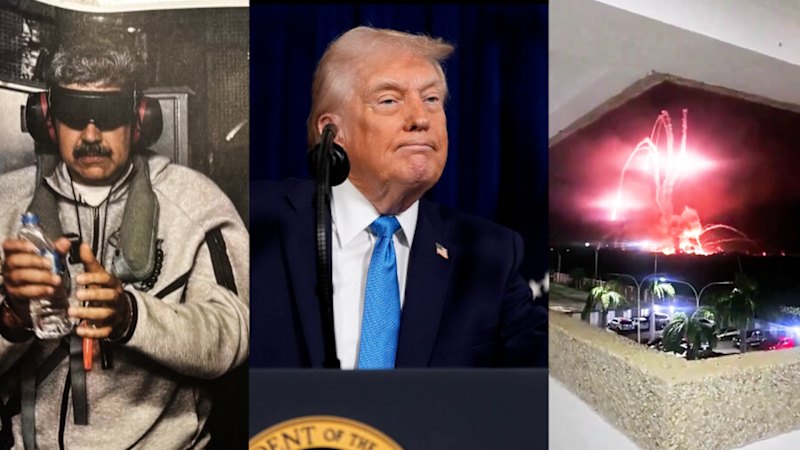
U.S. Forces Capture Venezuelan President Maduro in Military Strike, Plan to "Run" Country In an unprecedented military escalation, United States forces have captured Venezuelan President Nicolás Maduro and his wife, Cilia Flores, during a large-scale strike on Venezuelan territory. The operation, ordered by the Trump administration, has removed the long-time leader from power and triggered a profound political crisis in the oil-rich nation [41033][41227][41379]. The capture occurred following U.S. military strikes, including in the capital Caracas, on Saturday, January 3, 2026 [40921][41055][41227]. Former U.S. President Donald Trump announced the operation, describing it as a "large-scale strike" that resulted in the detention of the Venezuelan leader [40942][41088]. Following the capture, Trump stated the United States would now "run" Venezuela to "fix" its collapsed oil infrastructure and "take back the oil" [41227][41525][42114]. Maduro and his wife have been taken out of Venezuela and are expected to face criminal charges in a New York court [41136][40970]. The specific charges reportedly include narco-terrorism, with Trump accusing Maduro of running a "narco terrorist organisation" [40942][40970]. The U.S. government has long labeled Maduro's rule illegitimate, accusing his administration of corruption, human rights abuses, and stealing elections [41136][40668][41525]. For years, the U.S. has recognized opposition leader Juan Guaidó as Venezuela's legitimate president and imposed severe economic sanctions on the country [41379][40505]. The immediate aftermath has created a dangerous power vacuum, with no clear successor named to lead Venezuela [41136][40970]. The U.S. has suggested that Maduro's deputy, Delcy Rodríguez, could follow U.S. orders as an interim president, but her compliance is uncertain [41525]. The action places the U.S. in direct control of a nation suffering from hyperinflation, severe food shortages, and a humanitarian crisis, despite holding the world's largest proven oil reserves [40871][42114]. There has been no immediate public statement from the Venezuelan military or the remnants of Maduro's government [41379][40668]. The capture of a sitting head of state on his own soil by a foreign military is a rare event in modern history and is expected to provoke intense international debate over sovereignty and international law [40668][40737][40942]. U.S. Forces Capture Venezuelan President in Military Strike Venezuela Leader Ousted in U.S. Strike, Faces Charges in New York US Strikes Venezuela, Captures President Maduro U.S. Captures Venezuela's President in Secret Operation U.S. Forces Capture Venezuelan President Nicolás Maduro US Strikes Venezuela, Abducts President Maduro US Captures Venezuelan President in "Large-Scale Strike" U.S. Military Strike Captures Venezuelan Leader Maduro U.S. Captures Maduro: What Now for Venezuela? US Seizes Venezuelan President, Vows to "Run" Country and "Take Back the Oil" U.S. Claims Capture of Venezuelan Leader in Military Strike U.S. Strikes Venezuela, Captures President Maduro US Captures Venezuelan President in Military Strike U.S. Strikes Venezuela, Captures President Maduro Venezuelan President Captured in U.S. Military Raid
AI Takes the Field: How New Tech is Transforming the Olympics and Beyond
AI Takes the Field: How New Tech is Transforming the Olympics and Beyond From judging jumps to creating viral clips, artificial intelligence is fundamentally changing how the world watches and understands sports. The technology, which made a major global debut at the recent Milano Cortina Winter Olympics, is now being deployed to enhance broadcasts, assist officials, and engage fans in unprecedented ways. The most striking innovation allows viewers to see athletic feats from angles previously impossible. During the Games, when American figure skater Ilia Malinin executed a quadruple jump, a replay generated by artificial intelligence showed his four mid-air revolutions as if the camera was orbiting around him in space [82096]. This "orbiting" perspective is created by AI systems that build detailed three-dimensional models from standard broadcast camera feeds, enabling virtual cameras to be placed anywhere [82096]. Beyond spectacle, the technology serves practical purposes. Olympic officials are using these AI systems to aid in judging, analyzing performances with new levels of detail [82096]. The same tools are also automatically generating tailored content for social media platforms, feeding the global demand for instant, shareable highlights directly from the events [82096]. This high-tech integration even extends to honoring history. At the same Milano Cortina Games, photographers are using adapted 70-year-old Graflex cameras from the 1950s to shoot events, blending Olympic tradition with modern immediacy. The vintage cameras have been modified to transmit their images live to smartphones, allowing the nostalgic photos to reach a digital audience in real time [79782]. The move signals a broader shift where AI is moving from digital applications into the physical world. Similar machine-learning software is now powering robots on construction sites and optimizing assembly lines in factories, driving a noted productivity boom in blue-collar industries [30415]. In the United Kingdom, the military is testing drones that use AI to scan for landmines and hidden explosives from a safe distance, a tool aimed at saving lives during dangerous clearance operations [118535]. As the technology evolves, its role in both public entertainment and critical practical tasks is set to expand, reshaping fields from sports broadcasting to industrial work and security. AI Replay Tech Makes Olympic Jumps Spin on Screen Vintage Cameras Capture 2026 Olympics for Modern Crowd AI's New Blue-Collar Boom: Robots Fuel a Productivity Surge AI Drones Hunt Landmines: UK Tests Life-Saving Tech


Women's Sports Surge Toward $3 Billion Milestone as Viewership and Investment Soar
Women's Sports Surge Toward $3 Billion Milestone as Viewership and Investment Soar The commercial power of women's sports is accelerating at an unprecedented rate, with global revenue projected to surpass $3 billion in 2026 [125062]. This rapid growth, from an expected $2.4 billion in 2025, signals a major turning point for the industry, driven by rising viewership, expanding media deals, and increasing corporate investment [125062]. The momentum is visible across major events. The NCAA women's basketball Final Four, featuring a marquee matchup between defending champion University of Connecticut and South Carolina, is drawing significant attention [120219]. In rugby, England's women's team enters the Six Nations as world champions and heavy favorites, aiming to repeat a grand slam victory [124683]. Athletes are also directly leveraging viewer interest to push for greater inclusion. In Nordic combined, the last Olympic sport without a women's event, competitors are urging fans to watch the men's competitions this week. They hope strong television ratings will prove the sport's global appeal and secure a women's event for the 2030 Winter Games [77899]. The push for growth and visibility extends beyond traditional powerhouses. A team of Afghan refugee women, who fled after the Taliban banned women's sports, has formed a soccer team in Houston, Texas, using the sport to rebuild community and reclaim their identity [20194]. Meanwhile, at the elite level, American Paralympian Dani Aravich is attempting a rare double, competing in both track and field events to win medals and raise awareness for Paralympic sports [95020]. Industry analysts describe the current climate as building critical momentum, suggesting the $3 billion forecast is a sign of solidified commercial viability rather than a temporary spike [125062]. Women's Sports to Top $3 Billion in 2026 Final Four Live: Can Anyone Stop UConn's Repeat Bid? England Target Repeat Grand Slam in Women's Six Nations One Sport Bans Women. This Week's TV Ratings Could End It. Afghan Refugee Women Build New Team and Community on the Soccer Field Paralympian Races for Two Medals, One Mission


Viral Trends and Grandmas: How Everyday Culture Is Going Global Online
Viral Trends and Grandmas: How Everyday Culture Is Going Global Online From Italian slang lessons to traditional Chinese fasteners, intimate pieces of cultural heritage are exploding in popularity worldwide through social media, creating both connection and complex questions about authenticity. The phenomenon is driven by individuals sharing hyper-specific traditions online, where they often go viral with millions of views. In Canada, teacher Johnny D’Ambrosio and his 88-year-old grandmother have amassed a huge following by creating humorous musical videos about Italian family life, slang, and food, with one clip viewed over 20 million times [80130]. Similarly, a trend dubbed "Chinamaxxing" saw people of all backgrounds adopting habits like drinking hot water and wearing house slippers in videos that gathered hundreds of thousands of views [109231]. This digital spotlight is also reviving interest in tangible heritage items. The sudden popularity of "frog buttons," traditional Chinese fasteners seen on a jacket at Shanghai Fashion Week, was traced back to a deep history of design, illustrating how old crafts can find new audiences [44500]. For the communities at the center of these trends, the experience is mixed. While some, like D'Ambrosio, aim to share the joy of their heritage and see people connecting with their own roots [80130], others watch lifelong customs become short-lived memes. "People are trying to be more Chinese regardless of what their heritage is," observed London-based fashion label owner Michelle She, highlighting the strange sensation for those whose culture is being adopted as a viral trend [109231]. The online spread of these cultural snippets demonstrates a powerful, grassroots exchange. However, it raises questions about whether this digital appreciation fosters deeper understanding or remains a surface-level engagement dictated by algorithms. Grandma's Viral Hits: Italian Lessons for Millions Chinamaxxing: When Your Culture Becomes a Viral Meme **Hidden Stories: From Tattoo Needles to Viral Buttons**


China's Extreme Fitness Craze Sparks Major Health Warnings
China's Extreme Fitness Craze Sparks Major Health Warnings Doctors are sounding the alarm over dangerous new fitness trends in China, where a pursuit of health through intense exercise is leading to serious injuries and hormonal breakdowns, particularly among the young. A viral practice known as "neck-hanging exercise" has medical experts urgently warning the public. Participants suspend their full body weight by their head from tree branches, attempting to self-administer cervical traction [122710]. This follows a 2024 health report indicating over 200 million people in China suffer from cervical spine disorders, with more than 40% of patients under age 30 [122710]. Doctors state the unsupervised trend can cause permanent ligament damage, paralysis, and even stroke [122710]. In a separate but related case, a 23-year-old woman from Zhejiang province lost her menstrual cycle after adhering to a regimen of six workouts per week [46995]. Hospital tests showed her female hormone levels were comparable to those of a typical 50-year-old woman [46995]. She was diagnosed with symptoms of kidney deficiency by Traditional Chinese Medicine (TCM) practitioners and ordered to stop all exercise immediately while undergoing significant TCM treatment [46995]. These incidents highlight a clash between popular wellness culture and medical science. While global health improves through systemic care and technology [23147], these individual pursuits of extreme fitness are creating new patient crises. The "neck-hanging" trend continues to gain popularity online despite the dire warnings from spinal specialists [122710]. **Dangerous "Neck-Hanging" Trend Alarms Doctors in China** **Young Woman's Extreme Fitness Halts Her Periods** Africa's Health Revolution: Can 2030 Goals Be Met?

Latest Articles

Artemis II Crew Recovered After Ocean Splashdown
The four astronauts of NASA's Artemis II mission have been safely recovered from the Pacific Ocean. The crew completed a key test of emergency proced...

102-Year-Old CEO's Secret: Perfection in Pottery
George Strausman works four days a week running his family's construction business. At 102, this makes him one of America's oldest active CEOs. But...

Swalwell Urged to Exit Governor Race After Assault Claim
Top Democrats are calling on U.S. Representative Eric Swalwell to end his campaign for Governor of California. This follows a public allegation of se...

Artemis II Astronauts Return in Fiery Pacific Splashdown
The crew of NASA's Artemis II mission has safely returned to Earth. Their spacecraft completed a high-speed reentry through the atmosphere before lan...

Artemis II Crew Returns: NASA Debriefs After Historic Moon Mission
NASA officials have held a press conference following the successful return of the Artemis II crew to Earth. The astronauts splashed down in the Pac...

Trump's White House Paint Job: A Historic Facade Could Turn White
Former President Donald Trump has proposed a striking change to a historic White House building. He wants to cover its stone exterior with white pain...

Orbán Loses Lead: Trump Ally Trails in Hungary Polls
New polls show Hungarian Prime Minister Viktor Orbán and his ruling Fidesz party are now behind their main rival. Orbán, a close international ally...

2028 Race Begins: Democrats Flock to Sharpton Event Years Before Votes
Several potential Democratic candidates for the 2028 U.S. presidential election have already begun campaigning. They gathered this week at a conferen...

Boy, 9, Found Locked in Van Since Start of 2024, Police Say
A nine-year-old boy has been rescued from a utility van where he had been living since January, French authorities report. The child was discovered...

Teen Athlete's Year-Long Headache Mystery Solved
A teenage athlete suffered from a constant headache for over a year. Doctors finally discovered the surprising cause. Jack Alston, a student athlete...

No Deals Yet as U.S. and Iran Hold High-Stakes Talks
U.S. and Iranian negotiators have begun critical talks. This comes during a fragile, two-week pause in hostilities. A U.S. official stated clearly t...

Michael Jordan Swaps Courts for NASCAR in New Team Venture
Basketball legend Michael Jordan is steering into a new sport: professional stock car racing. The six-time NBA champion discussed his latest business...

Tennessee School Board Member Censured for Calling Student "Hot"
A Tennessee school board member has been formally censured after putting his arm around a female student and calling her "hot." The incident occurred...

Teen's Phone Captures Beirut Airstrike While She Runs
A teenager filmed her own escape from a Beirut street as airstrikes hit the area. The 13-year-old girl recorded the video on her mobile phone. The f...

Melania Trump Denies Epstein Link: "I Am Not a Victim"
Former First Lady Melania Trump has publicly denied having any relationship with the late financier Jeffrey Epstein. She made the statement in a rece...

U.S. to Automatically Register Men for Draft
The United States will soon automatically add young men to the military draft list. A new system, set to launch by December, will use existing gover...

Trump Accuses Iran of Blocking Oil in Critical Strait
U.S. President Donald Trump publicly criticized Iran on Thursday, accusing it of breaking an agreement concerning the Strait of Hormuz. Trump stated...

U.S. Inflation Jumps as Iran Conflict Shocks Oil Market
New government data shows inflation rose sharply in March. The increase follows a major oil price shock caused by the recent military conflict betwee...

Woman Calls 911 as Truck Sinks Around Her
A woman was rescued by sheriff's deputies after her pickup truck became trapped in floodwaters and began to sink near Tampa, Florida. Body camera fo...

WATCH: NFL Game in Danger as Monster Storm Hits
A powerful winter storm is disrupting major plans across the United States this weekend, from holiday travel to professional sports. The severe weat...