Latest News
Stay updated with the latest news and articles
Top Stories
Climate Crisis Forces First Official Relocation as Tuvaluans Land in Australia
**Climate Crisis Forces First Official Relocation as Tuvaluans Land in Australia** A group of citizens from the Pacific island nation of Tuvalu has arrived in Australia, marking one of the world's first official movements of people displaced by climate change. The arrivals are the initial beneficiaries of a special visa program created specifically for Tuvaluans whose homeland is disappearing due to rising sea levels [25540]. Australia established the pathway last year, allowing up to 280 Tuvalu citizens to migrate annually. The program grants them the right to live, work, and study in Australia permanently, with a clear route to citizenship [10674]. The policy is a direct response to the existential threat facing Tuvalu, a low-lying atoll nation where increasing flooding and coastal erosion are predicted to make areas uninhabitable in coming decades [25540]. The new migration agreement between the two countries also includes Australian funding to support Tuvalu's own coastal defense and climate adaptation projects [10674]. The arrival of the first group under this visa solidifies a planned, government-led approach to relocating entire populations affected by environmental breakdown, setting a significant precedent in global climate policy [25540]. Tuvalu Citizens Arrive in Australia as First Official Climate Migrants Australia Opens Special Visa Pathway for Climate-Affected Tuvaluans


Trump Revives Push to Buy Greenland, Using Tariff Threats and Cash Offers
Trump Revives Push to Buy Greenland, Using Tariff Threats and Cash Offers Former President Donald Trump is renewing his controversial effort to purchase Greenland, deploying a mix of financial offers, tariff threats, and public pressure to acquire the strategic Arctic territory [50444]. The campaign, which has resurfaced during his current political activities, treats the autonomous Danish island like a real estate deal and directly challenges the post-World War II international order [58552]. Speaking at the World Economic Forum in Davos, Switzerland, Trump publicly stated the United States should be allowed to buy Greenland and called for immediate negotiations [55297][55327]. He has previously suggested using cash offers to Greenlanders themselves while threatening economic consequences for Denmark if they refuse to discuss a sale [50444]. Although he has stated he does not want to use military force, he has refused to explicitly rule it out [50444][55327]. The motivation is strategic. Greenland’s location in the Arctic makes it increasingly valuable for shipping lanes and untapped natural resources as polar ice recedes [50444]. However, experts warn Trump’s tactics are doomed to fail, mirroring his business approach but ignoring the realities of sovereignty and diplomacy [52669][87536]. Both the Danish and Greenlandic governments have consistently and firmly stated the island is not for sale [50444][52669]. Analysts note the strategy conflates genuine geopolitical interests with an unrealistic, expansionist vision [50444]. By openly questioning the value of longstanding alliances like NATO in the same speeches where he promotes the Greenland purchase, Trump is rejecting the diplomatic norms of the liberal international order [55297][55515]. Historians compare the combined pursuit of foreign territory and dismissal of allied diplomacy to 19th-century imperial behaviors [58552]. The push has already caused significant diplomatic friction. After Denmark rejected an earlier offer, Trump called the response "nasty" and postponed a planned state visit [50444]. Experts further warn that aggressive tactics could destabilize the Arctic region, provoking backlash from other global powers like China and Russia who are monitoring the area closely [52669]. Ultimately, Greenland’s future remains a decision for its people, not a transaction to be forced by economic pressure [52669]. Trump’s campaign continues to treat international relations as a high-stakes negotiation, applying a real estate playbook to a matter of national sovereignty [87536]. Trump Eyes Greenland: Cash, Threats, and Military Force Trump at Davos: Questions NATO, Wants to Buy Greenland Trump at Davos: Skips Soft Power, Targets Greenland and NATO Allies Trump's Tariff Plan Fails to "Capture" Greenland Trump's 'New Imperialism': Land Grabs and a Rejected World Order

India's Farmers Block Highways, Fearing U.S. Trade Deal Will Crash Crop Prices
India's Farmers Block Highways, Fearing U.S. Trade Deal Will Crash Crop Prices Thousands of Indian farmers have taken to the streets and blocked major highways, protesting a new trade agreement with the United States that they fear will flood the market with cheap imports and destroy their livelihoods [75183][73750]. The protests, which have used tractors and trucks to barricade roads around the capital, New Delhi, center on concerns that the deal could force India to reduce crucial government price supports for staple crops like wheat and rice [73750]. Farmers argue that lowering import taxes on American agricultural goods would allow cheaper products to enter the country, threatening local incomes [75183]. The trade pact, struck during a recent high-level visit, is seen as a diplomatic victory for Prime Minister Narendra Modi in strengthening ties with a key partner [73750]. However, it has ignited immediate backlash from the politically powerful farming community, a crucial voting bloc. Protest leaders are demanding a legal guarantee that the existing minimum price system, which ensures farmers a stable income, will remain untouched [73750]. The Indian government has stated that the agreement includes safeguards to protect the domestic agriculture sector from sudden price drops [75183]. Officials maintain that the minimum price support system is not under threat [73750]. Despite these assurances, farmer unions have called for a nationwide strike, expressing deep distrust that the deal favors U.S. corporate interests over their survival [75183]. Negotiations between farmer leaders and government officials are ongoing, with security heightened at key entry points to the capital [73750]. The standoff highlights the persistent tension between India's international trade ambitions and the economic stability of its vast agricultural sector. Indian Farmers Strike, Fearing U.S. Trade Deal Will Flood Market India's Farmers Protest as Modi-Trump Trade Pact Threatens Key Crop Prices

U.S. Forces Capture Venezuelan President Maduro in Military Strike, Plan to "Run" Country
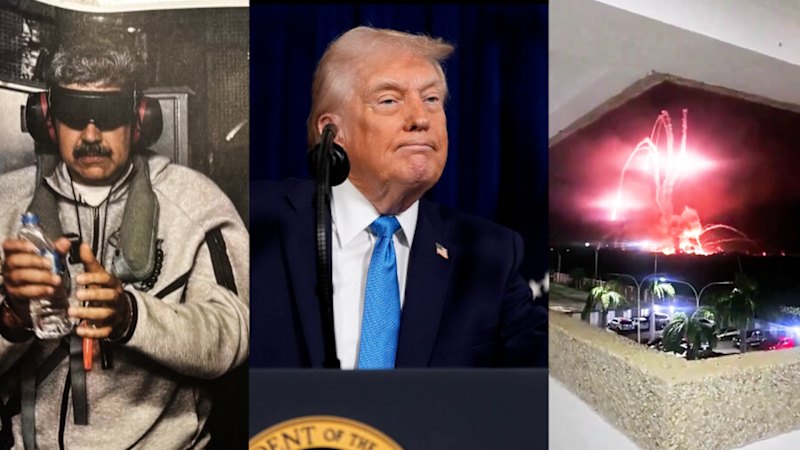
U.S. Forces Capture Venezuelan President Maduro in Military Strike, Plan to "Run" Country U.S. military forces have captured Venezuelan President Nicolás Maduro and his wife, Cilia Flores, in a large-scale military operation, marking an unprecedented direct intervention in the South American nation [41033][41227][41379]. The strike, which occurred on Saturday, January 3, 2026, targeted locations including the capital, Caracas [40921][41088]. Following the capture, former U.S. President Donald Trump announced that the United States would now "run" Venezuela, with a stated goal to "take back the oil" and fix the country's collapsed oil infrastructure [41227][40871][41525]. Venezuela holds the world's largest proven oil reserves, but its production has plummeted amid a severe economic and humanitarian crisis [40871][42114]. Maduro and his wife have been taken to New York, where they face criminal charges including terrorism and narcotics offenses [41136][40942][40970]. U.S. officials have long labeled Maduro's government as illegitimate, accusing it of corruption, human rights abuses, and ties to drug trafficking [41136][40668][40970]. The operation has created an immediate leadership vacuum in Venezuela, with no clear successor named [41136][40970]. The U.S. has recognized opposition leader Juan Guaidó as the country's legitimate president since 2019, but the path forward for governance remains unclear [41379][40505]. There has been no immediate public statement from the Venezuelan military or the remnants of Maduro's government [41379][40668]. The capture of a sitting head of state on foreign soil is a rare event in modern history and is expected to trigger a major political crisis and intense international debate over sovereignty [40668][40737][41088]. U.S. Forces Capture Venezuelan President in Military Strike Venezuela Leader Ousted in U.S. Strike, Faces Charges in New York US Strikes Venezuela, Captures President Maduro U.S. Captures Venezuela's President in Secret Operation U.S. Forces Capture Venezuelan President Nicolás Maduro US Captures Venezuelan President in "Large-Scale Strike" U.S. Military Strike Captures Venezuelan Leader Maduro U.S. Captures Maduro: What Now for Venezuela? US Seizes Venezuelan President, Vows to "Run" Country and "Take Back the Oil" U.S. Claims Capture of Venezuelan Leader in Military Strike U.S. Strikes Venezuela, Captures President Maduro US Captures Venezuelan President in Military Strike U.S. Strikes Venezuela, Captures President Maduro Venezuelan President Captured in U.S. Military Raid
AI Replay Tech Steals the Show at 2026 Winter Olympics, Creating "Orbiting" Jumps
AI Replay Tech Steals the Show at 2026 Winter Olympics, Creating "Orbiting" Jumps A new artificial intelligence-powered broadcasting system has transformed how millions of people watch sports, making its global debut at the 2026 Milano Cortina Winter Olympics. The technology generates stunning replays from angles never before possible, turning athletic performances into three-dimensional spectacles [82096]. The innovation was showcased during American figure skater Ilia Malinin's performance. For viewers at home, the replay of his quadruple jump did not simply play back from a fixed camera. Instead, the video frames appeared to spin and orbit around the athlete as he rotated in mid-air, creating a dramatic, immersive perspective [82096]. This "orbiting" replay is one of many new viewpoints created by the AI system. The technology constructs detailed 3D models of athletes and their movements using footage from standard broadcast cameras. Once the model is built, broadcasters can generate a video replay from any virtual vantage point, even positions where no physical camera was placed [82096]. Beyond enhancing the television spectacle for fans, the technology serves practical purposes for the Games. Officials are using the AI-generated models to assist with judging decisions, providing unprecedented clarity on complex maneuvers. The system also rapidly creates specialized content for social media platforms, catering to the demand for instant, shareable highlights [82096]. The adoption of cutting-edge tech at the Olympics extends beyond broadcasting. In a nod to history, photographers at the Milano Cortina Games are using adapted Graflex cameras from the 1950s—the era of the last Cortina-hosted Winter Games. These vintage devices have been modified to transmit their captured images directly to smartphones for live sharing, blending 70-year-old design with modern connectivity [79782]. Meanwhile, NASA has announced that astronauts on upcoming Artemis Moon missions, scheduled to begin no earlier than 2026, will be permitted to bring their personal smartphones. The devices, with their advanced consumer-grade cameras, will be used to document the experience with high-quality photos and videos for both private memories and public engagement, though they will play no role in critical spacecraft operations [69522]. AI Replay Tech Makes Olympic Jumps Spin on Screen Vintage Cameras Capture 2026 Olympics for Modern Crowd NASA Astronauts to Take Smartphones to the Moon


Women's Sports Revenue on Track to Smash $3 Billion Milestone by 2026
Women's Sports Revenue on Track to Smash $3 Billion Milestone by 2026 Global revenue for women's sports is accelerating toward a major financial milestone, with new projections showing it will surpass $3 billion in 2026 [125062]. This figure represents rapid commercial growth, following an expected total of $2.4 billion in 2025 [125062]. Industry analysts describe the trend as building significant momentum, signaling a major turning point for the economic power of women's athletics worldwide [125062]. The growth coincides with high-profile events driving viewership and interest. The NCAA women's basketball Final Four tipped off this weekend, featuring a marquee matchup between the defending champion University of Connecticut Huskies and the South Carolina Gamecocks [120219]. Meanwhile, the 2026 Women's Six Nations rugby tournament begins this weekend with world champion England as the clear favorite to repeat its grand slam victory from last year [124683]. The rising commercial tide is also creating opportunities for new stories and communities. In Houston, Texas, a group of Afghan refugee women who fled after the Taliban banned women's sports have formed a soccer team, rebuilding their lives and community around the game [20194]. In elite competition, American Paralympian Dani Aravich is attempting a rare feat by competing in both track sprints and the long jump, using her platform to increase awareness for Paralympic sports [95020]. Despite progress, gaps remain. Nordic combined is still the only Olympic sport without a women's event, and athletes are hoping strong viewership for the men's competition this week will prove the interest needed for inclusion by the 2030 Winter Games [77899]. Women's Sports to Top $3 Billion in 2026 Final Four Live: Can Anyone Stop UConn's Repeat Bid? England Target Repeat Grand Slam in Women's Six Nations Afghan Refugee Women Build New Team and Community on the Soccer Field Paralympian Races for Two Medals, One Mission One Sport Bans Women. This Week's TV Ratings Could End It.


Viral Trends and Grandmas: How Everyday Culture Is Going Global Online
Viral Trends and Grandmas: How Everyday Culture Is Going Global Online From Italian slang lessons to Chinese daily habits, intimate slices of cultural life are exploding in popularity on social media, creating massive—if sometimes fleeting—global audiences. This digital surge is turning personal heritage into public spectacle, with millions tuning in to learn traditions directly from their practitioners. In Canada, a teacher and his grandmother have become unlikely online stars by sharing their Italian heritage. Johnny D'Ambrosio creates short, musical videos with his 88-year-old *nonna*, humorously explaining traditions, slang, and family life [80130]. One of their videos has been viewed over 20 million times on TikTok and Instagram. D'Ambrosio says their goal is to share the joy of their heritage, focusing on universal themes like food and intergenerational bonding [80130]. Meanwhile, a separate viral trend dubbed "Chinamaxxing" saw people worldwide adopting Chinese cultural habits, regardless of their background. Popular videos showed creators drinking hot water, wearing house slippers, and using chopsticks, gathering hundreds of thousands of views [109231]. London-based fashion label owner Michelle She observed, “people are trying to be more Chinese regardless of what their heritage is” [109231]. For many Chinese people, watching lifelong customs become a short-lived internet meme has been a strange experience [109231]. The phenomenon extends to other crafts. In Hong Kong, a group of women tattoo artists are gaining attention by using their needles to channel traditional Chinese culture, incorporating elements of painting, calligraphy, and Buddhist philosophy into their work [44500]. Similarly, the sudden popularity of traditional "frog buttons" on a viral Adidas jacket at Shanghai Fashion Week highlighted a renewed interest in heritage design details [44500]. These online movements demonstrate a powerful, algorithm-driven appetite for authentic cultural expression, even as communities navigate the line between meaningful sharing and temporary trend. Grandma's Viral Hits: Italian Lessons for Millions Chinamaxxing: When Your Culture Becomes a Viral Meme **Hidden Stories: From Tattoo Needles to Viral Buttons**


Patients Sleep in Cars for Days as Free Pop-Up Clinics See Surge in Demand
Patients Sleep in Cars for Days as Free Pop-Up Clinics See Surge in Demand Across the United States, people are arriving up to two days early and sleeping in their vehicles to secure free medical care at temporary pop-up clinics [126324]. The scenes highlight a growing gap in the healthcare system, where basic procedures have become financially out of reach for many, even those with insurance [126324]. The clinics are run by the charity Remote Area Medical (RAM), which sets up operations in underserved areas to provide dental work, eye exams, and general medical care at no cost through volunteer staff [126324]. RAM's CEO, Chris Hall, reports a significant surge in demand, directly attributing it to soaring healthcare costs [126324]. The long lines and overnight waits underscore the burden of high deductibles and out-of-pocket expenses that prevent many Americans from accessing routine care [126324]. For those waiting, the charity clinic often represents their only chance to address neglected health issues without facing crippling debt [126324]. Americans Sleep in Cars for Free Healthcare

U.S. Forces Capture Venezuelan President Maduro in Unprecedented Military Raid
U.S. Forces Capture Venezuelan President Maduro in Unprecedented Military Raid In a dramatic escalation of tensions, United States military forces have captured Venezuelan President Nicolás Maduro, marking the first direct U.S. military attack on a South American nation in history [41064]. The surprise operation in Caracas on Saturday detained Maduro, 63, and his wife, who were subsequently transported to New York to face drug trafficking charges [41880]. President Donald Trump announced the capture, stating the U.S. will oversee Venezuela's government and declaring that "American dominance in the western hemisphere will never be questioned again" [41064]. The precision strike, described by analysts as an act of "extraterritorial apprehension," involved capturing a sitting head of state outside U.S. borders without the host country's consent [47297]. The action has sent shockwaves across Latin America, creating a deep political split among regional governments [47126]. While nations like Colombia and Brazil have offered cautious support, others, including Mexico and Bolivia, have condemned it as a dangerous violation of sovereignty and international law [47297]. Despite public divisions, analysts report a private, shared fear among leaders who are now asking, "Who could be next?" and conducting urgent internal reviews of their own vulnerability [47297]. The United Nations Security Council will hold an emergency meeting on Monday at Venezuela's request to address the incident [41880]. The operation is seen as a direct challenge to China's growing economic and diplomatic influence in the region, where Beijing has become a leading trade partner and lender [41460]. Experts warn the move revives the long-standing U.S. "Monroe Doctrine," a policy opposing foreign powers in the Americas, and sets a major precedent for direct foreign intervention [41460][47297]. U.S. Capture of Venezuela's Maduro Sends Shockwaves Through Latin America U.S. Capture of Maduro Sends Shockwave Through Latin America U.S. Captures Venezuela's Leader, Challenging China's Regional Reach Venezuela's President Seized by U.S., Faces Court in New York Trump Orders First Direct US Military Attack on South America Trump Revives US Habit of Ousting Latin American Leaders
World Braces for Economic Warfare as Top Global Threat in 2026
World Braces for Economic Warfare as Top Global Threat in 2026 A new report from the World Economic Forum (WEF) has identified "geoeconomic confrontation" as the most severe risk facing the world over the next two years, warning that nations are increasingly weaponizing trade and supply chains in a dangerous new form of conflict [49991]. The WEF's latest Global Risks Report, set to be discussed at its annual meeting in Davos, Switzerland, ranks economic conflict between nations above all other immediate dangers [49991]. The report states that geopolitical rivalry is forcing countries to turn economic tools into weapons, threatening international stability and growth [49991]. This volatile environment is dominated by three interconnected threats: geopolitical rivalry, the rapid spread of misinformation, and severe social and political polarization [49991]. Analysts observe that this shift signals a decisive break from the existing international order, with a global transformation in power now broadly recognized [54213]. Despite this fracturing, a century of globalized trade has created deep economic interdependence that makes most nations reluctant to pick sides in a major power rivalry, shaping 21st-century geopolitics [6971]. The defining global story of 2026, however, will be the U.S. presidential election, which international correspondents say will influence critical issues everywhere, from the war in Ukraine to competition with China and global climate policy [35508]. Every international move by the current or next U.S. administration will be seen through a political lens as allies and rivals prepare for the outcome [35508]. Geoeconomic Warfare Named Top Global Threat for 2026 Trump's Plan to Remake the World Order Begins Globalization Shifts, But It Doesn't Reverse 2026: A World Shaped by Washington
Latest Articles

Beirut Airport Stays Open Under Bombing Threat
Beirut's international airport is still operating after nearby Israeli airstrikes. Flights continue, but at a reduced capacity. Officials confirmed...

Iran Steps Into Mediator Role Amid Regional Tensions
Gavin Lee speaks with Oliver McTernan, Director of the conflict resolution organization Forward Thinking, about Iran's surprising new diplomatic stan...

Hungary's Election: A View from Germany
Vendeline Von Bredow, The Economist's Senior Germany Correspondent, is now also covering Hungary's election. Her unique position offers a distinct p...

Historic US-Iran Talks Open as Strait of Hormuz Cleared
Delegates from the United States and Iran held direct negotiations on Saturday. The talks in Islamabad, Pakistan, mark the first such meeting between...

An 8-Year-Old’s Stuffed Toy Is Flying to the Moon
A key item on NASA’s upcoming Artemis II moon mission was designed by a child. The crew’s official “zero-gravity indicator” is a small stuffed toy na...

AI "Mythos" Can Reportedly Find Flaws in Nearly Every Computer System
A new AI model from Anthropic, named "Mythos," has demonstrated a startling capability: it can automatically find critical security flaws in a vast r...

Odesa Hit: Deadly Drone Strikes Precede Holiday Truce
Russian drone attacks struck the Ukrainian port city of Odesa overnight. Local officials say the strikes killed at least two people. The attacks hap...

Artemis II Crew Returns, Global Focus Shifts to Iran Talks
The four astronauts of NASA's Artemis II mission have safely returned to Earth, splashing down in the Pacific Ocean. Their recovery marks the end of...

Pope to World Powers on Iran: "Enough. Stop This War."
Pope Leo XIV issued his strongest condemnation of the conflict in Iran on Saturday. He demanded an immediate end to the fighting. Speaking from St....

Court Orders Review: Could Stopping White House Renovation Risk President's Safety?
A federal appeals court has sent a case about White House renovations back to a lower judge. The court said it needs more information about security...

Artemis II Crew Breaks Silence: "We Are Going."
The four astronauts of NASA's Artemis II mission have spoken publicly for the first time since their historic lunar flyby. The crew addressed the med...

Artemis II Astronauts Return to Earth, Mission a Success
The four astronauts of NASA's Artemis II mission have returned home to Houston. This follows their safe splashdown in the Pacific Ocean on Friday nig...
Fury Wins, Calls Out Joshua After Lukewarm Victory
Tyson Fury defeated Arslanbek Makhmudov by unanimous decision in London on Saturday. The heavyweight boxing champion controlled the fight over all 12...
Brighton's Late Surge Dashes Burnley's Survival Hopes
Mats Wieffer scored twice to give Brighton a crucial win at Burnley. The victory boosts Brighton's chance to qualify for European competition next se...
Bayern Smash Bundesliga Goal Record in Title Charge
Bayern Munich demolished St. Pauli 5-0 on Saturday, setting a new Bundesliga record for goals in a single season. Leon Goretzka scored Bayern's 102n...
Leinster Reach Semis, But Doubts Remain After Sale Win
Leinster have advanced to the European Champions Cup semi-finals with a 43-13 victory over England's Sale Sharks. They will now face French club Toul...
Teenager Ngumoha Saves Liverpool's Season With First Anfield Goal
A 17-year-old winger gave Liverpool a crucial victory. Rio Ngumoha scored his first goal at Anfield and helped create another in a 2-0 win over Fulha...
Title: Arsenal's Title Hopes Punched? Arteta Apologizes After Shock Loss.
**Article:** Arsenal manager Mikel Arteta apologized to fans and said his team must show more character. This came after a damaging 2-1 defeat to Bou...
Fury Dominates, Calls Out Joshua After Unanimous Win
Tyson Fury easily defeated Russian challenger Arslanbek Makhmudov by unanimous decision on Saturday night. The 37-year-old former world champion cont...
The xx Reunite After Eight Years, Hypnotize Coachella
The English indie rock band the xx reunited on stage Friday night for their first festival performance in eight years. Their atmospheric set at the C...