Latest News
Stay updated with the latest news and articles
Top Stories
Tourism Industry Scrambles as Global Conflicts and Trends Redraw the World Travel Map
Tourism Industry Scrambles as Global Conflicts and Trends Redraw the World Travel Map From the Himalayas to the Mediterranean, the global tourism industry is undergoing a rapid and unexpected transformation. Destinations are seeing visitor numbers swing wildly as international conflicts disrupt traditional travel patterns, while social media and celebrity culture create instant, overcrowded hotspots overnight [80040]. The most dramatic shift is the direct result of war and sanctions. With traditional warm-weather destinations cut off, Russian tourists are flooding into China's tropical island of Hainan in record numbers [128786]. Direct flights from Moscow have fully resumed, and the island is catering to the surge with Russian-language menus, signs, and payment systems. Industry analysts confirm Russian arrivals are several times higher than last year, as Hainan positions itself as a friendly, visa-free alternative [128786]. Meanwhile, other destinations are facing a sudden vacuum. Nepal's critical spring trekking season has been hit by a steep decline in Western travelers, with arrivals from the Americas and Europe dropping by nearly 25% and 19% respectively in March [128459]. The country's tourism board blames the conflict in the Middle East, which has disrupted connecting flights and raised security concerns, causing widespread cancellations. In response, the industry is now aggressively marketing to travelers from India, China, and Southeast Asia to fill the gap [128459]. Simultaneously, the relentless power of viral media is creating intense, localized pressures. A single rooftop in Rio de Janeiro's Rocinha favela, dubbed the "Gateway to Heaven," has become a global pilgrimage site after videos of its framed view of Christ the Redeemer went viral [101397]. Visitors now wait for hours, with local guides offering special motorbike taxi rides up the favela's narrow streets to reach the spot, demonstrating how social media can instantly redirect tourist traffic to densely populated residential areas [101397]. A similar phenomenon has occurred in Venice, where a simple wooden dock used by celebrity Kim Kardashian during a high-profile wedding has been rebranded by tourists as the "Kardashian Jetty" [51924]. Fans now seek out the floating platform, which a local guide compared to a bus stop, alongside other locations linked to the event, showing how a single celebrity moment can reshape interest in an ancient city [51924]. In response to these pressures, some destinations and operators are pushing for more sustainable models. In the Indian Himalayas, the community-based project Village Ways has spent 21 years building a network of over 30 villages that host trekkers, providing direct income to reduce urban migration [100125]. In New Zealand, a wildlife encounter allowing visitors to gently pat giant stingrays is a tightly controlled partnership with Māori tribes, designed to build cultural and environmental respect [70326]. Russian Surge: Hainan Becomes China's Warm-Weather Refuge Nepal's Trekking Industry Pivots to Asia as Middle East Conflict Scares Off Western Tourists Viral 'Gateway to Heaven' Rooftop Floods Rio Favela with Tourists Venice's New Tourist Hotspot: The 'Kardashian Jetty' Village Tourism Pioneer Fights Urban Flight in India's Himalayas Title: Pat a 300kg "Sea Puppy"? In New Zealand, You Can. Tourist Destinations Hit Breaking Point: What Causes the Crush?
Iranians Flee Bombs, Others Rush Back to Family in Desperate Two-Way Exodus
Iranians Flee Bombs, Others Rush Back to Family in Desperate Two-Way Exodus A remote mountain border crossing between Iran and Turkey has become the stage for a desperate two-way flow of civilians, all driven by the intensifying conflict inside Iran. As some Iranians flee relentless bombardment, others are making the perilous journey back into the war zone, torn between personal safety and fears for trapped family members. At the snow-covered Kapıköy crossing, a steady stream of refugees is entering Turkey, escaping constant military strikes [95980][119947]. "Every night they are bombarding," said one recent arrival, who gave only the name Amir for safety [119947]. The exodus is compounded by widespread government internet blackouts that sever communication with loved ones [119947]. In a contrasting movement, other Iranians are traveling in the opposite direction, returning home from Turkey [95980][119947]. These individuals are driven by urgent concerns for relatives caught in conflict zones, often unable to contact them due to the communication disruptions [95980]. The crossing, which was recently busy with tourists, has transformed into a symbol of the war's divisive impact, with people moving both ways for the same fundamental reason: family and safety [119947]. The situation highlights the impossible choices facing civilians as the war grinds on. With few direct routes to the west, the remote mountain pass has become a critical, and grim, artery for those seeking refuge or reunion [119947]. Two-Way Flight: Iranians Flee Bombs, Others Rush Back to Family Iranians Cross Border in Both Directions as War Intensifies


Trump Revives Push to Buy Greenland, Mixing Real Estate Tactics with Geopolitics
Trump Revives Push to Buy Greenland, Mixing Real Estate Tactics with Geopolitics Former President Donald Trump is again pursuing the purchase of Greenland, employing a mix of financial offers, threats, and geopolitical pressure that critics compare to colonial-era land grabs. The autonomous Danish territory has become a focal point of Trump's unorthodox foreign policy, which repeatedly sidelines diplomatic norms in favor of transactional demands. Speaking at the World Economic Forum in Davos, Trump publicly renewed his interest in acquiring the vast Arctic island, stating the U.S. should be allowed to buy it [55297]. He later clarified he did not want to use military force for the acquisition but called for immediate negotiations [55327]. This follows previous reports that his approach has included cash offers to Greenlanders and threats of tariffs against Denmark if the sale is blocked [50444]. The push forms part of a broader foreign policy vision that directly challenges the post-World War II international order [58552]. At the same forum, Trump lambasted NATO allies, claiming the U.S. is treated "very unfairly" by members who do not spend enough on defense [55297][55327]. Analysts note his speeches consistently ignore traditional "soft power" diplomacy, emphasizing economic nationalism and direct demands instead [55327]. Historians warn that combining territorial acquisition with an aggressive, dismissive stance toward alliances mirrors 19th-century imperial behaviors, where intense rivalry over land and resources often led to conflict [58552]. The governments of Denmark and Greenland have consistently and firmly stated that the island is not for sale [50444]. Trump at Davos: Questions NATO, Wants to Buy Greenland Trump Eyes Greenland: Cash, Threats, and Military Force Trump at Davos: Skips Soft Power, Targets Greenland and NATO Allies Trump's 'New Imperialism': Land Grabs and a Rejected World Order

India's Farmers Mobilize Nationwide, Fearing U.S. Trade Deal Will Crash Crop Prices
India's Farmers Mobilize Nationwide, Fearing U.S. Trade Deal Will Crash Crop Prices A wave of protests has swept across India as farmers and trade unions mobilize against a newly announced trade agreement with the United States, fearing the pact will flood the market with cheap imports and destroy their livelihoods. The protests, which included a nationwide strike, saw farmers block major highways and railway lines with tractors and trucks, particularly around the capital, New Delhi [75183]. The core of their anger is a fear that the deal will lower import taxes on American agricultural goods, allowing subsidized U.S. produce to undercut Indian farmers [75183][73750]. Protest leaders have zeroed in on the government's Minimum Support Price (MSP) system, which guarantees set prices for staple crops like wheat and rice. They worry the trade terms could force India to reduce these crucial supports, leading to a catastrophic drop in their incomes [73750]. Their central demand is for a new law that would make the current MSP system a permanent, legal guarantee [73750]. The trade agreement, struck during a visit by former U.S. President Donald Trump, represents a significant diplomatic achievement for Prime Minister Narendra Modi in strengthening ties with a key partner [73750]. However, it has ignited immediate domestic tension with the politically powerful farming community, a crucial voting bloc [73750]. Government officials have repeatedly stated that the MSP system remains protected under the deal and that safeguards are in place for the agriculture sector [75183][73750]. They argue the agreement includes measures to prevent sudden price drops for local farmers [75183]. Despite these assurances, protest organizers express deep distrust. They argue the deal ultimately favors U.S. corporate interests over Indian farmers and are demanding the government reject it entirely [75183]. Negotiations between farmer unions and government ministers are ongoing, with security heightened at key entry points to the capital [73750]. The standoff highlights the difficult balance the Indian government must strike between pursuing international trade partnerships and maintaining domestic stability, with the welfare of millions of farmers hanging in the balance [73750]. Indian Farmers Strike, Fearing U.S. Trade Deal Will Flood Market India's Farmers Protest as Modi-Trump Trade Pact Threatens Key Crop Prices
U.S. Forces Capture Venezuelan President Maduro in Military Strike, Plan to "Run" Country
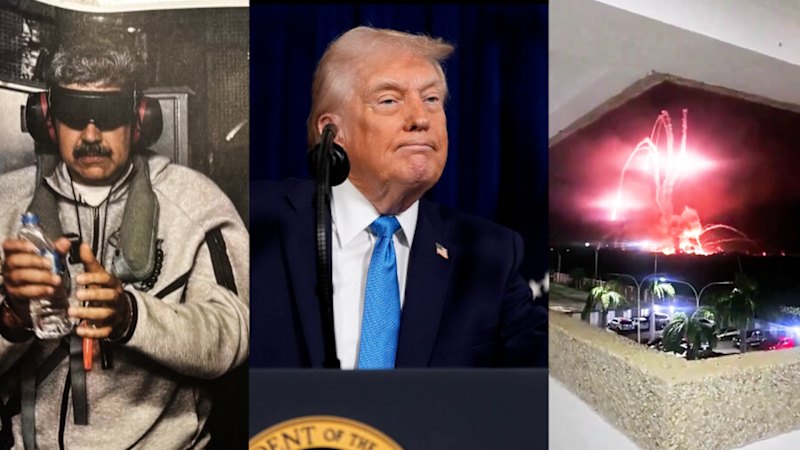
U.S. Forces Capture Venezuelan President Maduro in Military Strike, Plan to "Run" Country In an unprecedented military escalation, United States forces have captured Venezuelan President Nicolás Maduro and his wife, Cilia Flores, during a large-scale strike on Venezuelan territory. The operation, ordered by the Trump administration, has removed the long-time leader from power and prompted a U.S. announcement that it intends to directly administer the oil-rich South American nation [41033][41227][40871]. The capture occurred during an overnight operation on Saturday, January 3, 2026, which included airstrikes on targets in the capital, Caracas [40921][41055]. U.S. President Donald Trump described the action as a "large-scale strike" and stated that the United States will now "run" Venezuela to "fix" its collapsed oil infrastructure and "take back the oil" [41227][41525][41055]. Venezuela holds the world's largest proven oil reserves, but its production has plummeted amid a profound economic and humanitarian crisis [40871][42114]. Maduro and his wife were reportedly flown out of Venezuela and are now in U.S. custody [40921][40970]. They face criminal charges in a New York court, including accusations of "narco-terrorism" and running a narcoterrorist organization [40942][40970]. U.S. officials have long labeled Maduro's government as illegitimate, accusing it of corruption, human rights abuses, and stealing elections [41136][40668][40505]. The sudden removal of the sitting head of state has created an immediate power vacuum and leadership crisis within Venezuela, with no clear successor named [41136][40970]. The U.S. has recognized opposition leader Juan Guaidó as Venezuela's legitimate president since 2019, but the path forward for forming a new government remains uncertain [41379][42114]. The operation marks a dramatic break from established international law and sets a dangerous precedent for direct military intervention in a sovereign nation, analysts say [40737][41525]. While the immediate military action appears complete, the long-term plan for governing Venezuela and the international fallout from the strike are still unfolding [41055][42114]. U.S. Forces Capture Venezuelan President in Military Strike Venezuela Leader Ousted in U.S. Strike, Faces Charges in New York US Strikes Venezuela, Captures President Maduro U.S. Captures Venezuela's President in Secret Operation U.S. Forces Capture Venezuelan President Nicolás Maduro US Strikes Venezuela, Abducts President Maduro US Captures Venezuelan President in "Large-Scale Strike" U.S. Military Strike Captures Venezuelan Leader Maduro U.S. Captures Maduro: What Now for Venezuela? US Seizes Venezuelan President, Vows to "Run" Country and "Take Back the Oil" U.S. Claims Capture of Venezuelan Leader in Military Strike U.S. Strikes Venezuela, Captures President Maduro US Captures Venezuelan President in Military Strike U.S. Strikes Venezuela, Captures President Maduro Venezuelan President Captured in U.S. Military Raid
AI Companions for the Elderly: China’s Tech Giants Target 400 Million Seniors
AI Companions for the Elderly: China’s Tech Giants Target 400 Million Seniors A wave of artificial intelligence (AI) chatbots is being redesigned in China to serve as digital companions for the country’s rapidly aging population [129203]. Tech companies are retooling their popular AI assistants with features tailored for seniors, aiming to combat loneliness and provide daily assistance. The push targets a massive demographic shift. By 2035, an estimated 400 million people in China will be aged 60 or over, creating a vast new market for digital services [129203]. To reach this group, companies are moving beyond text-based interfaces. The updated chatbots operate by voice, eliminating the need to type, and are trained to understand local dialects instead of only formal Mandarin [129203]. Responses are programmed to be slower, louder, and more repetitive to accommodate older users [129203]. Seniors can ask these "Auntie AIs" to perform tasks like telling stories, playing traditional opera, or giving reminders to take medicine [129203]. For families, the technology offers a way to remotely check on older relatives who may live alone [129203]. Parallel developments in other countries show a similar focus on using technology to support seniors. In some communities, virtual reality (VR) programs are being introduced in senior living facilities to help residents combat social isolation through shared virtual experiences [129485]. These VR tools are designed with simple controls and familiar scenarios to reduce technical barriers [129485]. Tech analysts see the senior market as a major, mostly untapped business opportunity [129203]. Success hinges on making the technology feel familiar, helpful, and trustworthy rather than complex [129203]. If the strategy proves effective, AI companions could become a common feature in households across China, changing how millions experience aging [129203]. China’s AI Chatbots Get a New Job: Babysit Grandma VR for Seniors: Fighting Loneliness with Virtual Reality


Olympic Dreams Drive Athletes Through Setbacks, Delays, and Defiance
Olympic Dreams Drive Athletes Through Setbacks, Delays, and Defiance From GPS failures to snowstorms and political bans, athletes worldwide are pushing through significant obstacles in their determined pursuit of major sporting goals this weekend. In Poland, the British athletics team's arrival at the World Indoor Championships was delayed by a faulty aircraft navigation system [107260]. Despite the disrupted travel, star runner Keely Hodgkinson remains focused on her target: winning her first world gold medal. "I couldn't ask to be in a better position," Hodgkinson stated [107260]. Weather is causing major disruptions at the Winter Olympics, where a heavy snowstorm forced the postponement of the women's slopestyle skiing finals [78851]. Other events, including freestyle skiing's big air qualification and curling matches, are proceeding under challenging conditions [78851]. For some, the barriers are political. A group of Afghan refugee women, who fled after the Taliban banned women's sports, have formed a new soccer team in Houston, Texas, rebuilding community and identity through the game [20194]. Meanwhile, in the last Olympic sport that excludes women—Nordic combined—athletes are urging fans to watch the men's events this week, hoping high TV ratings will prove the interest needed to add a women's competition by 2030 [77899]. The drive to compete persists even against long odds. Three American sisters, each specializing in a different skiing discipline, continue to train together with their sights set on qualifying for the 2026 Winter Games [70176]. At the Paralympics, American Dani Aravich is attempting a rare double, competing in both track sprints and the long jump, aiming to inspire young athletes with disabilities [95020]. As competitions from the Africa Cup of Nations to World Darts unfold this weekend, the central story remains the athletes' unwavering commitment to their sports in the face of logistical, environmental, and societal challenges [40057]. British Team's GPS Fails, But Star Athlete's Focus is Unbreakable Too Much Snow: Women's Slopestyle Postponed at Winter Olympics Afghan Refugee Women Build New Team and Community on the Soccer Field One Sport Bans Women. This Week's TV Ratings Could End It. Olympic Dream Still Alive for Three-Sister Ski Team Paralympian Races for Two Medals, One Mission Sports Weekend: Darts Final, Cricket, and Africa's Cup Kick Off

Forget the Algorithm: From Burundi to the Arctic, Locals Fight to Save Culture from Fads and Forgetting
**Forget the Algorithm: From Burundi to the Arctic, Locals Fight to Save Culture from Fads and Forgetting** From the remote villages of Burundi to the Arctic homes of Sámi DJs, communities worldwide are mobilizing grassroots efforts to protect their unique cultural heritage from the dual threats of homogenization and fleeting viral trends. These movements emphasize deep, sustained practice over superficial online appreciation, using everything from children’s books to electronic music as tools for preservation. In Burundi, writer Aïta Chancella Kanyange, 33, is safeguarding traditions by authoring simple children’s stories. Her books, written for kids aged 2 to 10, are designed to pass on national customs and values in accessible language, ensuring the country’s rich heritage is not lost to modernization [129635]. Similarly, in Syria, the ancient craft of embroidery has endured through years of war. Researcher Heike Weber calls it a powerful symbol of living cultural identity, a deeply rooted form of expression that survives as a testament to resilience despite widespread physical destruction [47200]. The Circassian community in Syria also exemplifies this balance, having preserved its unique language and customs for over a century while fully integrating into national society [36001]. This work of preservation is also being done through sound. In Norway, the Sámi DJ duo Article 3, comprising Alice Marie Jektevik and Petra Laiti, draws direct inspiration from their Indigenous heritage. They blend modern electronic beats with traditional Sámi rhythmic singing, or *joik*, meeting a growing audience appetite for authentic Indigenous culture in global music [79759]. Meanwhile, a new collection of Ukrainian Christmas carols, or *koliadky*, connects centuries-old folk chants to the present, with scholars noting the songs have long preserved language and identity during periods of oppression [32337]. These sustained efforts stand in contrast to viral, short-lived internet trends. The recent "Chinamaxxing" phenomenon, which saw people globally adopting Chinese habits like drinking hot water for online content, highlighted a tension. For many Chinese people, watching lifelong customs become a temporary meme raises questions about the depth of such online appreciation [109231]. Experts stress that true cultural continuity requires more than passing fascination. As Chinese writer Feng Jicai explains about the Spring Festival, it is a "cultural river" that has flowed for thousands of years, offering a vital, living link to history and identity—far more profound than holiday imagery alone [84043]. Burundian Author Fights to Save Culture with Children's Books Syrian Embroidery Survives War, Defines Identity Syria's North Caucasus Legacy: The Circassians' Enduring Identity Remote DJs Rise with Sámi Sound, Fueling Indigenous Pride Ukrainian Christmas Carols: Ancient Sounds of Defiance and Hope Chinamaxxing: When Your Culture Becomes a Viral Meme Feng Jicai: Chinese New Year is More Than Fireworks

Private Healthcare Boom Sparks Fears of a "Two-Tier" UK Health System
Private Healthcare Boom Sparks Fears of a "Two-Tier" UK Health System
A surge in Britons turning to private doctors is triggering warnings of a deepening "two-tier" health system, where timely care increasingly depends on a patient's ability to pay.
Experts point to the ongoing crisis in National Health Service (NHS) dentistry as a blueprint for what could happen across general medicine. Many NHS patients now struggle to find affordable dental appointments, forcing those who can afford it to seek private treatment [129379].
The concern is that this pattern is now repeating. As more people opt for private general practice and hospital care to avoid long NHS waiting lists, the state-funded system could be critically weakened. Critics argue this creates a vicious cycle, draining public support and drawing key medical staff away from the NHS into the private sector [129379].
The debate centers on whether private care relieves pressure on the NHS or ultimately harms it by siphoning off resources. The current situation has sparked a national alarm that the fundamental principle of equal access to care is under threat [129379].
Two-Tier Health Warning: UK's Private Boom Echoes Dental Crisis


U.S. Forces Capture Venezuelan President Maduro in Shock Raid, Sparking Continental Crisis
U.S. Forces Capture Venezuelan President Maduro in Shock Raid, Sparking Continental Crisis U.S. military forces have captured Venezuelan President Nicolás Maduro, forcibly removing him from his country to face criminal charges in New York and triggering a political earthquake across Latin America [41460][41880]. In a surprise operation on Saturday, American troops entered Caracas and detained Maduro, 63, along with his wife [41880]. The Venezuelan leader is now in U.S. custody and is scheduled to appear in a federal court in New York on Monday to face drug trafficking charges [41880]. President Donald Trump announced the capture, stating the U.S. will run Venezuela's government but did not provide a timeline for new elections [41460]. The dramatic seizure of a sitting head of state has split regional governments and set a stark new precedent for foreign intervention in the Americas [47126][47297]. While nations historically critical of Maduro, including Colombia and Brazil, have offered cautious support, others have issued sharp condemnations [47297]. Mexico and Bolivia have denounced the action as a blatant violation of international law and national sovereignty [47297]. Analysts say the operation has revived the long-standing U.S. policy of the Monroe Doctrine, which opposes foreign powers in the Western Hemisphere, and is a direct challenge to China's expanding economic and diplomatic influence in the region [41460][45747]. China has become the leading trading partner and lender for many South American nations in recent years [45747]. Beyond the immediate crisis in Venezuela, the capture has instilled a private, continent-wide fear among leaders of all political stripes, who are now urgently reviewing their own vulnerability to similar foreign actions [47126][47297]. The United Nations Security Council will hold an emergency meeting on Monday at Venezuela's request to address the incident [41880]. U.S. Capture of Venezuela's Maduro Sends Shockwaves Through Latin America U.S. Capture of Maduro Sends Shockwave Through Latin America U.S. Captures Venezuela's Leader, Challenging China's Regional Reach Venezuela's President Seized by U.S., Faces Court in New York Trump Revives US Habit of Ousting Latin American Leaders
Latest Articles

House Democrats Move to Impeach Defense Secretary Pete Hegseth
U.S. House Democrats introduced formal articles of impeachment against Defense Secretary Pete Hegseth on Wednesday. The action begins a process to p...

Lock Your Mortgage Rate Before April? The Fed's Next Move Could Cost You.
Borrowers considering a home loan are facing a critical timing decision. Financial experts suggest locking in a mortgage rate now, before the U.S. Fe...

Sneaker Maker Ditches Shoes, Bets on AI; Stock Skyrockets 600%
The company Allbirds, known for its wool sneakers, is making a radical shift. It will sell its footwear business and change its name to "NewBird AI."...

U.S. Envoy: Trump's "End Iran" Threat Was a Tactic to Force Talks
A top American diplomat has stated that former President Donald Trump's extreme rhetoric toward Iran was a calculated strategy. U.S. Ambassador to t...

Two Lawmakers Exit Amid Scandal, Threatening House Majority
Two U.S. representatives announced their resignations Monday, a move that could weaken their party's narrow control of the House of Representatives....

Suspect in Court for Killing of 7-Month-Old Brooklyn Girl
The man accused of fatally shooting a 7-month-old girl in Brooklyn faces a judge Wednesday. His arraignment hearing will formally present the charge...

Trump Proposes "Arc de Triomphe" Style Monument for U.S. Veterans
White House Press Secretary Karoline Leavitt confirmed on Wednesday that President Trump is proposing a large, classical-style monument for American...