Latest News
Stay updated with the latest news and articles
Top Stories
Tourist Hotspots Fight Back: New Fees, Taxes, and Rules Target Overtourism
Tourist Hotspots Fight Back: New Fees, Taxes, and Rules Target Overtourism From the canals of Venice to the mountains of Morocco, popular travel destinations are pushing back against the crushing weight of too many visitors. Cities and countries are now implementing a wave of new measures—including tourist taxes, access fees, and strict crowd control—to manage the environmental and social damage of mass tourism. The problem, known as overtourism, occurs when an influx of visitors overwhelms local infrastructure, damages ecosystems, and disrupts daily life for residents [80040]. The issue is no longer confined to iconic landmarks; social media can suddenly create a "must-see" trend, flooding previously quiet neighborhoods or natural sites with crowds [101397]. In response, local governments are taking direct action. Galway, Ireland, is proposing a new nightly tourist tax on all short-term accommodations, a move officials say could raise €2 million annually to fund city maintenance and cultural events [131240]. While supporters argue the revenue is essential, the plan faces local opposition from critics who warn it could make the city less affordable [131240]. Beyond taxes, some communities are instituting direct access fees. In Rio de Janeiro's Rocinha favela, the owner of a viral rooftop attraction known as the "Gateway to Heaven" now charges visitors a small fee to visit the spot, which is overrun by tourists seeking the perfect photo [101397]. Similarly, in New Zealand, a wildlife tourism project allowing visitors to interact with giant stingrays is tightly controlled with rules against sunscreen and mandates for gentle touching to protect the animals [70326]. The strategies extend to promoting less-visited areas. Experts note that redirecting visitors to less crowded destinations and encouraging off-season travel are key tools to balance economic benefits with community protection [80040]. This aligns with a predicted travel trend for 2026, where tourists seek more meaningful, personalized experiences beyond crowded capital cities [36959]. The collective push represents a global shift from unrestrained tourist growth to managed sustainability, as destinations seek to preserve their environments and cultures from being loved to death. Tourist Destinations Hit Breaking Point: What Causes the Crush? Viral 'Gateway to Heaven' Rooftop Floods Rio Favela with Tourists Galway's Tourist Tax: A $2.1 Million Question Pat a 300kg "Sea Puppy"? In New Zealand, You Can. Beyond Paris: TV Drives 2026 "Meaningful Tourism" Trend
Climate Crisis Hits Home: First Official Climate Migrants from Tuvalu Arrive in Australia
Climate Crisis Hits Home: First Official Climate Migrants from Tuvalu Arrive in Australia The first group of people from the Pacific island nation of Tuvalu have arrived in Australia, marking a historic moment as some of the world’s first officially recognized climate migrants [25540]. They are relocating under a new, special visa pathway created by Australia in direct response to the existential threat that rising sea levels pose to their low-lying homeland [25540][10674]. The program, announced in late 2023, allows up to 280 Tuvalu citizens to migrate to Australia each year [25540][10674]. It grants them the right to live, work, and study in Australia, providing a permanent home and a clear path to citizenship [25540]. This initiative is part of a broader bilateral agreement that also includes Australian funding for Tuvalu’s coastal reclamation and climate adaptation projects [10674]. Experts warn that climate change-driven sea level rise is eroding Tuvalu’s land and increasing flooding, with parts of the nation at risk of becoming unlivable in the coming decades [25540]. The new migration scheme represents a concrete, government-led response to these long-term environmental changes, planning for the organized relocation of populations [25540]. The arrival of the first Tuvaluans under this program underscores a significant shift in how some nations are addressing the human displacement caused by climate disruption, moving from discussion to actionable policy [25540]. Tuvalu Citizens Arrive in Australia as First Official Climate Migrants Australia Opens Special Visa Pathway for Climate-Affected Tuvaluans



Trump Revives Bid to Buy Greenland, Pressuring Denmark at Davos
Trump Revives Bid to Buy Greenland, Pressuring Denmark at Davos Former President Donald Trump has renewed his controversial push for the United States to purchase Greenland, using a major international forum to pressure Denmark and question the value of key alliances. His remarks at the World Economic Forum in Davos, Switzerland, combined a serious challenge to the NATO defense pact with an unorthodox real estate proposition [55297]. Speaking to world leaders, Trump openly questioned the utility of the North Atlantic Treaty Organization (NATO), complaining that European members do not pay enough and that the U.S. is treated "very unfairly" [55327]. He then pivoted to Greenland, stating the U.S. should be allowed to acquire the vast, autonomous Arctic territory from Denmark [55297]. This is not the first time Trump has expressed interest in buying the strategically located island. His past overtures were firmly rejected, leading him to call Denmark's response "nasty" and to postpone a state visit [50444]. In his latest comments, Trump stated he does not want to use military force for the acquisition but called for immediate negotiations to buy it [55327]. Experts see the Greenland push as a pattern, where Trump conflates genuine strategic interests—the Arctic's growing importance for shipping and resources—with an expansionist, transactional approach more common in real estate than statecraft [50444]. The Danish and Greenlandic governments have consistently stated the island is not for sale [50444]. The Davos speech largely ignored traditional "soft power" diplomacy, instead emphasizing direct demands to allies and a focus on economic nationalism [55327]. Analysts note the approach reflects a broader rejection of the post-World War II international order built on alliances and rules, favoring instead a more unilateral and deal-oriented foreign policy [58552]. Trump at Davos: Questions NATO, Wants to Buy Greenland Trump at Davos: Skips Soft Power, Targets Greenland and NATO Allies Trump Eyes Greenland: Cash, Threats, and Military Force Trump's 'New Imperialism': Land Grabs and a Rejected World Order
India's Farmers Mobilize Nationwide, Fearing U.S. Trade Deal Will Crash Crop Prices
India's Farmers Mobilize Nationwide, Fearing U.S. Trade Deal Will Crash Crop Prices A wave of protests has swept across India as farmers and trade unions mobilize against a new trade agreement with the United States, fearing it will flood the market with cheap imports and devastate their livelihoods. Farmers launched a nationwide strike on Tuesday, blocking major roads and railways to voice their opposition [75183]. The protests, which have seen tractors and trucks used to barricade highways around the capital, New Delhi, are a direct response to a trade pact announced following a visit by former U.S. President Donald Trump [73750]. The core of the farmers' fear is that the deal will lower import taxes on American agricultural goods, allowing cheaper U.S. products to enter the Indian market and undercut local producers [75183]. Protest leaders specifically worry the terms could force India to reduce or abandon its system of minimum support prices for staple crops like wheat and rice, a move that would crash their incomes [73750]. While the Indian government insists the agreement includes safeguards for the agriculture sector and that the price support system remains protected, farmer unions express deep distrust [75183][73750]. They are demanding the government reject the deal entirely, arguing it favors U.S. corporate interests over the survival of millions of Indian farmers [75183]. The unrest highlights a significant domestic challenge for Prime Minister Narendra Modi's government. While the trade pact is viewed as a diplomatic win that strengthens ties with a key partner, the farming community represents a massive and politically crucial voting bloc [73750]. The government now faces intense pressure to reconcile its international trade ambitions with the need for domestic economic stability and food security. Officials have increased security at key points into New Delhi as negotiations between farmer leaders and the government continue [73750]. Indian Farmers Strike, Fearing U.S. Trade Deal Will Flood Market India's Farmers Protest as Modi-Trump Trade Pact Threatens Key Crop Prices
U.S. Forces Capture Venezuelan President Maduro in Military Strike, Plan to "Run" Country
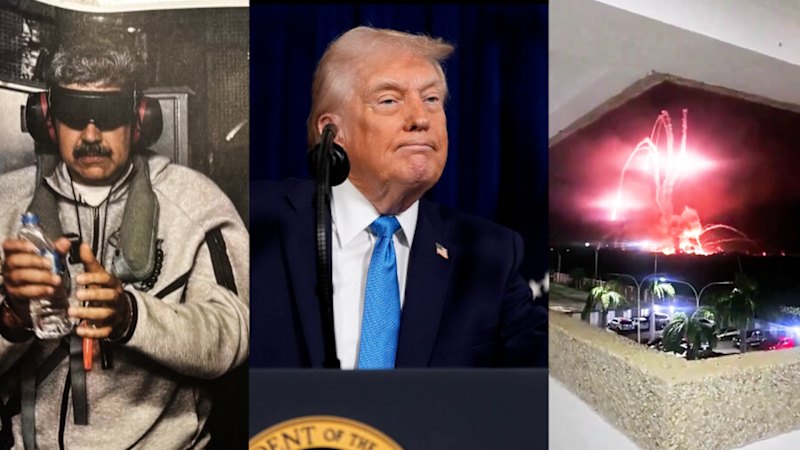
U.S. Forces Capture Venezuelan President Maduro in Military Strike, Plan to "Run" Country U.S. military forces have captured Venezuelan President Nicolás Maduro and his wife, Cilia Flores, in a direct military operation on Venezuelan soil, marking an unprecedented escalation in the long-standing political crisis [40668][41227][41379]. The strike, which occurred on a Saturday, resulted in the detention of the sitting head of state and his transfer to U.S. custody [40970][41088][41227]. Following the capture, former U.S. President Donald Trump stated that the United States will now "run" Venezuela, with a stated goal to "take back the oil" and fix the country's collapsed oil infrastructure [41227][41525][42114]. Venezuela holds the world's largest proven oil reserves, but its production has plummeted amid economic crisis [40871][41227]. Maduro and his wife are expected to face criminal charges in a New York court, including accusations of narco-terrorism and running a criminal organization [40942][40970][41136]. U.S. officials have long labeled Maduro's government as illegitimate, accusing it of corruption, human rights abuses, and stealing elections [40668][41136][41525]. The operation has created an immediate power vacuum and deep uncertainty for Venezuela's 30 million people, with no clear successor named [41136][42114]. There has been no immediate public statement from the remaining members of Maduro's government or the Venezuelan military [40668][41379]. The action represents a dramatic shift in U.S. foreign policy and a direct military intervention in South America, setting a major global precedent [40737][41525]. The long-term plan for governing Venezuela and the international reaction to the strike remain unclear [41055][42114]. U.S. Forces Capture Venezuelan President in Military Strike Venezuela Leader Ousted in U.S. Strike, Faces Charges in New York US Strikes Venezuela, Captures President Maduro U.S. Captures Venezuela's President in Secret Operation U.S. Forces Capture Venezuelan President Nicolás Maduro US Strikes Venezuela, Abducts President Maduro US Captures Venezuelan President in "Large-Scale Strike" U.S. Military Strike Captures Venezuelan Leader Maduro U.S. Captures Maduro: What Now for Venezuela? US Seizes Venezuelan President, Vows to "Run" Country and "Take Back the Oil" U.S. Claims Capture of Venezuelan Leader in Military Strike U.S. Strikes Venezuela, Captures President Maduro US Captures Venezuelan President in Military Strike U.S. Strikes Venezuela, Captures President Maduro Venezuelan President Captured in U.S. Military Raid
AI's New Battlefield: From Olympic Replays to Quantum Diamonds, Nations Race for Tech Dominance
AI's New Battlefield: From Olympic Replays to Quantum Diamonds, Nations Race for Tech Dominance A global technological race is intensifying, with nations and corporations pouring resources into artificial intelligence and advanced materials, aiming for supremacy in fields from entertainment to national security. The competition is driving rapid, dual-use innovations that are reshaping both daily life and global power dynamics. At the recent Milano Cortina Winter Olympics, broadcasters unveiled a startling new replay system. Using artificial intelligence (AI) to generate three-dimensional models from standard footage, the technology allowed viewers to see figure skating jumps from impossible, orbiting angles, as if a virtual camera was spinning around the athlete mid-air [82096]. This same push for advanced AI is fueling a higher-stakes contest. Major Chinese tech firms, along with a start-up founded by AI pioneer Li Fei-Fei, are now competing to develop sophisticated "world models"—AI systems designed to learn from and understand the physical world to power realistic simulations [130687]. Simultaneously, breakthroughs in material science are targeting the infrastructure behind this AI boom. Researchers at the Chinese Academy of Sciences have developed a diamond-coated copper composite that boosts cooling efficiency for AI data centers by up to 80 percent, addressing a critical bottleneck as computing demands skyrocket [130988]. In a separate quantum leap, scientists are using imperfect diamonds—deliberately flawed with nitrogen atoms—to build the core components for quantum computers, ultra-secure encryption, and sensors sensitive enough to detect a single brain cell [37022]. The drive for technological edge is explicitly tied to national strategy. A U.S. State Department advisory report calls for a new government agency dedicated to maintaining a significant AI lead over global competitors, citing economic strength and innovation as critical as military advantage [130765]. This competition blurs the line between civilian and military tech. Chinese researchers have created a "smart surface" that can transform electromagnetic waves, like enemy radar signals, into electricity—a development that could power future stealth aircraft and next-generation 6G networks [36179]. The practical applications are already being deployed. The United Kingdom is testing AI-powered drones that can scan for landmines from a safe distance, aiming to protect personnel [118535]. Hong Kong’s environmental agency uses AI camera systems and laser-scanning robot dogs to map ecosystems with high precision, aiming to protect wildlife from construction impacts [47560]. Even the hunt for an escaped wolf in South Korea employs AI to analyze trail camera images [130343]. As one report notes, the focus has expanded beyond cyberwarfare to encompass everyday economic and technological competition, highlighting AI's dual role as a state priority and a tool infiltrating the intimate spaces of daily life [130765]. AI Replay Tech Makes Olympic Jumps Spin on Screen AI "Godmother" Li Fei-Fei, Chinese Giants Race for "World Model" Dominance Diamond-Coated Copper Cools AI's Red-Hot Data Centers Imperfect Diamonds: The New Heart of a Quantum Revolution AI as a National Security Asset: From Battlefields to Household Pets Chinese Stealth Tech Could Turn Enemy Radar into a Power Source AI Drones Hunt Landmines: UK Tests Life-Saving Tech Hong Kong Deploys AI Robot Dogs to Scan for Wildlife AI and Howls: The High-Tech Hunt for South Korea's Escaped Wolf


Two Iranian Soccer Stars Defect, Join Australian Pro Team After Fleeing National Squad
**Two Iranian Soccer Stars Defect, Join Australian Pro Team After Fleeing National Squad** Two members of Iran's women's national football team have been granted asylum in Australia and have begun training with a top professional club, continuing their athletic careers far from home. Fatemeh Pasandideh and Atefeh Ramezanisadeh decided to remain in Australia following an international tournament earlier this year [131273]. The players have now started training with the Brisbane Roar, a club in Australia's professional A-League Women competition [131273]. In a statement, the athletes said they were "overwhelmed" by the support received but have asked for privacy as they focus on their sport and new lives [131273]. They emphasized that their sporting dream continues, with the aim of returning to elite football while building a future away from the spotlight [131273]. The move highlights the ongoing challenges faced by female athletes from certain nations. Another group of Afghan refugee women, who fled after the Taliban banned women's sports, have similarly rebuilt their lives around soccer, forming a community team in Houston, Texas [20194]. For these athletes, the pitch serves as a crucial space for reclaiming identity, exercise, and resilience after displacement [20194]. Iranian Footballers Seek Asylum, Train with Australian Club Afghan Refugee Women Build New Team and Community on the Soccer Field

Indigenous and Local Cultures Find Power in Modern Expression
Indigenous and Local Cultures Find Power in Modern Expression From the Arctic to Africa, communities are leveraging their unique cultural heritage to forge identity, achieve global recognition, and address contemporary challenges. This movement sees traditional practices—from music and storytelling to architecture and ritual—adapted for the modern world, creating new forms of cultural resilience. In Senegal’s capital, a new landmark demonstrates how local tradition can shape global dialogue. The recently opened Goethe-Institut Dakar, designed by architect Francis Kéré, is built primarily from compressed earth blocks [131302]. This sustainable, local material provides natural temperature control, making the building itself a statement of Senegalese craftsmanship and ecological design within an international cultural center [131302]. Similarly, in Gabon, a coastal community is employing ancient spiritual practices to combat a modern environmental threat. At Pointe-Denis, worshippers recently performed a centuries-old animist ritual, presenting offerings to the spirits of the sea [130928]. Participants believe the ceremony helps calm the waters and slow coastal erosion, blending cultural tradition with direct action against land loss [130928]. In the realm of music, Indigenous artists are finding new audiences. A Sámi DJ duo from Norway’s remote Arctic north draws direct inspiration from their culture, incorporating the traditional rhythmic singing style known as *joik* into modern electronic music [79759]. Their success meets a growing global appetite for Indigenous sounds in club culture, turning their heritage into a unique artistic advantage [79759]. Meanwhile, in Burundi, writer Aïta Chancella Kanyange is using children’s literature as a tool for preservation. She creates simple stories for young readers that celebrate national traditions, aiming to pass customs and values to the next generation [129635]. Her work focuses on ensuring Burundi’s rich cultural heritage remains accessible and alive for children [129635]. This theme of cultural endurance through art is echoed in Ukraine, where a new collection of Christmas carols, or *koliadky*, connects ancient folk chants to the present day [32337]. Music scholars note these songs have historically preserved language and national identity during periods of oppression, with many carrying subtle messages of resilience [32337]. Even major holidays are being re-emphasized as vital cultural anchors. Renowned Chinese writer Feng Jicai describes the Spring Festival not merely as a holiday, but as an unbroken “cultural river” that provides a crucial link to history and identity for Chinese people [84043]. These examples show a widespread pattern: communities are actively deploying their cultural heritage not as a relic of the past, but as a dynamic, living resource for education, environmental action, artistic innovation, and maintaining a distinct identity in a globalized world. Dakar's New Cultural Hub is Built from Earth Gabonese Village Fights Erosion with Ancient Ritual Remote DJs Rise with Sámi Sound, Fueling Indigenous Pride Burundian Author Fights to Save Culture with Children's Books Ukrainian Christmas Carols: Ancient Sounds of Defiance and Hope Feng Jicai: Chinese New Year is More Than Fireworks


China's "Neck-Hanging" Fitness Craze Sparks Paralysis Warnings as 200 Million Suffer Spine Issues
China's "Neck-Hanging" Fitness Craze Sparks Paralysis Warnings as 200 Million Suffer Spine Issues Doctors in China are issuing urgent warnings against a dangerous viral fitness trend where young people hang their full body weight by their necks from tree branches, risking severe spinal injury and paralysis. The practice, known as "neck-hanging exercise," attempts to mimic professional cervical traction therapy, a medical treatment for neck pain administered by specialists [122710]. It has gained popularity online amid a reported surge in cervical spine disorders. An official 2024 health report indicates over 200 million people in China suffer from such conditions, with more than 40% of patients under the age of 30 [122710]. Medical experts state that the unsupervised trend poses a critical danger. They warn that the uncontrolled force can cause permanent ligament damage, paralysis, and even stroke [122710]. Professional cervical traction uses carefully measured force applied in a clinical setting, a stark contrast to the risky amateur activity. Despite the clear health warnings, videos and posts promoting the "neck-hanging" exercise continue to circulate on social media platforms, highlighting a gap between public health information and risky online wellness behaviors [122710]. Dangerous "Neck-Hanging" Trend Alarms Doctors in China
U.S. Forces Seize Venezuelan President Maduro in Unprecedented Military Raid
U.S. Forces Seize Venezuelan President Maduro in Unprecedented Military Raid In a dramatic escalation of tensions, United States military forces captured Venezuelan President Nicolás Maduro in a surprise operation in Caracas, sending shockwaves across Latin America and challenging international norms. The sitting head of state was taken to New York, where he faces drug trafficking charges in federal court [41880]. The operation, which U.S. President Donald Trump announced, marks the first direct U.S. military attack on a South American nation in history [41064]. Analysts describe the action as an unprecedented act of "extraterritorial apprehension," where a person was seized outside U.S. borders without the host country's consent [47297]. Following the capture, President Trump declared that "American dominance in the western hemisphere will never be questioned again" [41064]. The bold move has deeply divided governments across Latin America [47126]. While some nations, including Colombia and Brazil, have offered cautious support, others have issued sharp condemnations. Mexico and Bolivia have denounced the action as a dangerous violation of international law and national sovereignty [47297]. The United Nations Security Council has scheduled an emergency meeting at Venezuela's request to address the crisis [41880]. Beyond the immediate crisis in Venezuela, the event has instilled a continent-wide atmosphere of suspicion [47126]. Regional leaders, regardless of their public stance on Maduro, are privately conducting urgent reviews of their own vulnerability to similar foreign interventions, with many asking, "Who could be next?" [47297]. The operation is seen as reviving the long-dormant "Monroe Doctrine," a U.S. policy historically used to justify opposition to foreign powers in the Americas [41460]. The capture is also viewed as a direct challenge to China, which has built significant economic influence in Latin America through major trade and infrastructure investments in recent years [41460]. The sudden U.S. intervention creates a major test for Beijing's diplomatic and economic partnerships in the region, setting the stage for renewed geopolitical competition [45747]. U.S. Capture of Venezuela's Maduro Sends Shockwaves Through Latin America U.S. Capture of Maduro Sends Shockwave Through Latin America U.S. Captures Venezuela's Leader, Challenging China's Regional Reach Venezuela's President Seized by U.S., Faces Court in New York Trump Orders First Direct US Military Attack on South America Trump Revives US Habit of Ousting Latin American Leaders
Latest Articles

Top UK Diplomat Quits After Clashing Over Cuts
A senior British civil servant, brought in to slash costs at the Foreign Office, has resigned after a short and turbulent tenure. Olly Robbins, a po...