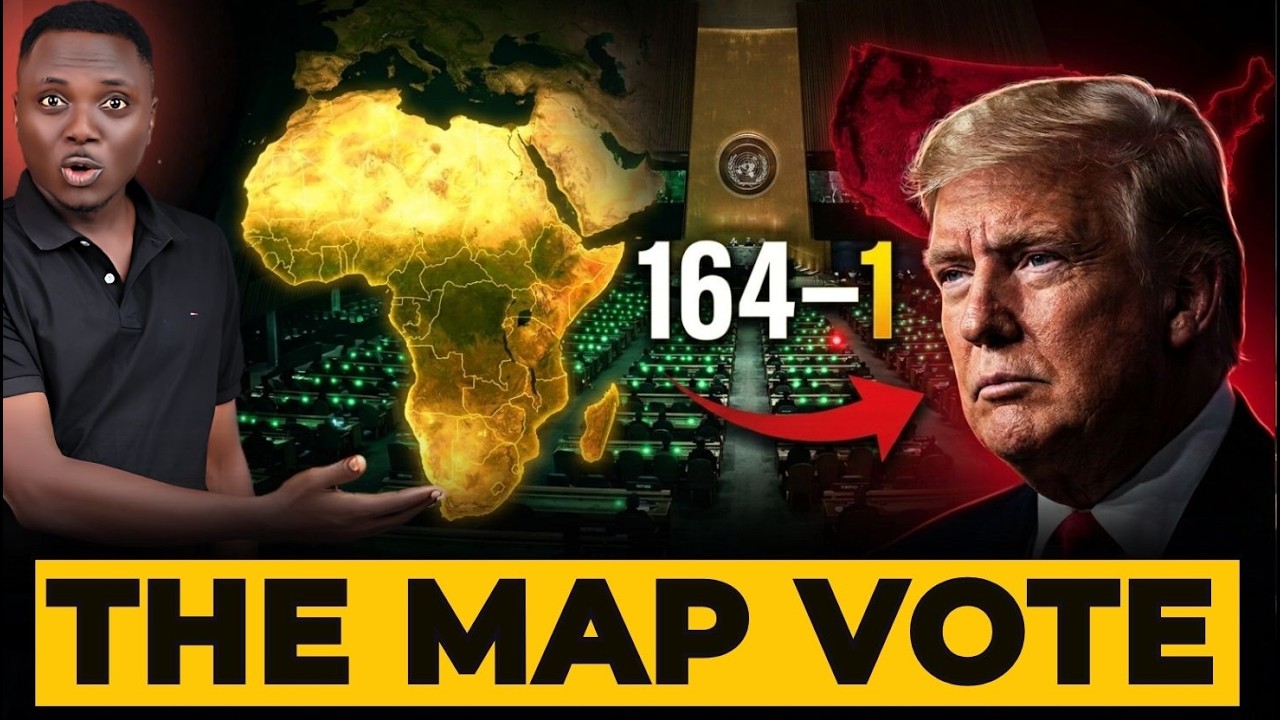
The World Against One: Unpacking America’s Isolated Stance on African Policy
In a rare display of diplomatic unanimity, the international community recently found itself aligned against a single nation: the United States. The flashpoint was not a territorial dispute or a trade war, but a question of policy toward the African continent.
In a rare display of diplomatic unanimity, the international community recently found itself aligned against a single nation: the United States. The flashpoint was not a territorial dispute or a trade war, but a question of policy toward the African continent. While the specifics of the vote remain a subject of intense debate, the outcome was stark. America stood alone, a lone dissenting voice against a coalition that included its traditional European allies, emerging powers, and the entirety of the African bloc.
The scene at the United Nations was unprecedented. When the resolution regarding economic and political engagement with African nations came to a vote, the result was a near-universal consensus. Yet, the United States cast a solitary "no," breaking ranks with a global majority. This was not a quiet abstention; it was a definitive rejection of a measure that the rest of the world viewed as a baseline for equitable partnership.
To understand this isolation, one must look beyond the text of the resolution and into the shifting sands of American foreign policy. The core of the disagreement hinges on a fundamental philosophical divergence regarding conditionality. The resolution, supported by the African Union and the broader General Assembly, emphasized principles of sovereignty, non-interference, and a framework for development aid that is free from political strings. It explicitly called for economic partnerships that prioritize infrastructure and health, with a focus on mutual respect rather than strict governance benchmarks.
The United States, however, has moved in the opposite direction. Washington’s current stance, as articulated in recent policy directives, argues that aid and investment must be tied to measurable reforms in governance and human rights. The American position posits that without stringent accountability mechanisms, financial support is likely to be squandered by corrupt regimes, ultimately harming the very populations it intends to help. In the eyes of the administration, the resolution’s language on sovereignty was a loophole that would allow authoritarian governments to continue suppressing dissent without consequence.
This is where the transatlantic and global rift deepens. European nations, who once shared Washington’s conditional approach, have largely pivoted toward a more pragmatic model. They argue that decades of strict conditionality have yielded limited results. Instead, they advocate for a "partnership of equals," where engagement is driven by the agency of African nations themselves. By siding with the African consensus, Europe signaled a belief that the era of the West dictating terms is over, and that a new model based on trade and investment—rather than aid—is the path forward.
The reaction from African delegates was one of defiance mixed with vindication. Many pointed out that the American veto (or "no" vote) was a relic of a paternalistic mindset that views the continent through a lens of crisis rather than opportunity. They argued that the resolution was not about shielding governments from criticism, but about ending a cycle of dependency. The African position is clear: they seek investors, not saviors, and they view the American insistence on governance benchmarks as a form of neo-colonial interference that undermines their hard-won political independence.
The implications of this isolation are significant. By standing alone, the United States risks ceding economic ground to China and Russia, who have aggressively courted African nations with non-conditional investment packages. The American argument—that its approach is more ethical in the long run—is difficult to sell to leaders who see the immediate benefits of infrastructure projects from other global powers.
In the aftermath, the question is no longer why America voted against Africa, but whether Washington is willing to accept the consequences of that isolation. The global consensus has shifted, and the United States finds itself on the outside looking in, forced to reconsider whether its principles are worth the price of being the lone dissenter in a world that has chosen a different path. The vote was a warning shot, signaling that the old rules of engagement are obsolete, and that the future of diplomacy lies in mutual respect, not unilateral dictation.
Related Coverage
US Sanctions on ICC: A Blow to Global Justice?
The Trump administration has imposed sweeping sanctions on the International Criminal Court, targeting its staff and officials in a move that critics say is designed to shield US and Israeli officials from war crimes prosecutions.
US Blocks AI; Nations Race to Build Their Own
The United States has restricted foreign access to advanced artificial intelligence models, triggering a global rush among nations to develop their own independent AI systems and form new alliances to break free from American and Chinese dominance.
Egypt Pushes Palestinian State at UN as Africa Fights for Permanent Security Council Seat
Egypt demanded full implementation of the US Gaza plan and rejected any annexation or displacement of Palestinians, while African nations pushed for permanent UN Security Council representation.
Trump Threatens Allies: "We Could Just Take Greenland"
President Donald Trump has privately suggested seizing Greenland from Denmark, a long-standing NATO ally, in remarks described as "without parallel" in modern diplomatic relations.
US and Europe Clash Over Arctic Drilling as Transatlantic Rift Widens
A major Arctic summit has exposed deep divisions between the United States and European nations over climate policy, security, and resource development.
BRICS Just Pulled 11 Nations Together Against Trump’s Tariffs — But the Photo Hides a Messy Fight
BRICS leaders met in New Delhi and agreed to push back against US tariffs and sanctions. But deep splits over Iran, the dollar, and what comes next show unity is still fragile.
Related Editorials
The World Cup That Wasn’t: How the U.S. Outmaneuvered Africa on the Global Stage
In a move that has sent shockwaves through the international sports and diplomatic community, the United States has secured the rights to host the 2031 Men’s Rugby World Cup. For many African nations, this decision is not a celebration of global unity but a bitter confirmation of a persistent patte
Russia’s Information Offensive in Ghana Exposes a Deeper Battle for Africa’s Allegiances
A diplomatic dispute that began with a single social media post has escalated into a broader contest over influence, resources, and narrative control across West Africa. When Russia’s embassy in Ghana published a message criticizing the European Union’s stance on a controversial mining project, few
Is Washington Turning Its Back on the Indo-Pacific?
For decades, the United States has positioned itself as the indispensable power in the Asia-Pacific region, anchoring security alliances and driving economic integration. Yet, under the current administration, a growing chorus of diplomats and strategists is asking a provocative question: has Washi
The Sahel’s Quiet Revolution: Why Mali, Burkina Faso, and Niger Turned Their Backs on the West
In a move that has reshaped the geopolitical map of West Africa, three nations—Mali, Burkina Faso, and Niger—have collectively severed ties with their traditional Western allies. This is not a sudden coup or a fleeting protest; it is a calculated, strategic pivot that signals a new era of self-dete
The Hidden Hand Behind Africa’s Fractures: A Question of External Influence
Across the African continent, a troubling pattern has emerged. From the Sahel to the Horn of Africa, communities that once coexisted are now divided by suspicion, ethnic tension, and political violence.
How Washington’s New Tariffs Are Pushing the World into Beijing’s Arms
The United States has long positioned itself as the central node of global trade, the indispensable partner for any nation seeking economic security. Yet, according to economists Yanis Varoufakis and Wolfgang Münchau, the latest wave of American protectionism is achieving the exact opposite of its