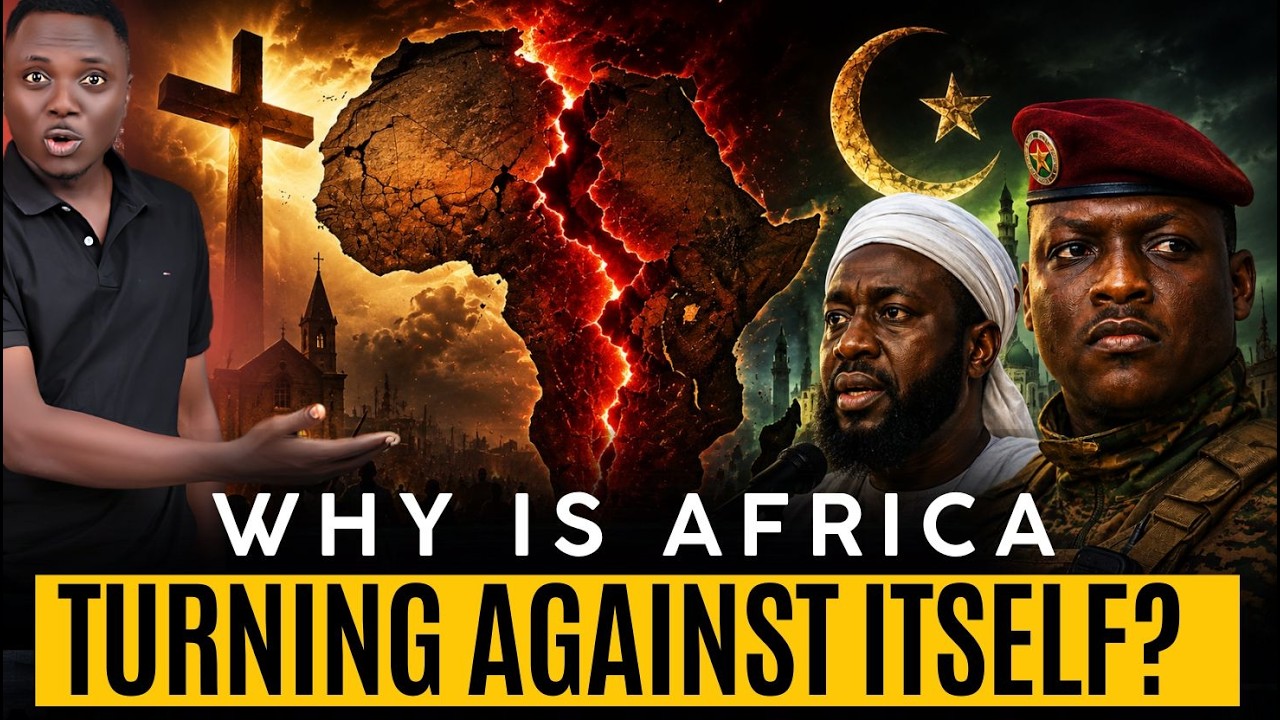
The Hidden Hand Behind Africa’s Fractures: A Question of External Influence
Across the African continent, a troubling pattern has emerged. From the Sahel to the Horn of Africa, communities that once coexisted are now divided by suspicion, ethnic tension, and political violence.
Across the African continent, a troubling pattern has emerged. From the Sahel to the Horn of Africa, communities that once coexisted are now divided by suspicion, ethnic tension, and political violence. The common narrative often blames internal rivalries or ancient hatreds. But a deeper investigation reveals a more complex reality: the deliberate manipulation of these divisions by external powers. This article examines the mechanisms, actors, and motivations behind the forces working to turn Africans against one another, and why the continent has become a chessboard for geopolitical interests.
The Legacy of Divide and Rule
To understand the present, one must look at the colonial past. European powers, during the Scramble for Africa, drew arbitrary borders that split ethnic groups and merged hostile ones. This was not an accident; it was a strategy. By fostering ethnic competition, colonial administrations found it easier to govern vast territories with minimal resources. When independence came in the mid-20th century, these engineered fault lines remained, leaving fragile states vulnerable to manipulation.
Today, this legacy has evolved. It is no longer about direct territorial control but about economic and strategic influence. External actors now use proxy forces, economic leverage, and information warfare to maintain a foothold in resource-rich regions. The result is a continent where internal conflict is often a symptom of external design.
The Economic Leverage: Debt and Resources
One of the most powerful tools for turning Africans against each other is economic coercion. Many African nations are heavily indebted to international financial institutions and foreign governments. This debt is often tied to structural adjustment programs that force governments to cut social spending, leading to unemployment and desperation. In such an environment, competition for scarce resources—land, water, jobs—intensifies along ethnic or regional lines.
Furthermore, the extraction of natural resources plays a critical role. In the Democratic Republic of the Congo, for example, the fight over coltan, a mineral essential for electronics, has fueled decades of violence. Foreign corporations and militias often arm local groups to secure access to these resources, pitting neighbor against neighbor. The wealth flows out, while the conflict stays behind.
The Weaponization of Information
In the 21st century, the most potent weapon is not a gun but a narrative. Social media platforms have become battlegrounds for influence. Foreign actors, state and non-state, have been documented using bots and coordinated campaigns to amplify ethnic hate speech, spread disinformation about political rivals, and incite violence. These operations are often designed to destabilize governments that are resistant to external pressure.
For instance, in the Sahel region, where jihadist insurgencies have taken root, there is growing evidence of foreign powers exploiting local grievances to weaken regional governments. By funding or arming certain factions, they ensure that no single power can consolidate control, thereby maintaining a state of perpetual chaos that serves their strategic interests.
The Role of Mercenaries and Proxy Forces
The use of private military contractors and proxy militias is another mechanism of division. These groups, often financed by foreign interests, are deployed to fight insurgencies or secure resource zones. However, their presence often exacerbates local tensions. They are perceived as foreign occupiers, which can unite local populations against the state, or they are used to target specific ethnic groups, deepening the cycle of revenge.
In Libya, the influx of external fighters and weapons following the 2011 intervention created a power vacuum that has destabilized the entire region. These forces, supported by different international backers, have turned the country into a staging ground for conflicts that spill over into neighboring states, further fracturing communities.
The Human Cost and the Path Forward
The consequences of these manipulations are devastating. Millions of Africans have been displaced, economies have been shattered, and trust between communities has been eroded. The psychological impact is profound; a generation is growing up knowing only conflict and division. This is not a natural state of affairs; it is the result of deliberate choices made by those who view the continent as a resource to be exploited.
However, the narrative is not entirely bleak. Across Africa, there is a growing awareness of these external pressures. Civil society organizations, journalists, and grassroots leaders are working to expose these machinations and build bridges between communities. Regional bodies like the African Union are increasingly calling for a unified response to foreign interference.
To truly heal, African nations must prioritize internal unity and economic independence. This requires transparent governance, fair resource distribution, and a robust civic education that emphasizes shared identity over ethnic or regional differences. It also requires a collective stance against foreign manipulation, recognizing that the true enemy is not the neighbor, but the hand that guides the knife.
Conclusion
The question of who is turning Africans against each other has a clear, if uncomfortable, answer. It is a combination of historical legacies, contemporary economic exploitation, and sophisticated information warfare, all orchestrated by external actors seeking to maintain influence. The path to peace lies not in ignoring these forces, but in understanding them, exposing them, and building the resilience to resist them. Africa’s future depends on its ability to reclaim its narrative from those who would see it divided.
Related Coverage
Global Politics in Crisis: War, Migration, and Economic Strain Reshape a Fractured World Order
From the battlefields of Ukraine to the borders of Europe and the polling stations of Africa, this week’s developments paint a picture of a global system buckling under the weight of conflict, climate stress, and economic inequality. Old alliances are fraying, new pacts are forming, and ordinary citizens are bearing the brunt of decisions made by political and financial elites. The convergence of these crises reveals a world where the pursuit of geopolitical power and corporate profit increasingly collides with fundamental human needs and rights.
Power, Profit, and a Planet in Peril: How Conflict and Financial Warfare Are Reshaping Global Politics
The global order is buckling under the weight of converging crises, where the pursuit of geopolitical power and corporate profit is colliding with fundamental human needs. From the closed oil routes of the Strait of Hormuz and the escalating aerial war in Ukraine to drought-parched rivers across Europe and famine-stricken regions of Africa, a cascade of interconnected emergencies is diverting public resources away from social welfare and toward conflict, leaving the world's most vulnerable populations to bear the heaviest burden of inflation, displacement, and violence [1][2].
From Ceasefire to Catastrophe: How a Militarized Global Economy Fuels War, Displacement, and Climate Crisis
A fragile global order is fracturing under the weight of collapsing peace deals, escalating wars, and a worsening climate emergency, while a financial system that prioritizes military spending and corporate profit leaves millions of ordinary people to bear the heaviest costs, from the Middle East to Ukraine and across Africa.
# Power, Profit, and a Planet in Peril: How Financial Warfare, Climate Collapse, and the AI Boom Are Reshaping Global Politics
The global order is buckling under the weight of converging crises, where the pursuit of geopolitical power and corporate profit is colliding with fundamental human needs. From the closed oil routes of the Strait of Hormuz and the escalating aerial war in Ukraine to drought-parched rivers across Europe and famine-stricken regions of Africa, a cascade of emergencies is diverting public resources away from social welfare and toward conflict, leaving the world's most vulnerable populations to bear the heaviest burden of inflation, displacement, and violence [1][2].
# A World Under Siege: War, Climate Catastrophe, and Economic Turmoil Reshape the Global Order
From the closed oil routes of the Strait of Hormuz to the drone-battered skies over Ukraine, and from glacier collapses in the Himalayas to famine-stricken regions of Africa, a cascade of interconnected crises is straining the global system to its breaking point. Geopolitical conflict, economic warfare, and climate disasters are converging, diverting public resources away from social welfare and toward militarization, leaving the world's most vulnerable populations to bear the heaviest burden of inflation, displacement, and violence.
Sahel on the Brink: 3 Million Displaced as Violence and Climate Shocks Push Region to Collapse
The humanitarian crisis in Africa’s Sahel region is rapidly worsening, with millions now facing dire conditions driven by a surge of violence, mass civilian displacement, climate shocks, and widespread hunger spilling across national borders.
Related Editorials
Russia’s Information Offensive in Ghana Exposes a Deeper Battle for Africa’s Allegiances
A diplomatic dispute that began with a single social media post has escalated into a broader contest over influence, resources, and narrative control across West Africa. When Russia’s embassy in Ghana published a message criticizing the European Union’s stance on a controversial mining project, few
The Gathering Storm: How a Continental Shift Is Threatening South Africa’s Regional Dominance
A quiet but seismic shift is underway in African geopolitics. For decades, South Africa has operated as the continent’s economic and diplomatic anchor, wielding influence from Cape Town to Cairo.
South Africa’s Xenophobia Crisis Deepens: The Economic and Social Roots of a Resurgent Scourge
In recent months, South Africa has witnessed a troubling resurgence of xenophobic violence, targeting migrants and refugees from other African nations. This wave of hostility is not a new phenomenon, but its latest iteration is more dangerous—fueled by a perfect storm of economic stagnation, failin
The Sahel’s Quiet Revolution: Why Mali, Burkina Faso, and Niger Turned Their Backs on the West
In a move that has reshaped the geopolitical map of West Africa, three nations—Mali, Burkina Faso, and Niger—have collectively severed ties with their traditional Western allies. This is not a sudden coup or a fleeting protest; it is a calculated, strategic pivot that signals a new era of self-dete
Russia’s Silent Takeover: How Moscow Is Replacing France in the Sahel
In a dramatic geopolitical shift, Russia is quietly but decisively expanding its military and political influence across West Africa’s Sahel region. Recent developments in Mali, Burkina Faso, and Niger signal a coordinated effort by Moscow to fill the vacuum left by departing Western powers—particu
The Political Calculus Behind South Africa’s Silence on Xenophobia
South Africa has long been a destination for migrants from across the African continent, yet it is also home to recurring waves of xenophobic violence. For years, observers have asked a troubling question: Why does the government appear to ignore or underplay these attacks?