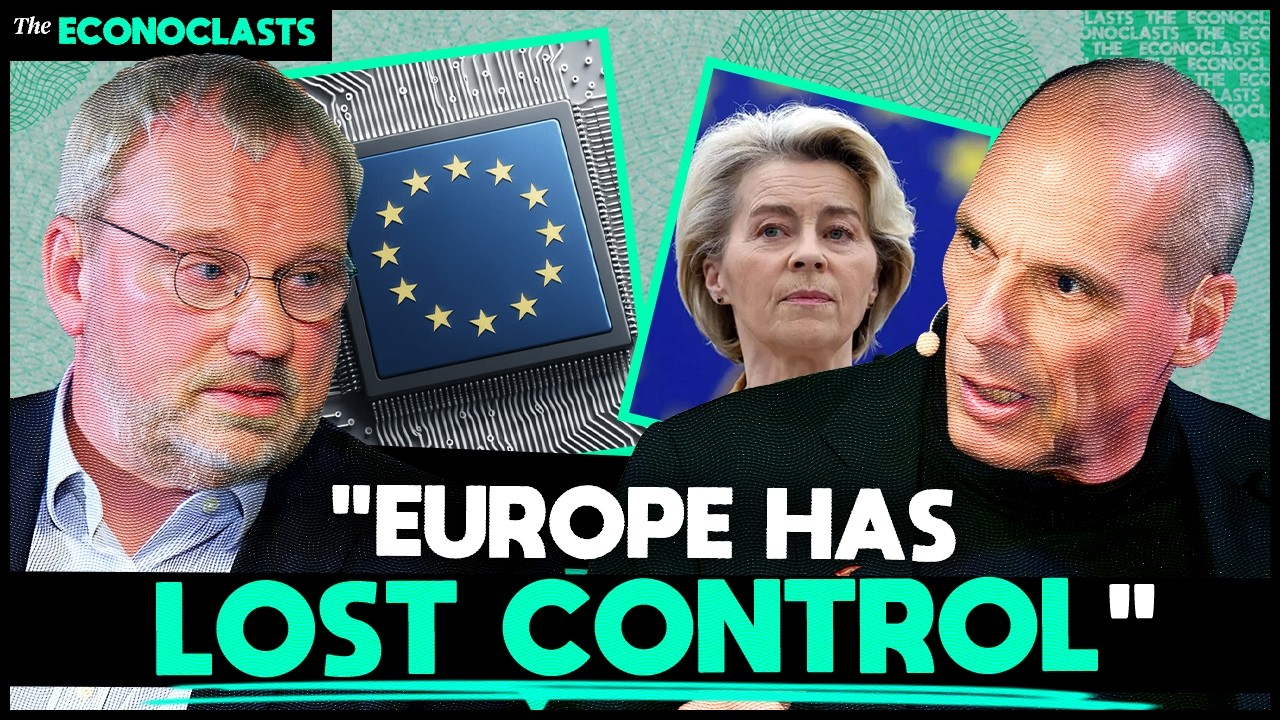
The AI Boom Will Not Crash Europe. Europe Is Already Crashing Itself.
By Yanis Varoufakis and Wolfgang Munchau Two unconventional thinkers on the future of capitalism, the AI race and why Britain's economic model is running on empty. The global economy is being reshaped by two forces that dominate every conference, every boardroom and every finance ministry: the arti
By Yanis Varoufakis and Wolfgang Munchau
Two unconventional thinkers on the future of capitalism, the AI race and why Britain's economic model is running on empty.
The global economy is being reshaped by two forces that dominate every conference, every boardroom and every finance ministry: the artificial intelligence boom and the deepening stagnation of the West. On one side stands the promise of a productivity revolution. On the other stands a political and financial establishment that seems to be waiting for the whole thing to collapse.
In a wide-ranging discussion, economist Yanis Varoufakis and financial journalist Wolfgang Munchau examined what AI really means for capitalism, why China is better positioned than the United States, and what a genuinely progressive British budget would look like. Their conclusions are uncomfortable for almost everyone.
The AI bubble that will not burst
Munchau opened with an unfashionable claim: the AI boom is not a bubble, and this time is different. He acknowledged that the phrase has been used to justify every speculative mania in history, from the railway boom to the dot-com craze. Investors always insist that a new technology will change everything, and financial markets always catch up with the excess.
But AI, he argued, is the first technology in his lifetime with the genuine potential to raise productivity across the entire economy, not merely to enrich a handful of technology executives. That does not mean valuations are safe. Munchau was careful to avoid giving investment advice and said he would be cautious as a buyer. His argument is about the underlying technology, not the stock price.
What can go wrong is timing. Innovation routinely takes longer than its promoters expect. Self-driving cars were predicted a decade ago and remain complicated to deliver. Linking AI to robotics, where the largest economic payoff lies, is harder still. It is far easier for a machine to solve a difficult mathematical problem than to change a car tyre.
Munchau's view is that AI will take longer than optimists think but will ultimately be more forceful than most people expect. The payoff will be massive, but investors who arrive too early may find themselves trapped.
The compute race
Varoufakis agreed that this time is different, but for different reasons. The pace of AI development depends on compute capacity, and compute capacity depends on energy. This is why China and the United States lead the world, and why China may be better placed than America.
China has invested heavily in renewable energy, particularly solar. Entire deserts are covered with solar panels generating the electricity needed for massive data centres. This is not primarily an environmental choice. Nuclear and fossil fuels simply cannot deliver generating capacity on that scale quickly enough. Even a government indifferent to climate change would need renewables to power AI.
The idea that the West can restrain China by restricting semiconductor sales is, in Varoufakis's view, completely wrong. The technology behind AI is largely open source and the models are published. The West holds a small lead, perhaps three to six months, but cutting China off is impossible.
The risk of a large AI company going bankrupt and triggering an industry crisis is real. A stock market correction is plausible. But Varoufakis argued this would resemble a correction rather than the sustained collapse of the dot-com era. The greater danger for Europe is different: that it fails to invest in the technology at all, and then has no control over how it reshapes European life.
Waiting for the crash
Munchau was blunt about Europe's position. European financial media is consumed by the question of when AI will burst, by fraud allegations and by security threats. This, he said, is the negativity of people who have not invested in the technology and largely do not understand it.
Germany, a country with deep manufacturing know-how, could be leveraging its industrial data and engineering skill to compete. Instead it is constrained by data protection rules and other self-imposed regulations that China does not face. The result is that Europe is, in Munchau's words, in a really bad spot, praying for Trump to go, for AI to go and for life to return to a vaguely remembered nineteenth century.
Two conversations about AI
Varoufakis distinguished two separate public debates. The first is the backlash in the United States against technology executives seen as close to the Trump administration, and against the expansion of data centres that many communities regard as a form of internal colonialism. Land is seized, water and electricity are consumed, prices rise, and locals gain nothing.
The second debate concerns jobs. Every technological revolution destroys professions and creates new ones. The automobile eliminated many equestrian trades but created mechanics, petrol station workers and motorway builders. The question exercising politicians and markets is whether AI will destroy more jobs than it creates.
Varoufakis considers this the wrong question. He has no doubt AI will produce far more than it destroys. The real question is: more of what?
Productivity, he argued, is output per hour of labour. If output means tasks accomplished, AI will deliver enormously. But if output means exchange value, value realised in a market, AI may prove a disaster for the system that depends on it.
The Alexa problem
His example is Alexa, Amazon's voice assistant. Even before AI enhancement, Alexa trained users to trust it, to rely on its recommendations. When your coffee maker breaks and you ask what to buy, Alexa answers, you click, and Jeff Bezos collects a commission on the sale.
No new commodity was produced. What Alexa generated was a power to extract rents from value created by others. Varoufakis calls this technofeudalism rather than capitalism. When a large share of the market capitalisation of the New York Stock Exchange rests on this kind of rent extraction, he argued, it is no longer a capitalist stock exchange.
His provocative conclusion: capitalism cannot survive AI because it is already gone. AI replaces labour without necessarily producing more commodities, while generating remarkable new powers to extract value. More stuff will be produced per hour of human work, and the crisis of the system will deepen.
Why China may win
Varoufakis argued the United States is bound to lose the AI race to China, not for technological reasons but for structural ones. China is limiting the extraction of cloud rents from its own economy. It is pushing AI directly into manufacturing by linking it with robotics. And it is building open-source systems that small businesses can use freely.
In China, small manufacturers already use free AI tools and bots to produce goods, including vegetables. They are adding exchange value. In the United States, Varoufakis argued, the emphasis on services such as cloud computing depletes it.
Munchau largely agreed. The real value of AI will come through robotics, where productivity gains actually occur. Chatting with a chatbot at a computer is not a productivity revolution. The perverse feature of current AI development, he noted, is that machines now paint, write music and compose poetry while humans still clean, shop and do the chores. Robotics may finally change that, which is precisely why China's focus is the right one.
The monopoly problem
Both men agreed that monopoly is capitalism's central threat. Munchau cited the economist Joseph Schumpeter's warning that capitalism's worst enemy is monopoly. In an economy dominated by giant technology firms, antitrust authorities need the power to walk in and break companies up, and to do so independently of political control.
Germany, he noted, should have closed one of its major carmakers years ago. The others would have performed better. Instead, politicians and executives sit on each other's boards, and nothing ever happens.
Varoufakis pushed further. Capitalism's worst enemy, he argued, is capital accumulating too fast, which invariably creates monopoly. Now that capital has become cloud capital, no antitrust body can contain it. The choice is between an ugly form of technofeudalism and some form of democratic socialism.
The British disease
In the second part of the discussion, Varoufakis set out what he would do as Britain's chancellor. Britain's malaise, he argued, is not a Brexit hangover. It is the exhaustion of a business model launched by Margaret Thatcher, deepened by Tony Blair and Gordon Brown, and propped up by George Osborne after 2008.
Thatcher's growth did not come from shrinking the state or from wealth trickling down. It came from selling off council houses and public utilities at knockdown prices into the City of London. After the 2008 crash, the Bank of England refloated the financial sector with newly created money while Osborne imposed austerity on everyone else. The printed money went into share buybacks and house prices, not into factories.
Between 2011 and 2018, Britain's 100 largest companies paid shareholders 468 billion pounds while the nation's net savings turned negative. British capitalism, Varoufakis said, has been devouring itself. This produced a new ruling class he calls the assetocracy. Both the Conservatives and Labour now feed the same beast.
The bond market excuse
Every chancellor is told the gilt market will not permit bold policy. Varoufakis does not dismiss this. Anyone who claims bond markets can be ignored, he said, has lost before leaving the changing room. But he pointed to a crucial detail: the UK gilt market is moved by no more than a quarter of its bonds, the ones traded most actively by US-based funds that borrow dollars to buy gilts as collateral. A minority of speculative holders wields all the leverage.
The answer is not to plead with them or provoke them, but to need them less. Austerity cannot achieve this because it is self-defeating. He proposed three immediate measures.
First, stop subsidising the City. The Bank of England pays interest on hundreds of billions in commercial bank reserves while selling gilts below cost and sending the losses to the Treasury. The bill runs to tens of billions a year, more than any tax rise a chancellor scrambles for.
Second, pay interest on only a portion of compulsory reserves and swap gilts for hundred-year or perpetual bonds. This requires no legislation to end the Bank of England's independence over interest rates. A chancellor need only insist, and legislate if refused.
Third, give savers an alternative to the gilt market and the stock exchange casino. A national infrastructure savings scheme holding non-tradable bonds that no hedge fund can short. Tax relief for ISAs and pensions should go only to savings invested in Britain. Those who want to bet on Silicon Valley may do so with their own money, not subsidised money.
Tear up the fiscal rules
Britain has had ten sets of fiscal rules since 1997, and a simple Commons vote can rewrite them. Varoufakis would replace them with a test of public sector net worth. Borrowing that builds earning assets is not a burden on grandchildren; it creates the means of its own repayment.
He proposed a new national investment bank, modelled on the old Post Office Savings Bank, issuing bonds the Bank of England announces it will support if necessary. If it announces that support, he argued, the support will never be needed. The bank would finance the impoverished Great British Railways, the electricity grid, battery storage for renewables and advanced manufacturing, at roughly 3 percent of national income, about 90 billion pounds a year. The bonds would be repaid from project revenues, not taxes, and released in tranches to avoid inflation.
Public money must buy public rights: equity stakes, board seats, union representation and capped returns. No more de-risking private profits at public expense. Monetary policy should be inverted: dear money for the assetocracy, cheap money for what society needs.
Water, housing and a digital pound
Water and electricity grids are natural monopolies. Water privatisation paid 78 billion pounds in dividends, loaded 64 billion in debt onto companies sold debt-free, and left sewage pouring into rivers. Varoufakis would place water companies in special administration under existing law rather than buying them back at inflated prices, bring the grid into public ownership, and price electricity from wind and solar at cost rather than at a margin set by imported gas.
On housing, private developers offer a few affordable flats at 80 percent of an exorbitant rent as a fig leaf for ten more at the full rate. Average social rent in London is around 550 pounds a month; private rent is over 2,300. The only cure is council housing built by municipalities at rents no higher than a quarter of disposable income, 100,000 homes a year on land bought or expropriated at existing use value. Families facing repossession should have the right to remain at a fair rent.
Breaking the assetocracy would mean a managed decline in house prices and a weaker pound. Kept orderly by controls on hot money, he argued, that is a price worth paying for the grandchildren of council tenants now locked out of decent homes.
He also proposed a public digital payment system: a free digital wallet for every resident, hosted by the Bank of England but governed as a commons, paying the overnight interest rate and charging nothing for transactions. Transactions would be anonymised, with de-anonymisation permitted only under narrow conditions set by a citizens' jury. Unlike a Chinese-style central bank digital currency, it would not be an instrument of surveillance. Unlike Visa or Apple Pay, it would levy no toll on every purchase. Every wallet would receive a monthly dividend by right, financed not by taxes but by the money supply effects of savings moving out of private banks, by levies on those who damage the commons starting with carbon, and by dividends on shares held by a social equity fund in companies backed by the state.
The European question
Varoufakis rejected the claim that nothing good is possible in Britain outside the European Union. Britain's stagnation, he argued, will not be reversed by rejoining a stagnant, de-industrialising bloc that bent the knee to Donald Trump, nor by waving the Union Jack. It will be reversed by a government willing to refuse the four words that have imprisoned every chancellor since 2008: we can't afford it.
Munchau was unconvinced. The programme, he said, is internally consistent but cannot be reached from here. Unforeseen accidents would derail it before the first policy announcement, as they derailed Liz Truss. The gilt market would raise rates immediately if the plans leaked, the next auction would flop, and a financial crisis would follow. Executing such a programme, he argued, would require something closer to a military operation: seizing control of the Bank of England and defaulting on day one.
Varoufakis pushed back. Speculators, he said, are smarter than Munchau allows. When he was Greece's finance minister, he met City of London financiers at the height of the crisis and proposed similar measures. The Athens stock exchange jumped 14 percent and bank shares rose 22 percent, because investors understood that converting internally held bonds into perpetuals gave the state room to grow and repay them. He also conceded that public support is essential. The plan would only work after a change in the mindset of the majority, not as a technocratic surprise.
What emerges from the exchange is a shared diagnosis and a divided prognosis. Both men agree that AI will transform the economy, that robotics is where the value lies, that China is pursuing the right strategy, and that monopoly and rent extraction threaten the system. They disagree on whether the West's financial and political structures can be reformed from within, or whether the system is already beyond saving.
One conclusion is difficult to avoid. Europe's greatest risk is not that AI collapses. It is that Europe watches, waits for the crash, and is left with no say in how the technology remakes the world.
Related Coverage
Global Economy Buckles Under Debt, War, and Energy Shocks as AI Boom Faces Reality Check
A worldwide surge in borrowing costs, spreading conflicts, and volatile fuel prices are exposing the fragile foundations of a global economic order that prioritizes financial accumulation over human welfare, while a massive artificial intelligence investment wave raises questions about who will benefit.
The AI Boom Is a Power Grab: How Compute, Debt, and Geopolitics Are Redrawing the Global Order
The artificial intelligence boom is not a neutral technological revolution. It is a geopolitical and economic battleground where control over chips, data, and capital is reshaping the balance of power between states and corporations, while workers and global financial markets absorb the shockwaves. The most immediate threat to the global economy is not AI itself, but the debt being piled up to build it, as massive borrowing by tech giants to construct data centers creates a bubble that central banks and Norway's $1.8 trillion sovereign wealth fund warn is overheating [1][2].
The Price of Power: How Sanctions, War, and Climate Chaos Are Reshaping the Global Economy
A global economy built on the promise of open trade and cheap energy is now buckling under the weight of geopolitical conflict, strategic blockades, and a technological gold rush that is straining the very limits of infrastructure. From the closed oil lifeline of the Strait of Hormuz to the drone-struck refineries of Russia and the record-breaking rallies in tech stocks, the global financial system is being pulled in opposing directions. While investors chase artificial intelligence (AI) profits and safe-haven assets like gold, millions of ordinary citizens are facing the harsh realities of inflation, fuel shortages, and a widening gap between the wealthy and the rest [15239].
Global Economy Reels as Energy Wars, Climate Collapse, and a Debt-Fueled AI Boom Crush the World's Most Vulnerable
The global economic order is buckling under the weight of converging crises, where the pursuit of geopolitical power and corporate profit is colliding with fundamental human needs. From the closed oil routes of the Strait of Hormuz and the escalating aerial war in Ukraine to melting glaciers in the Himalayas and a debt-fueled artificial intelligence boom, a cascade of interconnected emergencies is straining nations to their breaking point [1][2]. As the United Nations formally acknowledges that the 1.5°C warming target is "unavoidably" out of reach, the costs of inaction are being paid in lives, livelihoods, and the health of the planet itself [3].
Global Economy Buckles Under Debt, War, and Energy Shocks as AI Boom Faces Reality Check
A year of converging crises—soaring borrowing costs, spreading conflicts, and a trillion-dollar artificial intelligence bet—has exposed a global economic order that rewards financial accumulation while leaving ordinary people to absorb the shocks.
One Crisis, Not Many: How War, Oil, Water, and AI Converged to Reshape the Global Economy in 2026
The world economy in 2026 is no longer facing separate problems. War, energy shocks, water scarcity, and the artificial intelligence boom have fused into a single, self-reinforcing emergency—and ordinary households are absorbing the costs while a narrow set of powerful interests reaps record rewards.
Related Editorials
Europe’s Economic Doom Loop: Why Brussels Has Lost the Wheel
Europe’s economic engine is sputtering, and according to two of the continent’s most prominent economic voices, the drivers in Brussels have lost control of the vehicle. In a recent discussion, former Greek Finance Minister Yanis Varoufakis and Financial Times columnist Wolfgang Münchau painted a s
Europe’s Decline is Now Official: The Continent Has Lost Its Economic Soul
In a rare moment of bipartisan agreement, two of Europe’s most astute economic minds—Yanis Varoufakis, the former Greek Finance Minister, and Wolfgang Münchau, a veteran financial journalist and co-founder of *The Econoclasts*—have declared the end of an era. The evidence, they argue, is no longer
Germany Just Broke the EU’s Firewall
A conversation between Yanis Varoufakis and Wolfgang Münchau reveals how Berlin’s fiscal about-face is rewriting the rules of Europe—and why the bond markets may be the only referee left. For years, the European Union’s fiscal architecture rested on a simple promise: no member state would be allowe
Germany’s Economic Model Is Broken—and There’s No Going Back
Germany, long celebrated as Europe’s economic engine, is now facing a crisis that its political and financial leaders appear unwilling—or unable—to confront. In a candid discussion, economists Yanis Varoufakis and Wolfgang Münchau dissect the structural failures behind Germany’s stagnation, the Eur
Germany Has Just Hit the Point of No Return
In a stark and urgent analysis, economist Yanis Varoufakis and journalist Wolfgang Münchau argue that Germany’s economic model has reached a critical juncture—a “point of no return. ” The conversation, hosted on *The Econoclasts*, dissects the structural collapse of the German economy, moving beyond
# Has Macron Broken France? A Debate on Debt, Democracy, and the Future of Europe
Two leading economic thinkers argue that France's crisis is deeper than a budget deficit—and that the eurozone's rules may be making it worse. When French President Emmanuel Macron called snap parliamentary elections in the summer of 2024, he framed the vote as a moment of clarification for the