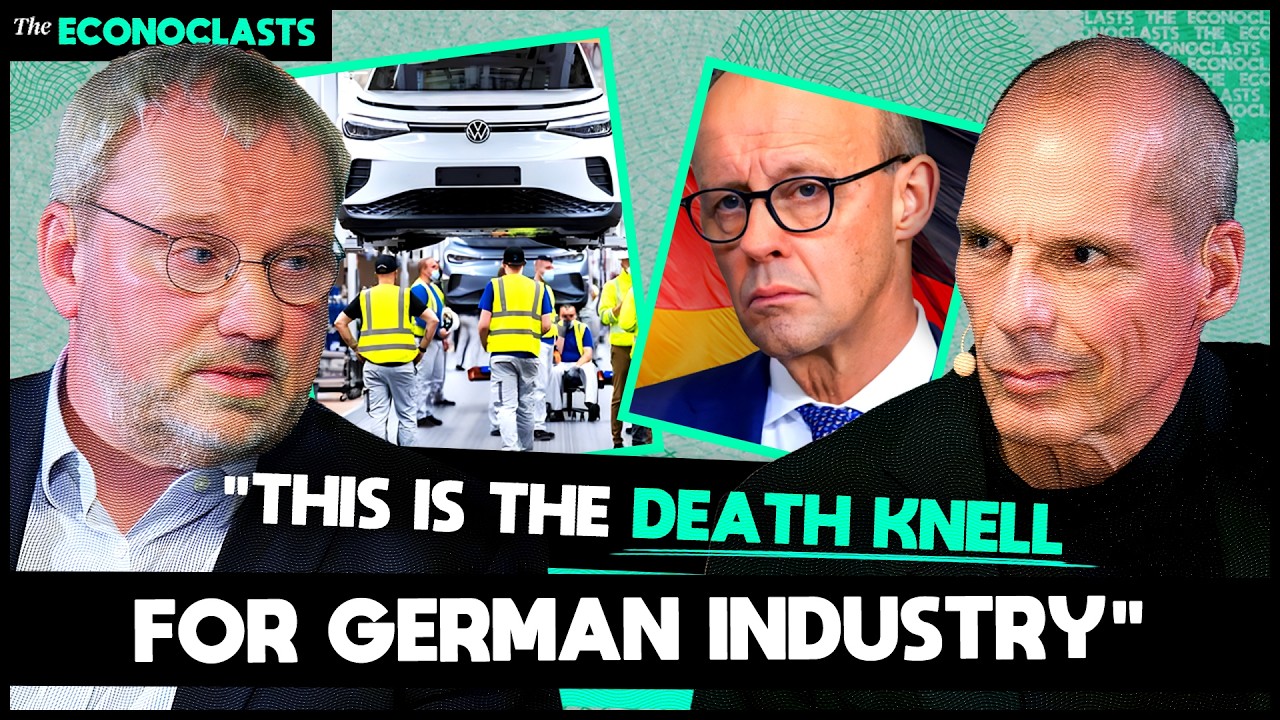
Germany Has Just Hit the Point of No Return
In a stark and urgent analysis, economist Yanis Varoufakis and journalist Wolfgang Münchau argue that Germany’s economic model has reached a critical juncture—a “point of no return. ” The conversation, hosted on *The Econoclasts*, dissects the structural collapse of the German economy, moving beyond
In a stark and urgent analysis, economist Yanis Varoufakis and journalist Wolfgang Münchau argue that Germany’s economic model has reached a critical juncture—a “point of no return.” The conversation, hosted on The Econoclasts, dissects the structural collapse of the German economy, moving beyond temporary crises to diagnose a permanent shift. For decades, Germany prospered as the industrial powerhouse of Europe, but the foundations of that success are now crumbling. The result is not just a recession, but a fundamental transformation that will reshape Europe’s economic landscape.
The core of the problem lies in Germany’s reliance on cheap Russian energy and a globalized export market. The war in Ukraine severed the first pillar, while geopolitical fragmentation is dismantling the second. The country’s manufacturing sector, once the envy of the world, is now trapped between high energy costs and declining demand from China, its largest trading partner. This is not a cyclical downturn; it is a structural rupture.
Varoufakis and Münchau highlight that the German government’s response has been inadequate. The Schuldenbremse (debt brake), a constitutional rule limiting public borrowing, prevents the state from investing in the infrastructure and digitalization needed to revive the economy. Meanwhile, the European Central Bank’s interest rate hikes, designed to combat inflation across the eurozone, disproportionately hurt Germany’s industrial base. The result is a policy trap: Germany cannot spend its way out of the crisis without breaking its own fiscal rules, and it cannot rely on the ECB for relief.
The consequences for Europe are severe. Germany has long been the engine of the European Union, financing bailouts and driving growth. If that engine stalls, the entire bloc faces stagnation. The authors warn that the EU’s current structure, with its focus on austerity and rigid fiscal rules, is ill-equipped to handle a German recession. Countries like France and Italy, already struggling with their own debts, will find no support from Berlin.
Crucially, the discussion refutes the idea that this is a temporary problem solved by new energy sources or trade deals. The shift is permanent. Germany’s industrial model was built on three pillars: cheap energy from Russia, open markets in China, and a security umbrella from the United States. All three are now compromised. The country is entering a period of de-industrialization, with factories closing and jobs moving abroad. This is not a political choice; it is an economic inevitability.
Varoufakis and Münchau conclude that Germany has reached the point of no return because its political and economic elites refuse to acknowledge the scale of the change. They cling to the narrative of a temporary shock, while the ground shifts beneath them. For the rest of the world, this means the end of the post-Cold War economic order. For Germany, it means a future of lower growth, higher unemployment, and a diminished role in global affairs. The question is no longer if Germany will change, but what it will become.
Related Coverage
Iran’s Economy in Freefall as Middle Class Collapses and Oil Crisis Deepens
Iran’s economy is spiraling as U.S. sanctions and the Strait of Hormuz crisis push millions of middle-class families toward poverty, while global oil demand is set to crash by 1.6 million barrels a day.
# Climate Collapse, Conflict, and the Crushing of the Vulnerable: A World on the Brink
The planetary ecological crisis, driven by an economic model built on relentless extraction and fossil fuel dependence, has moved from a distant warning to a deadly reality, converging with geopolitical conflict and financial instability to crush the world's most vulnerable populations and future generations.
Global Economy Buckles as War, Climate Chaos, and Financial Greed Reshape the World Order
A global economy built on the promise of open trade and cheap energy is buckling under the weight of geopolitical conflict, strategic blockades, and a climate crisis that is no longer a distant warning but a lived reality. From the besieged oil routes of the Middle East and the battlefields of Ukraine to the drought-parched heart of Europe, the pursuit of geopolitical power and corporate profit is increasingly colliding with fundamental human needs. This convergence of crises is leaving the world’s most vulnerable populations to bear the heaviest burden of inflation, fuel shortages, and a widening chasm between financial accumulation and human welfare [1][2].
Related Editorials
Germany’s Economic Model Is Broken—and There’s No Going Back
Germany, long celebrated as Europe’s economic engine, is now facing a crisis that its political and financial leaders appear unwilling—or unable—to confront. In a candid discussion, economists Yanis Varoufakis and Wolfgang Münchau dissect the structural failures behind Germany’s stagnation, the Eur
Germany Just Broke the EU’s Firewall
A conversation between Yanis Varoufakis and Wolfgang Münchau reveals how Berlin’s fiscal about-face is rewriting the rules of Europe—and why the bond markets may be the only referee left. For years, the European Union’s fiscal architecture rested on a simple promise: no member state would be allowe
Europe’s Decline is Now Official: The Continent Has Lost Its Economic Soul
In a rare moment of bipartisan agreement, two of Europe’s most astute economic minds—Yanis Varoufakis, the former Greek Finance Minister, and Wolfgang Münchau, a veteran financial journalist and co-founder of *The Econoclasts*—have declared the end of an era. The evidence, they argue, is no longer
Europe’s Economic Doom Loop: Why Brussels Has Lost the Wheel
Europe’s economic engine is sputtering, and according to two of the continent’s most prominent economic voices, the drivers in Brussels have lost control of the vehicle. In a recent discussion, former Greek Finance Minister Yanis Varoufakis and Financial Times columnist Wolfgang Münchau painted a s
The Establishment is Panicking: Why the Old Rules of Economics No Longer Apply
The global economic establishment is in a state of deep anxiety. This is not merely a feeling; it is a rational response to a world in which the central pillars of post-war economic policy—inflation targeting, central bank independence, and the assumption of stable growth—are crumbling.
Keir Starmer’s Resignation: The Vacuum, the Right, and the Road to Realignment
In a political landscape already fracturing under the weight of austerity and stagnation, the resignation of UK Labour leader Keir Starmer marks a pivotal moment. But as economists Yanis Varoufakis and Wolfgang Münchau argue in a recent episode of *The Econoclasts*, the departure is less a solution