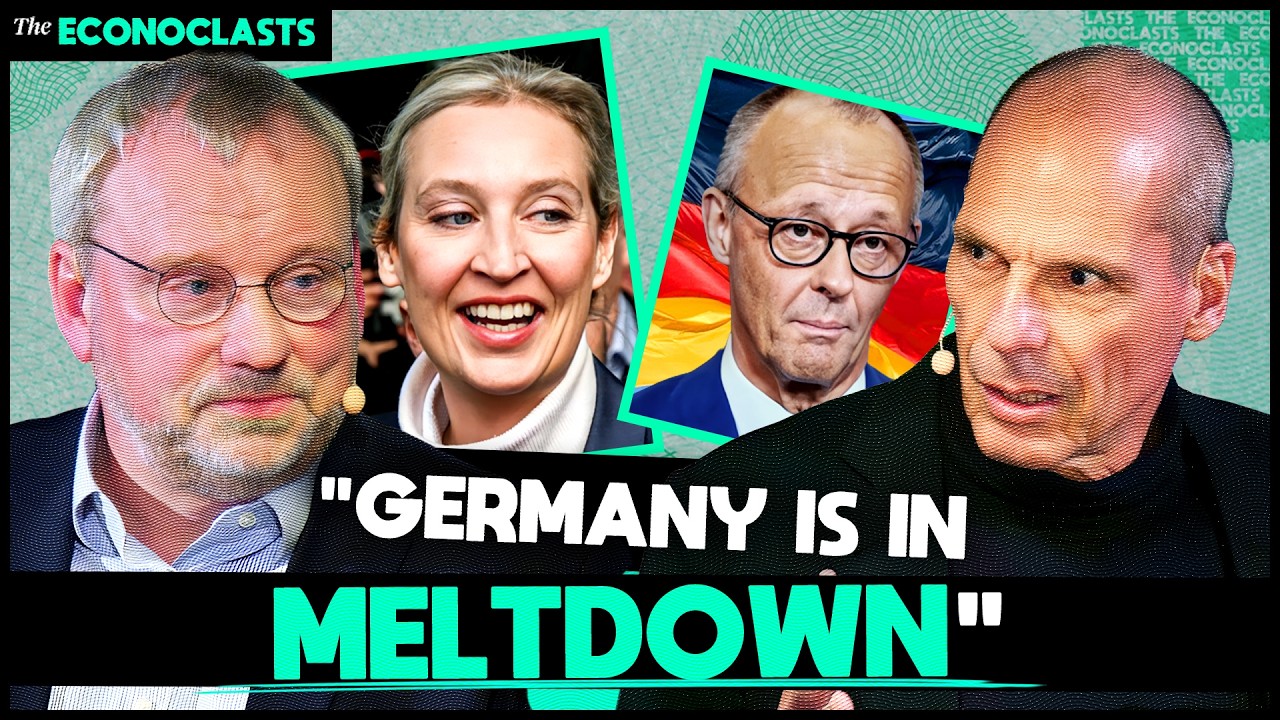
# Germany’s Economic Model Is Broken—and There’s No Going Back
Germany, long celebrated as Europe’s economic engine, is now facing a crisis that its political and financial leaders appear unwilling—or unable—to confront. In a candid discussion, economists Yanis Varoufakis and Wolfgang Münchau dissect the structural failures behind Germany’s stagnation, the Eur
Germany, long celebrated as Europe’s economic engine, is now facing a crisis that its political and financial leaders appear unwilling—or unable—to confront. In a candid discussion, economists Yanis Varoufakis and Wolfgang Münchau dissect the structural failures behind Germany’s stagnation, the European Union’s role in perpetuating them, and why conventional remedies will not work.
A Model Built on Sand
Germany’s post-war prosperity rested on three pillars: cheap Russian energy, robust global export markets, and a monetary union designed to serve German interests. Each of these pillars has collapsed or is crumbling.
The loss of Russian gas following the Ukraine war exposed Germany’s energy-intensive industries to crippling costs. Simultaneously, competition from China has eroded Germany’s export dominance, particularly in automobiles and machinery. Yet the deeper problem lies within the eurozone itself.
The Euro: A Machine for German Surplus
Varoufakis argues that the euro was never a neutral currency. It functions as a mechanism that systematically benefits Germany at the expense of weaker member states. By sharing a currency with countries like Greece, Portugal, and Italy, Germany enjoys an artificially competitive exchange rate. German goods remain affordable abroad, while southern European economies cannot devalue to regain competitiveness.
This arrangement produces persistent trade imbalances. Germany accumulates massive surpluses; other nations accumulate debt. When crisis hits, the burden falls on debtor countries through austerity—policies that deepen recessions and fuel political instability.
The Debt Brake: A Self-Inflicted Wound
Germany’s constitutional debt brake, which limits government borrowing, prevents the kind of public investment needed to modernize infrastructure, education, and green technology. Münchau notes that this fiscal straitjacket enjoys broad political support, even as Germany’s roads, bridges, and digital networks fall behind.
The result is a vicious cycle: insufficient investment leads to slower growth, which reduces tax revenues, which justifies further austerity. Breaking this cycle requires political courage that no major German party currently displays.
Europe’s Leadership Vacuum
Both economists express frustration with the European Union’s response to repeated crises. Rather than reforming the eurozone’s flawed architecture, Brussels has opted for short-term fixes—bailouts conditioned on austerity, vague promises of “ever closer union,” and a central bank that props up bond markets without addressing root causes.
Varoufakis contends that the EU’s democratic deficit makes meaningful reform nearly impossible. Decisions are made by technocrats and finance ministers accountable to no one. Citizens who resist—whether in Greece, Italy, or France—are dismissed as populists.
No Easy Way Out
The conversation offers little comfort. Germany cannot simply return to its pre-2022 model. The energy is gone, the export markets are shifting, and the eurozone’s imbalances remain unresolved. Münchau suggests that without a fundamental rethinking of fiscal policy and European integration, Germany faces a prolonged period of stagnation.
Varoufakis goes further, warning that the political consequences could be severe. Economic decline breeds resentment, and resentment fuels extremist movements across the continent. The center may not hold.
What Comes Next?
Neither economist pretends to have a simple solution. But both agree on one point: denial is not a strategy. Germany and Europe must either reform the eurozone’s architecture, embrace fiscal federalism, and invest in their shared future—or accept a slow unraveling that will harm everyone.
The choice, they imply, is not between pain and comfort. It is between managed transition and chaotic decline.
Related Coverage
Germany’s ‘Firewall’ Against Far-Right AfD Shows Cracks
Germany’s long-standing political consensus to isolate the far-right Alternative for Germany (AfD) is beginning to fracture under political pressure.
Europe’s Rivers Are Drying Up—Nazi Warships Emerge as Danube Hits Record Lows
Record-low water levels across Europe’s major rivers are exposing sunken Nazi warships in the Danube and forcing nuclear plants to shut down, as the continent’s worst drought in decades cripples shipping, farming, and energy production [218912][218108].
Related Editorials
### Germany Has Just Hit the Point of No Return
In a stark and urgent analysis, economist Yanis Varoufakis and journalist Wolfgang Münchau argue that Germany’s economic model has reached a critical juncture—a “point of no return. ” The conversation, hosted on *The Econoclasts*, dissects the structural collapse of the German economy, moving beyond
Title: Europe’s Economic Doom Loop: Why Brussels Has Lost the Wheel
Introduction Europe’s economic engine is sputtering, and according to two of the continent’s most prominent economic voices, the drivers in Brussels have lost control of the vehicle. In a recent discussion, former Greek Finance Minister Yanis Varoufakis and Financial Times columnist Wolfgang Mü
# Germany Just Broke the EU’s Firewall
A conversation between Yanis Varoufakis and Wolfgang Münchau reveals how Berlin’s fiscal about-face is rewriting the rules of Europe—and why the bond markets may be the only referee left. For years, the European Union’s fiscal architecture rested on a simple promise: no member state would be al
# Germany’s Economic Engine Sputters: Why the World’s Former Export Champion Is Running Out of Steam
Introduction For decades, Germany was the gold standard of European economic might—a manufacturing powerhouse whose efficiency, discipline, and engineering prowess powered the continent. Today, that engine is sputtering.
Europe’s Decline is Now Official: The Continent Has Lost Its Economic Soul
In a rare moment of bipartisan agreement, two of Europe’s most astute economic minds—Yanis Varoufakis, the former Greek Finance Minister, and Wolfgang Münchau, a veteran financial journalist and co-founder of *The Econoclasts*—have declared the end of an era. The evidence, they argue, is no longer
# Germany’s Political Upheaval Will Reshape Europe
Germany, long viewed as Europe’s anchor of stability, is entering a period of profound political change. The shifts underway in Berlin will not remain contained within Germany’s borders; they will reshape the European Union itself.