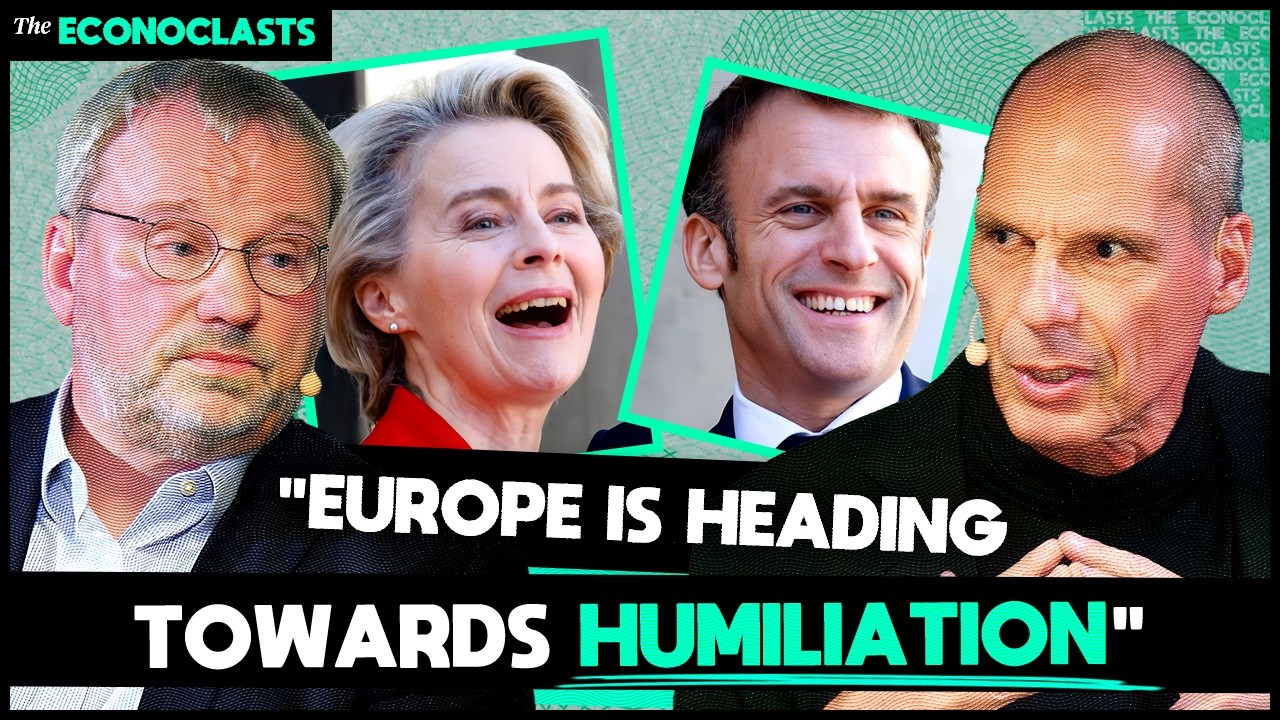
Europe’s Decline is Now Official: The Continent Has Lost Its Economic Soul
In a rare moment of bipartisan agreement, two of Europe’s most astute economic minds—Yanis Varoufakis, the former Greek Finance Minister, and Wolfgang Münchau, a veteran financial journalist and co-founder of *The Econoclasts*—have declared the end of an era. The evidence, they argue, is no longer
In a rare moment of bipartisan agreement, two of Europe’s most astute economic minds—Yanis Varoufakis, the former Greek Finance Minister, and Wolfgang Münchau, a veteran financial journalist and co-founder of The Econoclasts—have declared the end of an era. The evidence, they argue, is no longer anecdotal; it is structural. Europe is not merely experiencing a recession or a period of slow growth. It is undergoing a systemic decline that has fundamentally altered its place in the global order.
The core thesis is stark: the European Union, once a beacon of post-war integration, technological ambition, and social stability, has become a museum of its own past. The continent has lost its competitive edge in the industries that define the 21st century, namely digital technology, artificial intelligence, and advanced manufacturing. More critically, it has lost the political will to innovate.
The Three Pillars of Collapse
Varoufakis and Münchau identify three interconnected drivers of this decline.
First is the deindustrialization disguised as a green transition. While the EU champions ambitious climate targets, its implementation has created a punishing regulatory environment. Energy costs, driven by a flawed electricity market and a premature abandonment of stable baseload power, have made European manufacturing uncompetitive. Companies are not relocating to Asia or America simply for lower wages; they are fleeing to places with cheaper, more reliable energy. The result is a hollowing out of the industrial base that once provided high-quality employment and export revenue.
Second is the failure of the digital single market. Despite years of rhetoric, Europe has no equivalent of Silicon Valley, Shenzhen, or Bangalore. The continent’s digital economy is dominated by American platforms and Chinese hardware. EU regulations, designed to protect privacy and curb monopolies, have instead created a compliance burden that crushes startups before they can scale. "We have regulated ourselves into irrelevance," Münchau argues, noting that the only major tech companies in Europe are those that have moved their headquarters to the United States.
Third is the fiscal straitjacket of the eurozone. The Maastricht criteria and the Stability and Growth Pact, designed for a different era, prevent member states from investing in the future. While the United States runs massive deficits to fund industrial policy and innovation, Europe obsesses over debt-to-GDP ratios. Varoufakis calls this a "suicidal austerity reflex." The result is chronic underinvestment in infrastructure, research, and education—the very foundations of long-term growth.
The Political Consequence: A Crisis of Legitimacy
The economic decline has a direct political corollary. As living standards stagnate and opportunities shrink, trust in EU institutions evaporates. The rise of populist parties across the continent is not a sign of irrationality, but a rational response to a system that no longer delivers prosperity.
Münchau points to the paradox of the German economic model. For decades, Germany was the engine of Europe, exporting cars and machinery to the world. Now, that model is broken. The country is stuck between its reliance on cheap Russian gas (now gone) and its inability to pivot to a digital economy. The German constitutional court’s strict interpretation of fiscal rules prevents Berlin from borrowing to invest. "The country that once defined European efficiency is now a drag on the entire continent," he says.
Is There a Way Out?
The diagnosis is grim, but the economists offer a prescription—though they admit it is politically improbable. The EU must fundamentally rewrite its fiscal rules to allow for large-scale public investment. It must abandon the idea that every member state must have the same energy price. And it must stop regulating technology as if it were a public utility.
Varoufakis is blunt: "Europe needs a new narrative. Not one of austerity and rules, but of investment and common purpose. If we cannot do that, the decline is terminal."
For now, the evidence supports his conclusion. Europe is not falling; it has already fallen. The question is whether it has the courage to rebuild.
Related Coverage
Global Economy Buckles as War, Climate Chaos, and Financial Greed Reshape the World Order
A global economy built on the promise of open trade and cheap energy is buckling under the weight of geopolitical conflict, strategic blockades, and a climate crisis that is no longer a distant warning but a lived reality. From the besieged oil routes of the Middle East and the battlefields of Ukraine to the drought-parched heart of Europe, the pursuit of geopolitical power and corporate profit is increasingly colliding with fundamental human needs. This convergence of crises is leaving the world’s most vulnerable populations to bear the heaviest burden of inflation, fuel shortages, and a widening chasm between financial accumulation and human welfare [1][2].
Global Economy Buckles Under War, Climate Chaos, and Financial Greed
A global economy built on the promise of open trade and cheap energy is buckling under the weight of geopolitical conflict, strategic blockades, and a climate crisis that is no longer a distant warning but a lived reality. From the battlefields of Ukraine and the besieged oil routes of the Middle East to the drought-parched heart of Europe, the pursuit of geopolitical power and corporate profit is increasingly colliding with fundamental human needs, leaving the world’s most vulnerable populations to bear the heaviest burden of inflation, fuel shortages, and a widening gap between the wealthy and the rest [1][2].
Global Economy Buckles Under War, Climate Chaos, and Financial Greed
A global economy built on the promise of open trade and cheap energy is buckling under the weight of geopolitical conflict, strategic blockades, and a climate crisis that is no longer a distant warning but a lived reality. From the battlefields of Ukraine and the besieged oil routes of the Middle East to the drought-parched heart of Europe, the pursuit of geopolitical power and corporate profit is increasingly colliding with fundamental human needs, leaving the world’s most vulnerable populations to bear the heaviest burden of inflation, fuel shortages, and a widening gap between the wealthy and the rest [15315][15322].
Russia Fires Top Economist Who Warned War Effort Is Unsustainable — Kremlin Cracks Show as Election Nears
A senior Russian economist has been fired after warning the Kremlin that the country cannot sustain a prolonged war with Ukraine, while a Swedish TV host’s on-air slip has become a national story about political masks falling on election night.
War, Drought, and Debt: How a Strained Global Economy Is Crushing the Vulnerable
A global economy built on the promise of open trade and cheap energy is buckling under the weight of geopolitical conflict, strategic blockades, and a climate crisis that is no longer a distant warning but a lived reality. From the battlefields of Ukraine and the besieged oil routes of the Middle East to the drought-parched heart of Europe, the pursuit of geopolitical power and corporate profit is increasingly colliding with fundamental human needs, leaving ordinary citizens to bear the brunt of inflation, fuel shortages, and a widening gap between the wealthy and the rest.
# Power, Profit, and a Planet in Peril: How Financial Warfare, Climate Collapse, and the AI Boom Are Reshaping Global Politics
The global order is buckling under the weight of converging crises, where the pursuit of geopolitical power and corporate profit is colliding with fundamental human needs. From the closed oil routes of the Strait of Hormuz and the escalating aerial war in Ukraine to drought-parched rivers across Europe and famine-stricken regions of Africa, a cascade of emergencies is diverting public resources away from social welfare and toward conflict, leaving the world's most vulnerable populations to bear the heaviest burden of inflation, displacement, and violence [1][2].
Related Editorials
Title: Europe’s Economic Doom Loop: Why Brussels Has Lost the Wheel
Introduction Europe’s economic engine is sputtering, and according to two of the continent’s most prominent economic voices, the drivers in Brussels have lost control of the vehicle. In a recent discussion, former Greek Finance Minister Yanis Varoufakis and Financial Times columnist Wolfgang Mü
### Germany Has Just Hit the Point of No Return
In a stark and urgent analysis, economist Yanis Varoufakis and journalist Wolfgang Münchau argue that Germany’s economic model has reached a critical juncture—a “point of no return. ” The conversation, hosted on *The Econoclasts*, dissects the structural collapse of the German economy, moving beyond
Title: America Is Quietly Losing the World: Two Top Economists on the Empire’s Unraveling
Introduction The United States has long been the undisputed center of global capitalism. Yet, according to two of the world’s most prominent dissenting economists, Yanis Varoufakis and Richard D.
# Germany Just Broke the EU’s Firewall
A conversation between Yanis Varoufakis and Wolfgang Münchau reveals how Berlin’s fiscal about-face is rewriting the rules of Europe—and why the bond markets may be the only referee left. For years, the European Union’s fiscal architecture rested on a simple promise: no member state would be al
Title: Iceland’s Quiet Revolt: The End of Europe’s Political Illusion?
For decades, the European Union has sold itself as a project of perpetual integration—a political and economic engine designed to smooth over national differences and deliver shared prosperity. Yet, according to two of Europe’s most prominent economic thinkers, the recent actions of a small Nordic
Keir Starmer’s Resignation: The Vacuum, the Right, and the Road to Realignment
In a political landscape already fracturing under the weight of austerity and stagnation, the resignation of UK Labour leader Keir Starmer marks a pivotal moment. But as economists Yanis Varoufakis and Wolfgang Münchau argue in a recent episode of *The Econoclasts*, the departure is less a solution