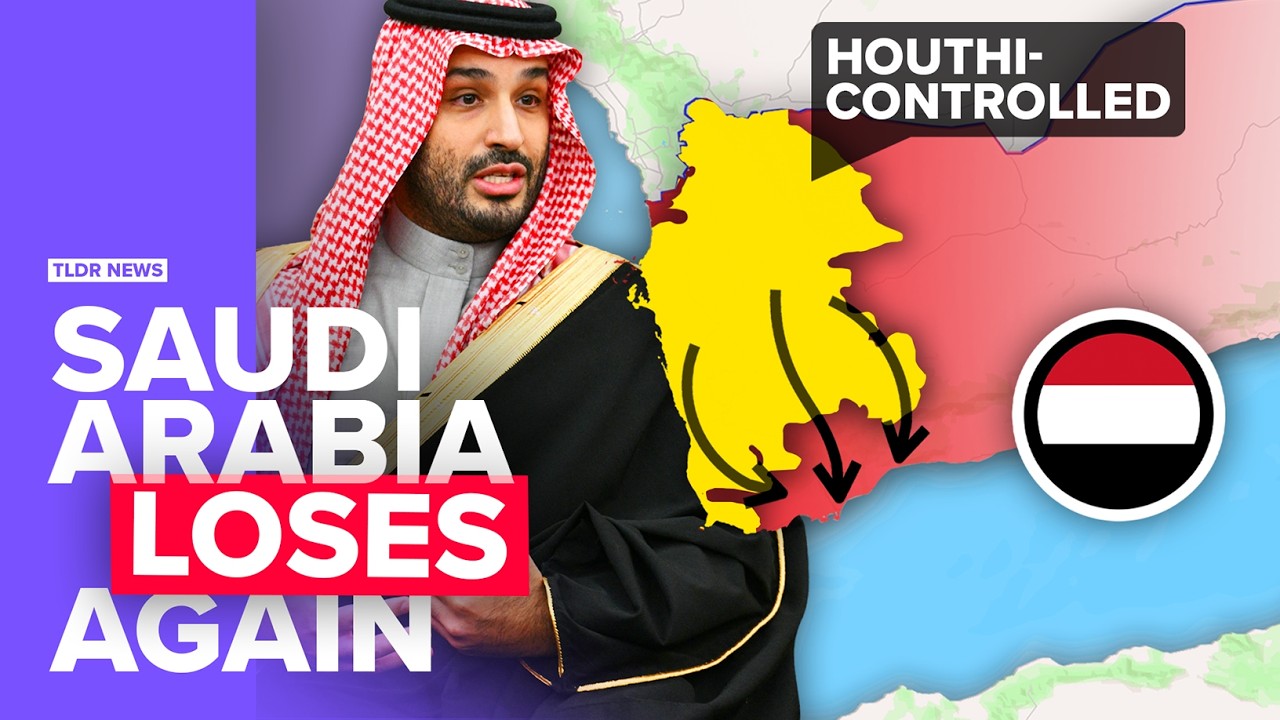
Houthi Forces Close In on Aden: Why Saudi Arabia’s Yemen Strategy Is Unraveling
For months, the war in Yemen appeared locked in a stalemate. Now, a series of rapid Houthi advances has upended the balance of power, leaving Saudi Arabia and Yemen’s internationally recognized government facing their most serious threat in years.
For months, the war in Yemen appeared locked in a stalemate. Now, a series of rapid Houthi advances has upended the balance of power, leaving Saudi Arabia and Yemen’s internationally recognized government facing their most serious threat in years. With the Houthis setting their sights on Aden, the conflict may be entering a decisive new phase.
The current war is a continuation of the instability that followed Yemen’s 2011 Arab Spring protests, which forced President Ali Abdullah Saleh from power after nearly 30 years. His deputy, Abdrabbuh Mansur Hadi, succeeded him but struggled to contain persistent infighting within the Yemeni state. In 2014, Hadi proposed a federal Yemen divided into six regions. The plan infuriated powerful Shia Muslim tribes in the northwest, who had waged a multi-decade insurgency against the previous government. That insurgency, originally led by Hussein al-Houthi—killed in 2004—became known as the Houthis, though they are officially called Ansar Allah. The Houthis rejected the federal plan because their heartland region would lack access to the Red Sea and oil fields. The dispute quickly escalated into civil war.
The Houthis initially appeared poised to win. They seized the capital, Sana’a, and pushed toward Aden, where Hadi’s government had relocated. Saudi Arabia then intervened, backing the internationally recognized government. Riyadh acted for two reasons: as Sunni Muslims, the Saudis did not want a Shia-dominated Houthi state on their southern border, and the Houthis were backed by Iran, Saudi Arabia’s regional rival. The Saudi intervention halted the Houthi advance, but the Houthis retained Sana’a and most of northwestern Yemen. The war settled into a territorial stalemate, with the Houthis controlling most of western Yemen except for a small pocket in the far northwest and a larger pocket in the southwest.
A ceasefire agreed in April 2022 held up remarkably well, even during the regional turmoil that followed the October 7 attacks. Tensions ratcheted up in July of this year after the Houthis organized the first direct flight between Yemen and Iran since 2015. The two sides exchanged air and drone strikes for weeks before the Houthis launched a renewed ground offensive in early September toward the government-controlled pocket in the southwest. That offensive was remarkably successful. The Houthis quickly overran the pocket and then encircled Taiz, one of the few population centers still held by government forces.
In early October, the Saudi-backed coalition announced a new offensive, vowing to retake the entire country and oust the Houthis. Their first move was an operation to recover coastal territory along the Red Sea, focused on Mocha. It initially made good progress, and the coalition appeared to have a chance. Over the past month, however, the situation has deteriorated dramatically for the Saudis. Three developments stand out.
First, the Houthis halted and then reversed the coastal offensive. They now control a strip of territory running to Yemen’s southwestern corner, tightening their grip on the Bab al-Mandab strait and further limiting Saudi Arabia’s ability to export oil through the Red Sea.
Second, the Houthis have tightened their encirclement of Taiz, a city of about 1.5 million people. All main roads in and out of Taiz have been at least partially blocked since mid-October, and the Houthis have now blocked even the alternative mountain routes that had served as a lifeline. The siege has lasted about a month, causing widespread shortages of fuel, food, water, medicine, and cooking gas.
Third, in recent days the Houthis achieved a rapid advance east of Taiz, moving south from As Shat toward Al Fashay’a. If the advance continues and the Houthis reach the south coast, they will be positioned to encircle all the territory between there and the Bab al-Mandab.
On a map, this may not appear to be much territory in the context of Yemen as a whole, but several factors make it significant. Nearly all of Yemen’s population lives in the west; the east is essentially desert. Though the Houthis control only about a third of Yemen’s geographic territory, roughly 75 percent of the population lives under their control. Completing the encirclement would raise that figure by perhaps 5 percent. The speed of the Houthi advance—and the speed at which the Saudi-backed coalition essentially disintegrated—does not bode well for Riyadh. And the advance sets the stage for an assault on Aden, the temporary capital and interim base of the internationally recognized government, and one of the few population centers under its control. If the Houthis complete their push to the south coast, Aden would be less than 100 kilometers away. Should the Houthis retake Aden, the internationally recognized government would probably collapse, given that the vast majority of Yemen’s population would then be under Houthi control.
An assault on Aden would be a tall order, but Houthi sources reportedly told The Telegraph that this is indeed the plan, and recent events make it feel increasingly possible. The Houthis will be aided by the reluctance of Saudi Arabia’s international allies to get involved, presumably because no one wants to join the losing side. Several countries, including Turkey, Pakistan, Syria, and Egypt, have pledged some military support for Saudi Arabia, but all have said their forces would serve only in a defensive capacity on the Saudi side of the border—help that would be of little use in defending Aden.
Related Coverage
Oil Hits $110 as Houthis Seize Red Sea Strait, 500 Die in Yemen in a Week
Houthi forces have captured key points along the Bab el-Mandeb Strait, threatening global oil shipments and pushing prices above $100 a barrel as Saudi Arabia shuts down a major pipeline.
Houthis Target Saudi Oil Refinery as Tensions Escalate
The Houthi group in Yemen says it has attacked a major oil refinery in Saudi Arabia, raising new concerns about regional security.
Houthis Seize Red Sea Coast, Hit Riyadh With Missile as US Refuses to Defend Saudi Arabia
Houthi rebels have captured large areas of Yemen's Red Sea coast and struck Saudi Arabia's capital with a missile, killing hundreds and displacing more than 100,000 people. The United States has refused Saudi requests for military help, leaving its longtime ally exposed.
Saudi Pipeline Shutdown and Houthi Island Seizure Threaten Two Oil Chokepoints as Iran Tensions Escalate
Saudi Arabia halts a major pipeline after attacks while Iran-backed Houthis seize a key island near the Bab el-Mandeb Strait, raising fears that two vital oil routes could be disrupted at once.
Yemen's War Explodes: 135,000 Displaced, 200+ Fighters Killed in 24 Hours as Airstrikes Hit Sana'a
Fighting across Yemen has sharply escalated, with airstrikes hitting Houthi-held cities, over 200 fighters reported killed in a single day, and more than 135,000 people displaced from Taiz province in just two months.
Saudi Arabia Joins US Strikes as Iran War Risks Engulf the Middle East
Saudi Arabia has openly joined US military strikes against Iran-backed militias, signaling a dangerous escalation in a regional conflict that is spreading across multiple fronts and threatening global oil supplies.
Related Editorials
# The Houthis Batter the Saudis: What Next?
The Iran-backed Houthi movement has escalated its attacks on Saudi Arabia and the UAE, exposing the limits of Riyadh's air campaign and threatening to reshape the balance of power in the Middle East. --- ## A New Phase in the Yemen War The Houthis, a Zaidi Shia movement that seized Yemen's capi
The Saudi-Houthi Truce Shatters: A Return to Yemen’s Endless War
The fragile calm that had settled over Yemen’s front lines has evaporated. After months of relative quiet and tentative diplomatic overtures, the truce between the Saudi-backed coalition and the Houthi movement has collapsed, plunging the region back into active conflict.
The Houthi Blockade of Bab al-Mandab: A Strategic Chokepoint Under Siege
In a dramatic escalation of regional conflict, the Houthi movement has effectively closed the Bab al-Mandab strait, one of the world’s most critical maritime chokepoints. This narrow waterway, connecting the Red Sea to the Gulf of Aden, handles roughly 10% of global seaborne trade.
Myanmar’s War Reaches a Crossroads: Can the Junta Survive?
For years, the civil war in Myanmar has been a brutal, grinding stalemate. But recent months have seen a seismic shift in the balance of power.
The Drift Toward War: Why Syria and Israel Are Inching Closer to a Direct Confrontation
The long-standing ceasefire between Israel and Syria is unraveling. What was once a stable, if tense, border is now a flashpoint for escalating military action, shifting alliances, and deepening suspicion.
The World Is Running Out of Oil Buffers Just as Iran Turns Up the Heat
When the United States and Iran went to war in February, oil analysts predicted catastrophe. With the Strait of Hormuz effectively closed, commentators warned of $200-a-barrel crude.