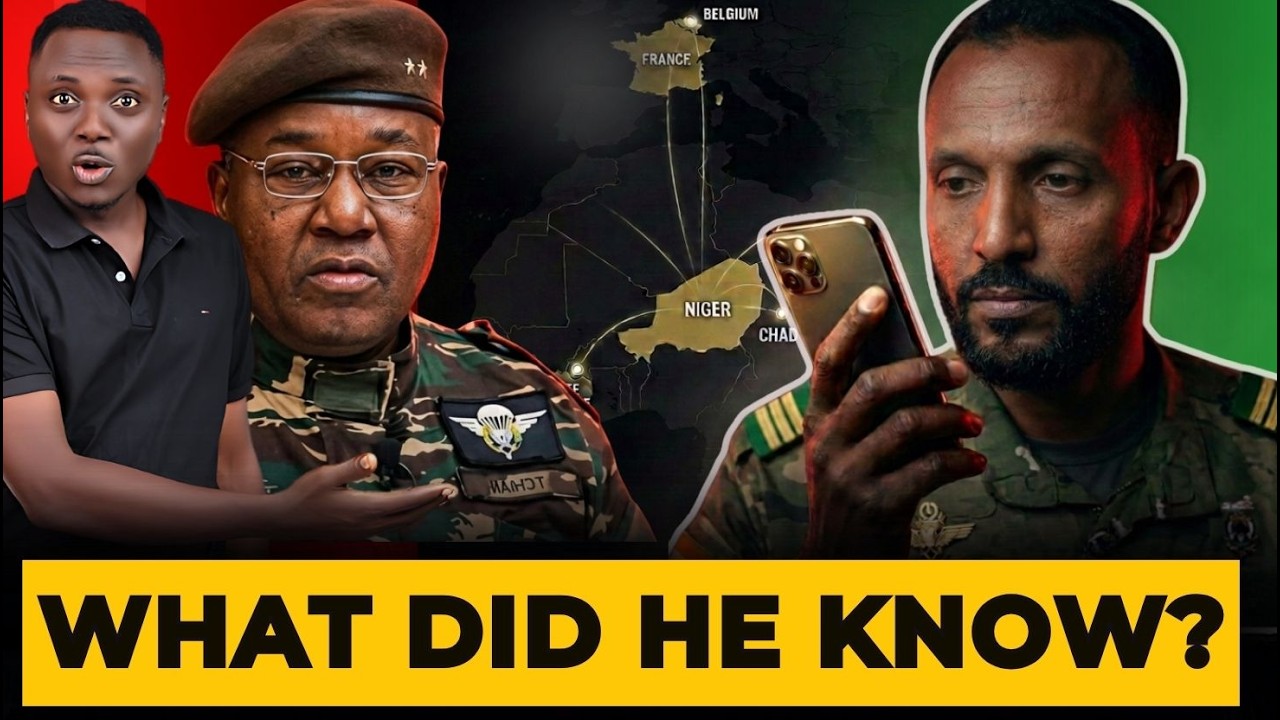
Title: The Call Log That Could Rewrite Niger’s Coup Narrative
In the wake of Niger’s July 2023 military takeover, a single piece of evidence has emerged that challenges the official version of events. A classified call log, attributed to a captain within the coup’s inner circle, suggests the plot may have been broader and more coordinated than initially repor
In the wake of Niger’s July 2023 military takeover, a single piece of evidence has emerged that challenges the official version of events. A classified call log, attributed to a captain within the coup’s inner circle, suggests the plot may have been broader and more coordinated than initially reported. While the authenticity of the document remains unverified, its contents have sparked serious questions among regional security analysts.
The log in question details communications that allegedly took place in the hours before President Mohamed Bazoum was detained. According to the transcript, the captain coordinates with multiple units across the capital, Niamey, not just the presidential guard. This contradicts the narrative that the coup was a spontaneous act by a disgruntled faction. Instead, the timing and specificity of the orders point to a premeditated operation involving logistical support from outside the immediate military chain of command.
One of the most significant revelations is the mention of external actors. The call log references a "key contact" in a neighboring country, though the name is redacted. This has led to speculation about foreign involvement, a claim that the Nigerien junta has categorically denied. For context, Niger has been a critical partner for Western nations in the Sahel, hosting French and American troops for counterterrorism operations. A coup with external backing would fundamentally alter the geopolitical calculus in a region already fraught with instability.
Furthermore, the log indicates a deliberate effort to secure key infrastructure—specifically the airport and state broadcasting facilities—before any public announcement. This level of operational planning suggests a timeline that extends weeks, if not months, prior to the actual event. It also implies a level of coordination that goes beyond the immediate circle of General Abdourahamane Tchiani, who later declared himself head of state.
However, experts urge caution. "Call logs can be fabricated or selectively edited to serve a narrative," notes Dr. Amara Konaté, a Sahel security researcher. "Without independent verification of the source, we are looking at a piece of intelligence, not a fact." The document’s provenance is murky, reportedly leaked by a disaffected officer who fled to Benin. His motives remain unclear, and his claims have not been substantiated by any international body.
If the log is genuine, it would suggest that the coup was not merely a domestic power grab but part of a larger strategic shift. This aligns with the junta’s subsequent actions: expelling French forces, reorienting toward Russia, and forming a mutual defense pact with Mali and Burkina Faso. These moves, which seemed abrupt at the time, would appear far more deliberate if they were part of a long-planned pivot away from Western alliances.
The implications for the region are profound. The Economic Community of West African States (ECOWAS) has struggled to respond effectively to the coup, with threatened military intervention failing to materialize. If the call log is proven authentic, it would confirm that the junta’s defiance is not impulsive but calculated, backed by a network that extends beyond Niger’s borders. This would force a reassessment of diplomatic strategies, as sanctions and negotiations may prove ineffective against a coordinated regional bloc.
For now, the document remains a shadow over the events of last summer. It offers a compelling, albeit unverified, alternative explanation for how a democratic government fell in a matter of hours. As international investigators press for access to the original files, one thing is clear: the story of Niger’s coup is far from closed. The call log, whether fact or forgery, has opened a door that the junta would likely prefer to keep shut.
Related Editorials
Title: Niger’s Silent Coup: Why the Junta’s Own Soldiers Turned on General Tiani
Article: In a dramatic turn of events that has sent ripples through the Sahel region, Niger’s military junta faces its most significant internal challenge yet. Reports from Niamey confirm that a faction of the country’s own armed forces has moved against General Abdourahamane Tiani, the man who
Title: The Silent Pivot: Why Chad’s Unnoticed Move Just Rewrote the Rules
Introduction In the high-stakes arena of international strategy, the most consequential moves are often the ones that make no sound. While commentators focused on the obvious theater and public posturing, a subtle but seismic shift occurred—one that most observers completely missed.
Title: The Sahel’s Hidden War: Why Mali’s Conflict Is Far Larger Than Reported
For years, the war in Mali has been framed as a remote insurgency—a localized struggle between government forces and Tuareg rebels in the country’s vast northern desert. But new evidence suggests that this framing is dangerously incomplete.
Title: Traoré’s 2026 Reforms: The Quiet Revolution That Changed a Nation’s Trajectory
Introduction For years, the narrative surrounding President Ibrahim Traoré’s leadership in Burkina Faso was dominated by speculation and polarized debate. Critics dismissed his tenure as a continuation of military rule without substance, while supporters hailed him as a pan-African savior.
Title: Mali’s Bold Move: How Assimi Goïta’s Crackdown on Gold Mining Is Reshaping Africa’s Wealth Equation
Introduction For decades, a familiar narrative has plagued the African continent: vast mineral wealth extracted by foreign corporations, with local populations seeing little of the profit. Mali, one of Africa’s largest gold producers, has long been a textbook example of this dynamic.