Democrats Won Big. Here's Exactly Who Abandoned Trump.
Earlier this week, Trump and the Republican Party suffered a historic defeat in the midterms. The Democrats took control of the House of Representatives by a wide margin and were on track to win at least 55 Senate seats, with a 56th possible if Mississippi, still being counted at the time of record
Earlier this week, Trump and the Republican Party suffered a historic defeat in the midterms. The Democrats took control of the House of Representatives by a wide margin and were on track to win at least 55 Senate seats, with a 56th possible if Mississippi, still being counted at the time of recording and hanging on a knife's edge, flips.
This shocked almost everyone. Before the election, prediction markets gave the Democrats roughly a 10 percent chance of winning 56 seats. The result also implies that the pollsters got it very wrong, just in the opposite direction to usual. Many observers expected Trump and the GOP to outperform the polls, as they had in recent presidential elections. This time, Democrats massively outperformed them. According to analysis by the New York Times, Democrats won the popular vote by about 13 points, the biggest congressional margin in over 50 years and about four points more than the nine-point lead predicted by polling aggregators. The pollsters will not take as much criticism this time because they did not underestimate Trump again, but this was a big miss, worse than in 2020 and 2024 and about as off as in 2016, just in the other direction.
So how did this happen? The answer lies in which demographic groups swung hardest against Trump and the GOP.
First, the big picture: almost everyone shifted against the GOP. According to the SSRS exit poll, the survey most widely used for demographic breakdowns, every group apart from black women and voters over 65 shifted toward the Democrats compared to 2024. The biggest shifts came among three groups that overlap considerably: young people, lower-income people, and ethnic minorities.
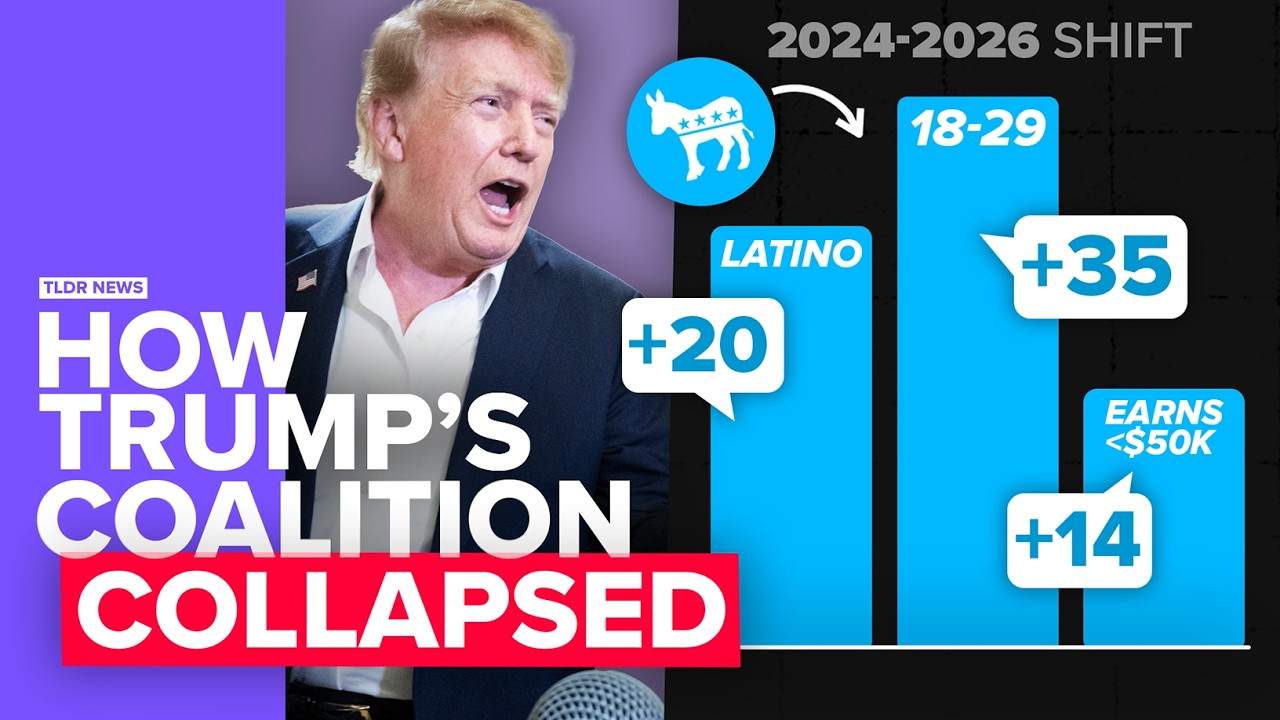
Young voters moved dramatically. Seventy-two percent of 18 to 29-year-olds voted Democratic in these midterms, while only 25 percent voted Republican, an astonishing 47-point margin. That implies a 35-point swing relative to 2024, when the same exit poll gave Kamala Harris just a 12-point margin with this group. For context, 53.5 percent of all voters voted Democratic while 45.5 percent voted Republican, an eight-point margin implying a 9.5-point swing relative to 2024, when Trump won the popular vote by 1.5 points. The pattern formed a clear gradient: the older the voters, the smaller both the margin and the swing. Voters aged 30 to 44 broke 60 to 36 for the Democrats, a 24-point margin and an 18-point swing on 2024. Those aged 45 to 64 broke 51 to 47 for the Democrats, a four-point margin and an 11-point swing. Voters over 65 actually broke 51 to 48 for the GOP, a three-point margin against the Democrats and a three-point swing toward the GOP relative to 2024.
Income showed a similar gradient. Voters earning under $50,000 broke 56 to 41 for the Democrats, a 15-point margin and a remarkable 14-point swing on 2024. Those earning between $50,000 and $100,000 broke 53 to 46 for the Democrats, a seven-point margin and an 11-point swing. Those earning over $100,000 broke 54 to 44 for the Democrats, a 10-point margin but only a two-point swing. This is broadly consistent with the state of Trump's economy: good for the stock market and thus for richer households, who are more likely to own stocks, but bad on inflation, which tends to hurt lower earners more.
Ethnic minorities swung sharply as well. Seventy percent of Asian voters went Democratic compared to just 29 percent who went Republican, a 41-point margin and a 25-point swing compared to 2024. The overall shift in the black vote was less dramatic at only six points, largely because there was little space to swing, given that black voters voted overwhelmingly Democratic in 2024. There was, however, a more marked shift among black men, who were surprisingly keen on Trump in 2024 but swung back toward the Democrats by 15 points this time. Most notably, Latino voters broke 62 to 35 for the Democrats, a remarkable 27-point margin and a 20-point swing compared to 2024, when Trump fared famously well with Latino voters. Republicans suffered their steepest losses with Latino men specifically, who swung 24 points toward the Democrats.
This is bad news for the Republicans, not only because these groups formed the backbone of Trump's successful 2024 coalition, but also because it implies difficult electoral arithmetic ahead. If the swing in the Latino vote holds even partially, it will become significantly harder for the GOP to hold Texas, where Latinos account for a large and growing share of the population. Without Texas, which accounts for 40 votes in the Electoral College, it becomes far harder to see how a Republican candidate could reach the required 270 votes in a presidential election.
These, then, are the three groups that swung hardest against Trump: young people, low-income people, and minorities, especially men. As readers may have noticed, these are all groups with which Trump over-performed expectations in 2024, prompting speculation that he might be forging an electorally invincible working-class, multiracial coalition for the Republican Party. That thesis has not aged well. More broadly, many voters who swung toward Trump in the last election cycle have since swung back toward the Democrats. A comparison of group-level swings between 2024 and the midterms against the swings between 2020 and 2024 shows a positive, if imperfect, correlation: groups that swung hard toward Trump in 2024 were more likely to swing back in 2026.
From the Democratic perspective, there are two ways to interpret this. One is that post-pandemic Trump was an electoral aberration and that normal order has been restored, with Democrats able to expect continued dominance among minorities and younger voters, as they enjoyed to some extent under Obama. The other is that the severity of these swings suggests voters are now more fickle and less loyal than ever, opening the door to highly volatile politics in the near future. For the moment, however, things look very good for the Democrats. They have assembled a remarkably wide electoral coalition and reduced Trump to a lame duck.
Related Coverage
Democrats Sweep Both Chambers as Trump’s Grip on Congress Breaks
Democrats have won control of both the House and the Senate in a historic midterm result, according to live coverage, dealing a major blow to President Donald Trump's hold on Washington.
Democrats Flip Over 40 House Seats, Seize Full Congress in Stunning Rebuke to Trump
Democrats won control of both the House and Senate in Tuesday's midterm elections, flipping more than 40 Republican-held House seats and ending Republican dominance of Congress. The victory sets up a direct collision course with President Donald Trump in the final two years of his term.
Democrats Flip Six Senate Seats, Win House and Senate in 2026 Blue Wave
Democrats won control of both the House of Representatives and the Senate in the 2026 midterm elections, flipping six Senate seats and dealing a major blow to President Donald Trump's power. The result, widely described as a "blue wave," reshaped the balance of power in Washington.
Democrats Flip Over 250 House Seats and Senate in Historic Midterm Wave
Democrats have won control of Congress in the 2026 midterm elections, flipping more than 250 House seats and picking up five Senate seats. The sweeping victory, driven by voter anger over inflation, the Iran war, and tariffs, has Republicans searching for answers and Democrats planning investigations into President Trump.
Democrats Flip 7 Senate Seats, Elect First Muslim Senator and First Texas Democrat in Decades
Democrats won control of both chambers of Congress in a historic midterm wave, flipping seven Republican-held Senate seats and electing a record number of historic firsts.
Democrats Eye Senate Sweep as 58 Million Early Voters Deliver Verdict on Trump
A Democratic wave threatens to strip President Trump of his congressional majority as voters head to the polls in midterm elections widely seen as a referendum on his leadership.
Related Editorials
Blue Tsunami: Democrats Storm House and Senate in Historic Rebuke of Trump
Democrats have seized control of both chambers of Congress in a sweeping midterm victory, delivering a stinging rebuke to Donald Trump and fundamentally reshaping the balance of power in Washington for the remainder of his term. What began as expectations of a modest blue wave became something clos
Why the Democratic Midterm Outlook Is No Longer a Certain Disaster
For much of 2025, the political consensus held that the Democrats were heading into the midterm elections with a structural disadvantage. Economic anxiety, lingering inflation, and historical precedent—where the party holding the White House almost always loses seats—painted a grim picture.
Trump’s Legislative Agenda Faces a Steep Climb: The Math and the Mess
The promise of a sweeping legislative victory for President-elect Donald Trump is colliding with the hard realities of Capitol Hill. While the Republican Party holds a majority in the House of Representatives, that majority is historically narrow.