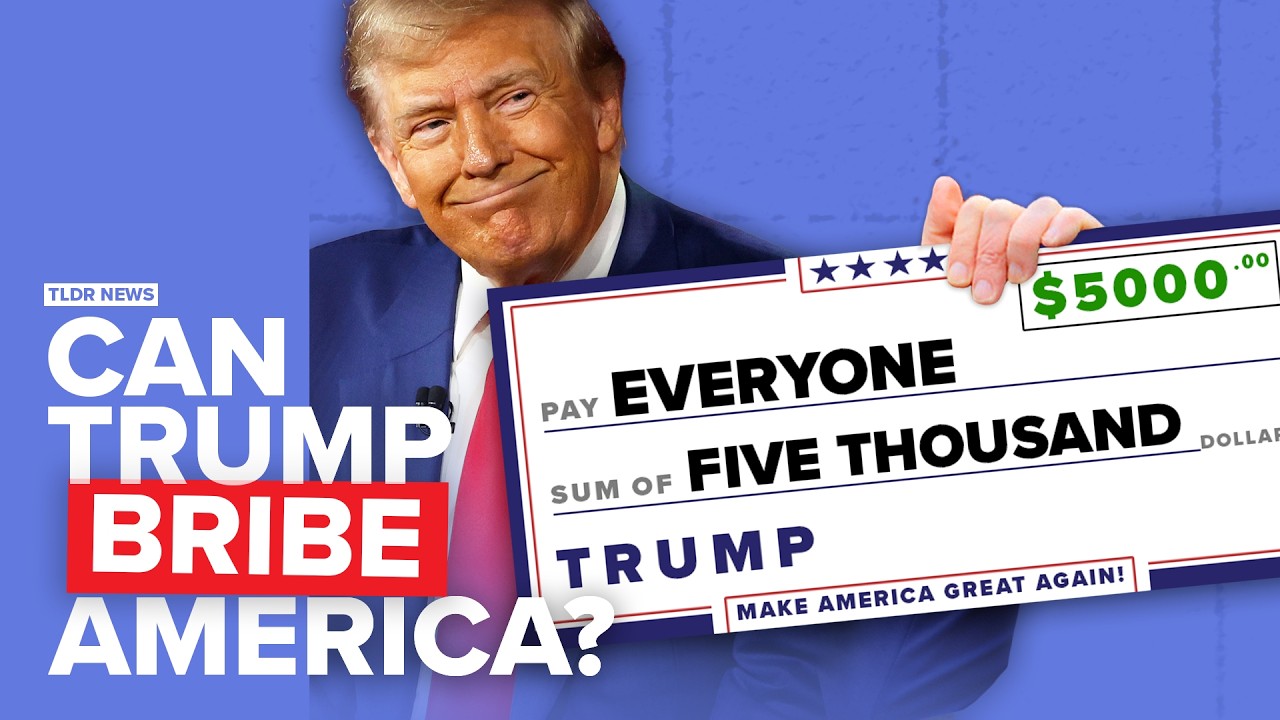
# The $5,000 Question: Can Trump Really Send a Check to Every American?
A proposal to distribute tariff revenue as direct payments raises fundamental questions about presidential power, economic wisdom, and the nature of American governance. --- ## The Proposal A remarkable economic idea has entered the national conversation: using revenue from tariffs to send dire
A proposal to distribute tariff revenue as direct payments raises fundamental questions about presidential power, economic wisdom, and the nature of American governance.
The Proposal
A remarkable economic idea has entered the national conversation: using revenue from tariffs to send direct payments to American citizens. The concept, sometimes framed as a "DOGE dividend" or tariff rebate, raises an intriguing question—could the president simply give everyone $5,000?
The short answer is no. The longer answer reveals important truths about how American government actually works.
Why the President Cannot Write Checks
The Constitution grants Congress, not the president, the power of the purse. Article I, Section 9 states that "no money shall be drawn from the Treasury, but in consequence of appropriations made by law." This means any federal spending must be authorized by Congress through legislation.
A president cannot independently decide to distribute federal funds to citizens. Even if tariff revenue arrives in government accounts, those dollars do not become the president's personal discretionary fund. They flow into the Treasury, subject to congressional appropriation.
This is not a partisan observation—it is a structural feature of American governance designed to prevent exactly this kind of unilateral action.
The Mechanics of Tariffs
Tariffs are taxes on imported goods, paid by American importers, not by foreign governments. When a tariff is imposed, the importing company pays the duty to Customs and Border Protection. That revenue goes to the federal Treasury.
The economic incidence of tariffs—who ultimately bears the cost—depends on market conditions. In many cases, importers pass costs to consumers through higher prices. In others, foreign exporters reduce prices to remain competitive. The burden is shared, though economists generally agree that domestic consumers bear a significant portion.
The Math Problem
Consider the numbers. If the United States collected $100 billion in tariff revenue and distributed it equally among approximately 260 million adults, each would receive roughly $385—not $5,000. To provide $5,000 per adult would require $1.3 trillion, far exceeding realistic tariff projections.
Even optimistic estimates of tariff revenue fall dramatically short of funding such payments. The proposal's arithmetic does not work at the stated scale.
Economic Implications
Direct payments funded by tariffs would represent a significant fiscal intervention. Economists across the political spectrum have raised concerns:
Inflationary pressure: Injecting trillions into the economy while supply chains face disruption from tariffs could accelerate price increases.
Trade retaliation: Major trading partners would likely respond with their own tariffs, harming American exporters and workers.
Fiscal sustainability: Using temporary tariff revenue for permanent or recurring payments creates structural deficits when trade patterns shift.
Distributional effects: Tariffs function as regressive taxes, disproportionately affecting lower-income households who spend larger portions of income on goods. A flat payment might offset this for some, but the net effect varies by consumption patterns.
The Political Reality
Even if constitutionally permissible, such a proposal would require congressional approval. The House of Representatives originates spending bills, and the Senate must concur. A president cannot bypass this process through executive order or agency action.
Some have suggested the president could declare a national emergency to redirect funds. This misunderstands emergency powers. While the executive branch has limited authority to reallocate certain appropriated funds during genuine emergencies, it cannot create new payment programs or seize tariff revenue for unauthorized purposes. Courts have consistently rejected expansive interpretations of emergency authority.
What Is Actually Possible
Congress could, if it chose, pass legislation creating a tariff rebate program. Such a law would specify eligibility, payment amounts, and funding mechanisms. It would face normal legislative hurdles: committee review, floor votes, and potential filibuster in the Senate.
Alternatively, Congress could adjust tax rates or credits to return revenue to citizens. This approach would be more administratively straightforward but still requires legislation.
The Broader Debate
The proposal touches on legitimate policy questions. Should tariff revenue fund specific programs, reduce the deficit, or return to citizens? How should the government balance trade protection with consumer costs? What is the appropriate role of direct transfers in American social policy?
These are debates worth having. But they must occur within constitutional boundaries and with honest accounting of costs and consequences.
Conclusion
The idea of a $5,000 check from tariff revenue is constitutionally impossible as described and mathematically implausible even if legal barriers were removed. The president cannot unilaterally distribute federal funds, and tariff revenue cannot support payments at that scale.
This does not mean the underlying questions are unimportant. It means that serious policy proposals require serious mechanisms—legislation, appropriation, and democratic deliberation. The Constitution's separation of powers exists precisely to ensure that major economic interventions receive careful consideration rather than unilateral action.
For now, Americans should expect no $5,000 check. They should expect instead the ongoing, messy, essential work of representative government.
Related Coverage
Trump’s $5,000 Check Promise: 55 Days to Save His Agenda
Trump is betting big on the midterms, promising cash to every American adult while warning of doom if Republicans lose Congress.
Trump Hijacks America's 250th Birthday as 185 Million Swelter in Record Heatwave
The United States marks its 250th anniversary of independence on Saturday under extreme heat and deep political division, with President Donald Trump taking center stage at celebrations while critics accuse him of turning the milestone into a personal tribute and a record heatwave disrupts events nationwide.
Supreme Court Hands Trump Power to Fire Regulators, Overturning 90-Year Precedent – But Protects Fed Chief
In a landmark decision, the U.S. Supreme Court has ruled that President Donald Trump can fire the heads of most independent federal agencies at will, overturning a 1935 legal precedent that had shielded them from political dismissal. However, the court carved out a major exception by protecting the independence of the Federal Reserve, blocking Trump from firing Fed Governor Lisa Cook.
Trump’s Honduras Aid Threat: A Cash-for-Votes Shakedown
Donald Trump has openly threatened to cut U.S. aid to Honduras unless his preferred candidate wins the country’s presidential election, turning a foreign democratic process into a direct financial transaction [12511].
Related Editorials
Title: Is Trump’s Trade War a Prelude to Economic Annexation of Canada?
The recent escalation in US-Canada trade relations has raised a provocative question: is the Trump administration’s tariff strategy a calculated economic maneuver aimed at undermining Canadian sovereignty? While official statements cite border security and trade imbalances, the broader implications
The Hidden Flaw in How Economists Define Your Income
What is income? It seems like a simple question.
Title: Žižek’s Provocative Question: Is Trump a “Secret Stalinist”?
Introduction In a recent short-form video, the Slovenian philosopher Slavoj Žižek posed a deliberately provocative question that cuts through the noise of contemporary political analysis: Is Donald Trump a secret Stalinist? While the question is designed to shock, Žižek’s argument is less about
# The Tariff Paradox: Why Trump’s Trade War Exposes the True Limits of Government Power
When a head of state launches a trade war, the assumption is simple: the government, with all its authority, can dictate economic outcomes. Yet, the unfolding reality of President Donald Trump’s aggressive tariff campaign has revealed a counterintuitive truth.
# Does Andy Burnham Understand Economics? A Critical Look at the Mayor’s Fiscal Vision
By an Expert Editor, International Policy Review The question sounds almost impertinent: does a successful mayor, a former cabinet minister, understand the basic principles of economics? Yet, when Andy Burnham, the Mayor of Greater Manchester, recently laid out his vision for the region’s finan
# Will Trump’s Escalation with Iran Trigger a UK Housing Market Crash?
The connection between geopolitical tensions in the Middle East and the value of a semi-detached house in Manchester may seem tenuous. Yet, as President Donald Trump intensifies his administration’s stance toward Iran, a growing number of analysts are asking a pointed question: could a military con