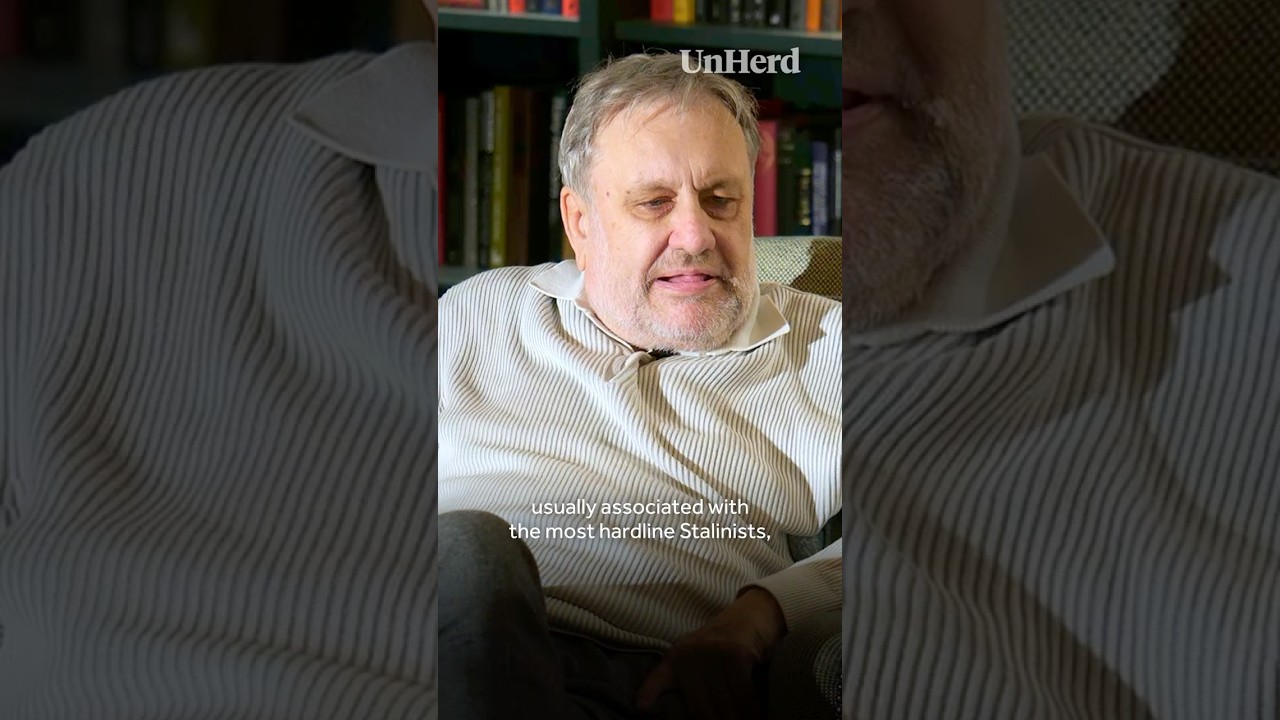
Žižek’s Provocative Question: Is Trump a “Secret Stalinist”?
In a recent short-form video, the Slovenian philosopher Slavoj Žižek posed a deliberately provocative question that cuts through the noise of contemporary political analysis: Is Donald Trump a secret Stalinist? While the question is designed to shock, Žižek’s argument is less about historical equiv
In a recent short-form video, the Slovenian philosopher Slavoj Žižek posed a deliberately provocative question that cuts through the noise of contemporary political analysis: Is Donald Trump a secret Stalinist? While the question is designed to shock, Žižek’s argument is less about historical equivalence and more about the structural logic of power. By stripping away the surface-level chaos of Trump’s rhetoric, Žižek forces us to examine the uncomfortable parallels between populist authoritarianism and the mechanics of totalitarian rule.
The Core Argument
Žižek does not suggest that Trump is a communist or that he has any ideological affinity with the Soviet leader. Instead, his comparison hinges on a specific, narrow definition of Stalinism: the use of constant, unpredictable purges to maintain absolute personal loyalty. In this model, ideology is secondary; the primary goal is the survival of the leader’s power through a climate of fear and instability.
Under this lens, Žižek argues that Trump’s management style—characterized by rapid cabinet turnovers, public humiliations of former allies, and the strategic leaking of information to destabilize rivals—mirrors the Stalinist tactic of keeping subordinates in a state of perpetual insecurity. The goal is not to build a stable state apparatus, but to ensure that no single figure ever accumulates enough independent authority to challenge the leader.
The Mechanics of Instability
The philosopher highlights a crucial distinction between a traditional autocrat and a "secret Stalinist" in this sense. A classic dictator consolidates power by creating a rigid hierarchy. A Stalinist, by contrast, thrives on dissolving that hierarchy. By constantly shifting the lines of loyalty and punishing even loyalists for minor infractions, the leader ensures that all power flows directly to the top.
Žižek suggests that Trump’s apparent disorganization is not a bug but a feature. The chaos is a tool. When advisors never know if they are in favor or out of favor, they become more reliant on the leader’s immediate whims than on institutional norms or legal constraints. This creates a personalized form of rule that bypasses the traditional checks of a democratic system.
A Structural, Not Historical, Comparison
It is vital to note that Žižek is not drawing a moral equivalence between the Gulag and the White House. He is using the term "Stalinist" as a heuristic device—a conceptual tool to illuminate a specific dynamic. The violence is incomparable, and the historical contexts are radically different.
The point is structural. In both cases, we see a leader who prefers a "divide and conquer" approach to governance. By fostering an environment of paranoia and competition, the leader prevents the formation of any coalition that could oppose him. This is a strategy of power for power’s sake, devoid of a coherent political project beyond the maintenance of that power.
Conclusion
Žižek’s provocation is not a claim about Trump’s secret reading list, but a warning about the seductive logic of strongman rule. The question forces us to look beyond the policy debates and ask a deeper question: What happens to a political system when the leader views the state apparatus not as an institution to serve, but as a personal fiefdom to be managed through perpetual destabilization?
By invoking the specter of Stalinism, Žižek challenges us to recognize that the erosion of democratic norms does not always look like a military coup. Sometimes, it looks like a chaotic reality show where loyalty is the only currency, and yesterday’s hero is today’s traitor. In that specific, structural sense, the question is not as absurd as it first appears.
Related Editorials
Title: Žižek’s Provocation: Is Elon Musk an Unwitting Communist?
Slavoj Žižek, the Slovenian philosopher known for his provocative cultural critiques, has thrown a rhetorical grenade into the tech world. In a recent short video, he suggests that Elon Musk, the billionaire CEO of Tesla and SpaceX, might be functioning as a communist—albeit in a way that defies tr
Why I Am a Communist: Slavoj Žižek’s Unsettling Case for a Radical Idea
In a world where communism is often dismissed as a failed ideology of the past, philosopher Slavoj Žižek offers a provocative defense. Speaking in a concise video, he argues that communism remains the only coherent response to the systemic crises of capitalism—not as a nostalgic dream, but as a pra
The $5,000 Question: Can Trump Really Send a Check to Every American?
A proposal to distribute tariff revenue as direct payments raises fundamental questions about presidential power, economic wisdom, and the nature of American governance. --- The Proposal A remarkable economic idea has entered the national conversation: using revenue from tariffs to send direct paym
Why One Political Candidate Calls for a “French Revolution” in Britain
In a provocative statement that has sparked debate, political candidate Stella Tsantekidou has argued that Britain needs a radical overhaul reminiscent of the French Revolution. Speaking in a recent video, Tsantekidou did not call for literal guillotines or regicide, but rather a fundamental restru
Will Trump’s Escalation with Iran Trigger a UK Housing Market Crash?
The connection between geopolitical tensions in the Middle East and the value of a semi-detached house in Manchester may seem tenuous. Yet, as President Donald Trump intensifies his administration’s stance toward Iran, a growing number of analysts are asking a pointed question: could a military con