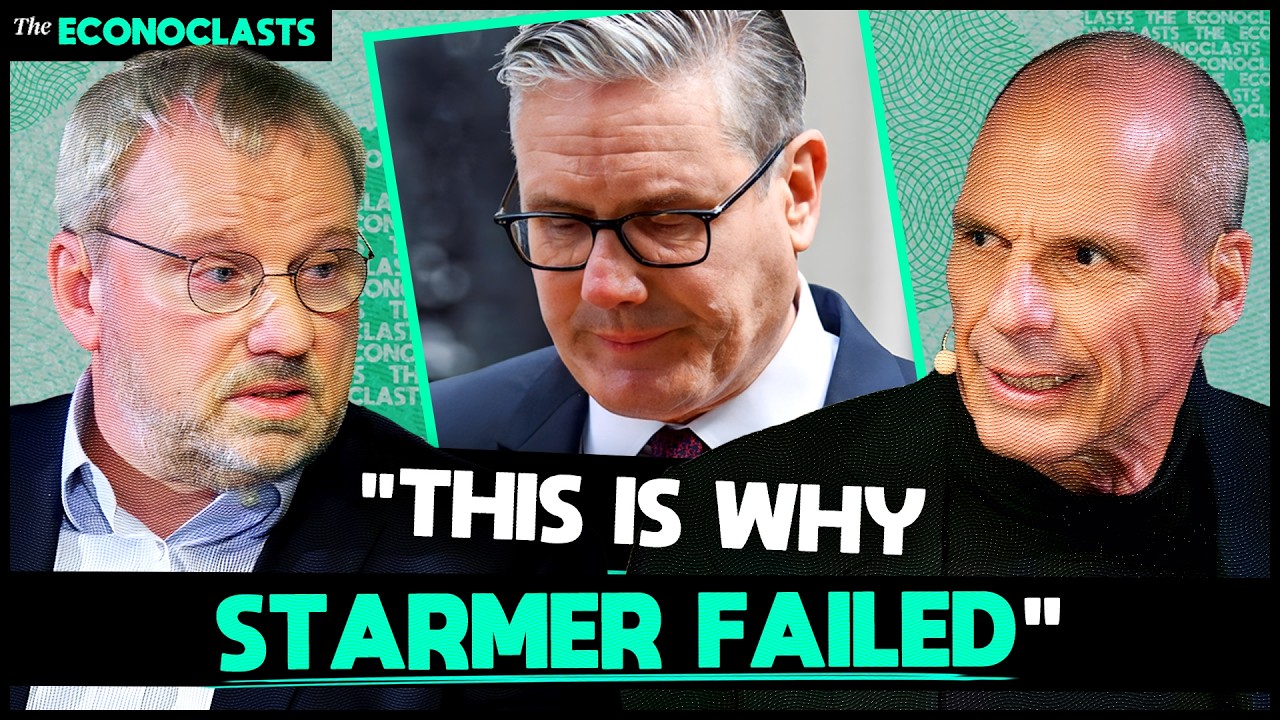
Keir Starmer’s Resignation: The Vacuum, the Right, and the Road to Realignment
In a political landscape already fracturing under the weight of austerity and stagnation, the resignation of UK Labour leader Keir Starmer marks a pivotal moment. But as economists Yanis Varoufakis and Wolfgang Münchau argue in a recent episode of *The Econoclasts*, the departure is less a solution
In a political landscape already fracturing under the weight of austerity and stagnation, the resignation of UK Labour leader Keir Starmer marks a pivotal moment. But as economists Yanis Varoufakis and Wolfgang Münchau argue in a recent episode of The Econoclasts, the departure is less a solution and more a symptom of a deeper crisis: the collapse of the centrist project and the rise of a dangerous political vacuum.
Starmer’s tenure, defined by a strategy of cautious opposition and internal party discipline, failed to offer a compelling alternative to the Conservative government. According to Varoufakis, this was not a personal failure but a structural one. The Labour Party, he argues, has become a “hollowed-out vessel” that abandoned its working-class base in pursuit of a mythical “center ground.” Münchau agrees, noting that Starmer’s focus on fiscal responsibility and managerial competence left the field wide open for populist movements on the right.
The immediate consequence, the economists predict, is a power vacuum. Without a credible left-of-center force, disaffected voters—especially those in deindustrialized towns and struggling rural areas—will turn to the Reform Party or a resurgent, more radical Conservative faction. “The center is not holding,” Münchau states. “What we are seeing is a realignment, not a return to normal politics.”
Varoufakis points to a specific mechanism: the “scissors crisis” of the working class. As real wages stagnate and public services deteriorate, both the traditional Labour voter and the former Conservative voter find themselves in the same economic predicament. The only difference is cultural identity. The right, he warns, is far better at exploiting this cultural anxiety than the left is at offering economic solidarity.
The article’s most striking argument is that Starmer’s resignation will not lead to a progressive revival. Instead, it opens the door for a more aggressive, anti-establishment conservatism. The next leader of the Labour Party will inherit a party without a clear ideology, a shrinking membership, and a public that no longer believes in the traditional social contract.
Münchau concludes with a sobering forecast: “We are entering a period of political volatility where the old rules no longer apply. The question is not whether the right will win, but which faction of the right will dominate.”
For readers unfamiliar with the dynamics, the core takeaway is this: Starmer’s departure is not a reset button. It is a signal that the political center, in the UK and across much of Europe, has collapsed under its own contradictions. The future belongs not to moderates, but to those who can harness the anger of a generation left behind by globalization and austerity.
Related Coverage
Russia Fires Top Economist Who Warned War Effort Is Unsustainable — Kremlin Cracks Show as Election Nears
A senior Russian economist has been fired after warning the Kremlin that the country cannot sustain a prolonged war with Ukraine, while a Swedish TV host’s on-air slip has become a national story about political masks falling on election night.
Power, Profit, and a Planet in Peril: How War, Debt, and Climate Collapse Are Reshaping Global Politics
The global order is buckling under the weight of converging crises, where the pursuit of geopolitical power and corporate profit is colliding with fundamental human needs. From the closed oil routes of the Strait of Hormuz and the escalating aerial war in Ukraine to drought-parched rivers across Europe and famine-stricken regions of Africa, a cascade of interconnected emergencies is diverting public resources away from social welfare and toward conflict, leaving the world's most vulnerable populations to bear the heaviest burden of inflation, displacement, and violence [15692][15698].
# Power, Profit, and a Planet in Peril: How Financial Warfare, Climate Collapse, and the AI Boom Are Reshaping Global Politics
The global order is buckling under the weight of converging crises, where the pursuit of geopolitical power and corporate profit is colliding with fundamental human needs. From the closed oil routes of the Strait of Hormuz and the escalating aerial war in Ukraine to drought-parched rivers across Europe and famine-stricken regions of Africa, a cascade of emergencies is diverting public resources away from social welfare and toward conflict, leaving the world's most vulnerable populations to bear the heaviest burden of inflation, displacement, and violence [1][2].
Power, Profit, and a Planet in Peril: How Conflict and Financial Warfare Are Reshaping Global Politics
The global order is buckling under the weight of converging crises, where the pursuit of geopolitical power and corporate profit is colliding with fundamental human needs. From the closed oil routes of the Strait of Hormuz and the escalating aerial war in Ukraine to drought-parched rivers across Europe and famine-stricken regions of Africa, a cascade of interconnected emergencies is diverting public resources away from social welfare and toward conflict, leaving the world's most vulnerable populations to bear the heaviest burden of inflation, displacement, and violence [1][2].
Spain’s Sumar Party Implodes: Two Top Leaders Resign, Accusing Chief of Harassment and Fraud Ahead of July Congress
Spain’s left-wing Movimiento Sumar party is in deep crisis after its secretary of Organization and communications secretary both resigned, publicly accusing party coordinator Lara Hernández of workplace harassment and fraud in internal voting.
Global Politics in Crisis: War, Migration, and Economic Strain Reshape a Fractured World Order
From the battlefields of Ukraine to the borders of Europe and the polling stations of Africa, this week’s developments paint a picture of a global system buckling under the weight of conflict, climate stress, and economic inequality. Old alliances are fraying, new pacts are forming, and ordinary citizens are bearing the brunt of decisions made by political and financial elites. The convergence of these crises reveals a world where the pursuit of geopolitical power and corporate profit increasingly collides with fundamental human needs and rights.
Related Editorials
Europe’s Economic Doom Loop: Why Brussels Has Lost the Wheel
Europe’s economic engine is sputtering, and according to two of the continent’s most prominent economic voices, the drivers in Brussels have lost control of the vehicle. In a recent discussion, former Greek Finance Minister Yanis Varoufakis and Financial Times columnist Wolfgang Münchau painted a s
Europe’s Decline is Now Official: The Continent Has Lost Its Economic Soul
In a rare moment of bipartisan agreement, two of Europe’s most astute economic minds—Yanis Varoufakis, the former Greek Finance Minister, and Wolfgang Münchau, a veteran financial journalist and co-founder of *The Econoclasts*—have declared the end of an era. The evidence, they argue, is no longer
Germany Has Just Hit the Point of No Return
In a stark and urgent analysis, economist Yanis Varoufakis and journalist Wolfgang Münchau argue that Germany’s economic model has reached a critical juncture—a “point of no return. ” The conversation, hosted on *The Econoclasts*, dissects the structural collapse of the German economy, moving beyond
Germany’s Economic Model Is Broken—and There’s No Going Back
Germany, long celebrated as Europe’s economic engine, is now facing a crisis that its political and financial leaders appear unwilling—or unable—to confront. In a candid discussion, economists Yanis Varoufakis and Wolfgang Münchau dissect the structural failures behind Germany’s stagnation, the Eur
The Blame Game: How Modern Politics Abandoned Solutions for Scapegoats
A growing chorus of analysts argues that Western democracies are trading problem-solving for finger-pointing—and the consequences may be profound. Something has shifted in the machinery of democratic politics.
Germany Just Broke the EU’s Firewall
A conversation between Yanis Varoufakis and Wolfgang Münchau reveals how Berlin’s fiscal about-face is rewriting the rules of Europe—and why the bond markets may be the only referee left. For years, the European Union’s fiscal architecture rested on a simple promise: no member state would be allowe