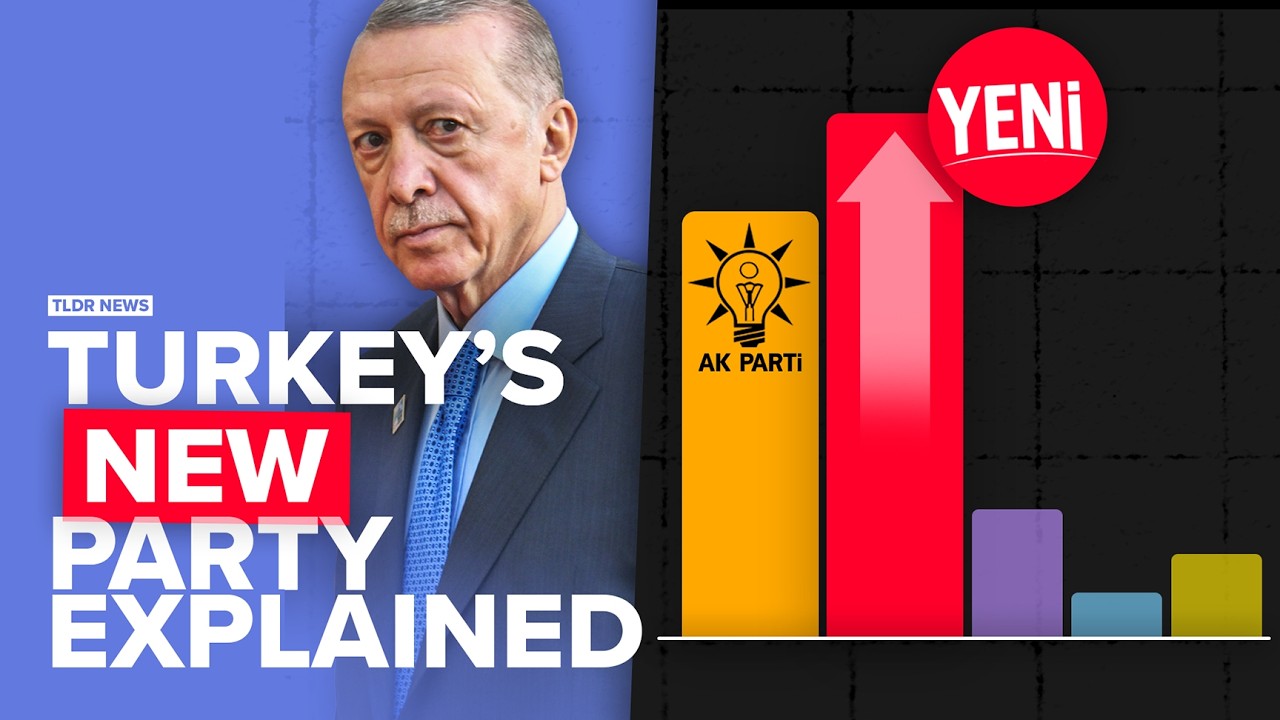
The Ghost of Erdogan’s Rival: Can a New Party Break Turkey’s Political Glass Ceiling?
Article: In Turkish politics, the ruling Justice and Development Party (AKP) has dominated the landscape for over two decades. Yet, a new political entity is attempting to rewrite the rules of engagement.
Article:
In Turkish politics, the ruling Justice and Development Party (AKP) has dominated the landscape for over two decades. Yet, a new political entity is attempting to rewrite the rules of engagement. The formation of a new party, led by a former heavyweight from President Recep Tayyip Erdoğan’s inner circle, has sparked a critical question: Can this movement actually oust the entrenched leader, or is it merely a political mirage?
To understand the stakes, one must first define the challenger. The party in question is the Democracy and Progress Party (DEVA), founded by Ali Babacan. Babacan is no fringe figure; he served as Turkey’s chief economist and deputy prime minister during the AKP’s most prosperous years. His departure from the ruling bloc in 2019 was framed not as a hostile break, but as an attempt to "restore" the economy and democratic institutions he claims have eroded.
The Economic Fault Line
Babacan’s primary ammunition is economic instability. Turkey is currently grappling with a currency crisis and inflation rates that have eroded household purchasing power. Babacan argues that the current administration’s unorthodox monetary policy—specifically, the insistence on low interest rates to combat high inflation—has created a "trust deficit" that scares off foreign investors.
He presents himself as the architect of Turkey’s earlier economic boom, offering a return to orthodox financial management. However, the challenge is substantial: voters have heard promises of recovery before, and the opposition has historically struggled to consolidate votes against Erdoğan’s powerful state machinery and media influence.
The Structural Hurdles
The new party faces a formidable obstacle: the electoral system itself. Turkey’s high electoral threshold requires parties to secure at least 7% of the national vote to enter parliament. For a new movement, this is a steep climb. While DEVA polls in the low single digits, its potential influence lies in coalition-building.
The key to dislodging Erdoğan is not a single party, but a united opposition front. Babacan’s party is part of a six-party "Table of Six" alliance. This coalition shares a common goal: a return to a parliamentary system. They argue that Erdoğan’s executive presidency has concentrated too much power in one office, leading to authoritarian drift.
The Voter Fatigue Factor
Despite the alliance’s unity, analysts remain skeptical about the "ouster" narrative. Erdoğan retains a loyal base that views him as a bulwark against instability. Furthermore, the opposition has yet to articulate a clear, compelling vision beyond "getting rid of Erdogan."
The political calculus suggests that while Babacan’s party may not win the presidency outright, it serves as a critical swing vote. If the alliance can force a second round of voting, they may peel away disaffected AKP voters who are tired of economic hardship but wary of radical change.
The Verdict
Can the new party oust Erdoğan? The short answer is: not alone. The longer answer is that it is a necessary catalyst. Babacan’s party legitimizes the opposition’s economic critique, providing a moderate, pro-business alternative to the more nationalist or leftist factions.
The upcoming elections are less about the rise of a new party and more about the durability of an old leader. If the opposition can translate economic anger into a unified vote, the "ghost" of the AKP’s past may indeed haunt its present. If they fail, the new party becomes another footnote in Turkey’s long history of failed political resurrections. The clock is ticking, and the margin for error is razor-thin.
Related Coverage
Turkey Opposition Figure Demands Legal Action to Speed Up Democracy, as CHP Holds Emergency Talks
Turkey is facing a critical political moment as a leading opposition figure calls for concrete legal steps to accelerate the democratic process, while the main opposition party holds an emergency meeting to assess the rapidly shifting political landscape.
Erdogan’s AK Party Turns 25: A “Historic Transformation” Ends With a Vow for Economic Reboot
Türkiye’s ruling party is celebrating a quarter-century in power, with President Recep Tayyip Erdogan promising a renewed push on the economy, technology, and legal reforms.
Turkey’s Ruling Alliance Cracks Down on Dissent as Opposition Struggles to Respond
Turkey’s ruling AKP-MHP alliance is tightening its grip on the country by turning its ideology into law, leaving opposition groups fragmented and unable to mount a unified response.
Turkey’s DEM Party Sets September Congress, Lawmaker Demands July Vote on Mystery Framework Law
A Turkish political party has announced its next major congress for September, while one of its lawmakers is pushing for a critical vote on a new framework law as early as July.
Turkey Seizes Control of Billion-Dollar Poultry Sector as Opposition Leader Threatens to Split Party
Turkey has appointed a state trustee to oversee the country’s billion-dollar white meat industry, creating uncertainty that could disrupt production and exports, while the leader of the main opposition party announced plans to form a new political group amid deepening internal turmoil.
New Saudi-Turkey-Pakistan Defense Pact Shakes Up Middle East, But Can It Survive First Test?
A new trilateral defense agreement between Saudi Arabia, Turkey, and Pakistan is reshaping regional security, but experts question whether the alliance can hold together under pressure.
Related Editorials
Turkey’s Silent Surge: How Ankara Is Reshaping the Battlefield in Mali
For years, the conflict in Mali has been defined by a complex web of local militias, foreign mercenaries, and shifting jihadi alliances. Yet, a new player has quietly moved to the center of the board, altering the strategic calculus of the Sahel.
Will Trump’s Escalation with Iran Trigger a UK Housing Market Crash?
The connection between geopolitical tensions in the Middle East and the value of a semi-detached house in Manchester may seem tenuous. Yet, as President Donald Trump intensifies his administration’s stance toward Iran, a growing number of analysts are asking a pointed question: could a military con
Can Andy Burnham Rebuild Britain If the OBR Says No?
The United Kingdom faces a fundamental question about its economic future: can a government deliver large-scale national renewal when the country’s independent fiscal watchdog says the numbers don’t add up? Greater Manchester Mayor Andy Burnham believes the answer is yes—but only if Westminster cha
Can Andy Burnham Think Big Enough to Succeed as Prime Minister?
Andy Burnham, the Mayor of Greater Manchester, is frequently cited as a potential future leader of the Labour Party and, by extension, a candidate for Prime Minister. His record, however, presents a complex picture.
Could Turkey and Israel Go to War? The Rising Risk of a New Middle Eastern Conflict
For decades, the relationship between Turkey and Israel has oscillated between strategic partnership and bitter rivalry. Today, that rivalry has reached its most dangerous point in modern history.
Germany Just Broke the EU’s Firewall
A conversation between Yanis Varoufakis and Wolfgang Münchau reveals how Berlin’s fiscal about-face is rewriting the rules of Europe—and why the bond markets may be the only referee left. For years, the European Union’s fiscal architecture rested on a simple promise: no member state would be allowe