Chinese EVs Are Eating Europe’s Lunch: BYD and Geely Hit Record Sales as BMW Cuts 8,000 Jobs
Chinese automakers are posting record sales while Western rivals slash jobs and profits, forcing Europe to confront a painful question: how to compete without closing its market.
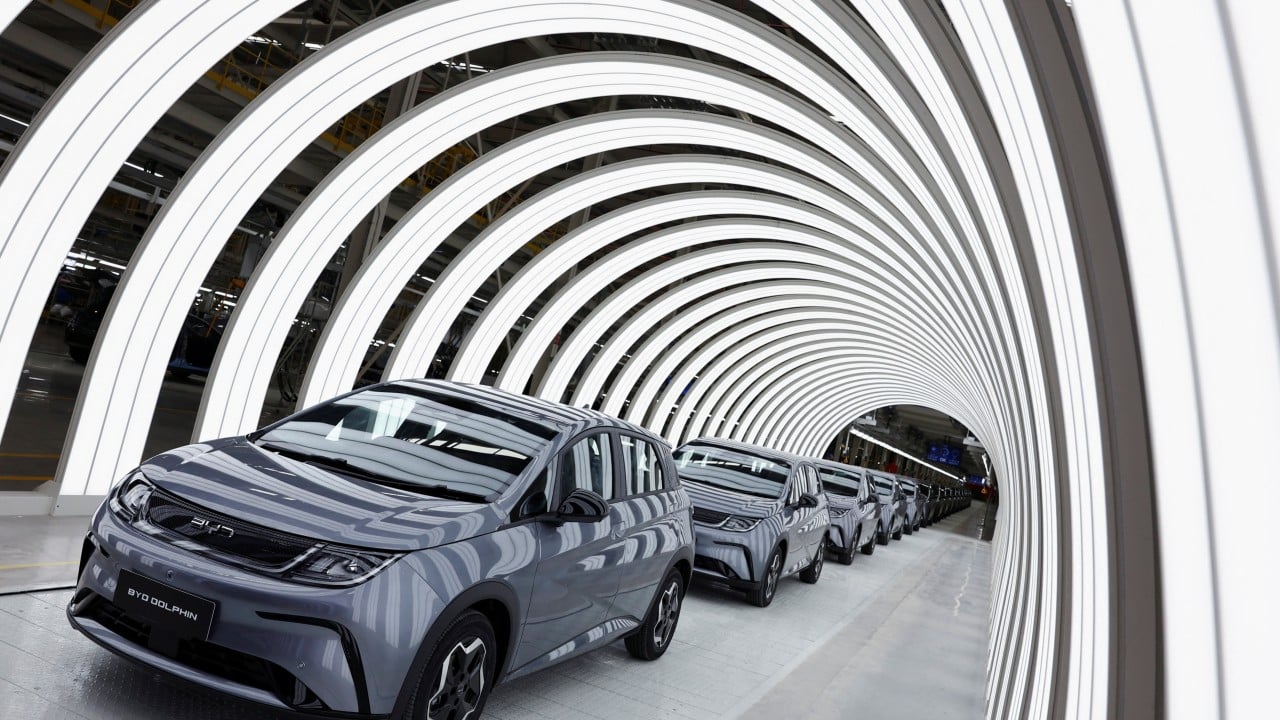
China’s two largest carmakers, BYD and Geely Auto, recorded their strongest monthly sales of the year in October, even as smaller rivals face growing pressure to turn a profit in the world’s largest automotive market [1]. BYD, based in Shenzhen, delivered 490,168 electric vehicles to customers in China and abroad last month — an 11 per cent increase from the same month last year — while Geely, headquartered in Hangzhou, delivered 310,183 petrol and electric cars worldwide during the same period [1].
The surge comes as Western automakers struggle to keep pace. BMW has issued its second profit warning in a year, blaming restructuring costs that include 8,000 job cuts and ongoing competition from China [2]. The German carmaker cut its profit margin forecast to between -0.5% and 0.5% for this year, and it is the latest German automaker to downgrade its outlook after Mercedes-Benz cut its profit forecast the week before [2]. Western carmakers are struggling to compete with lower-cost Chinese rivals, leading to falling sales in China and a rise in Chinese exports to Europe [2].
The pressure is not limited to passenger cars. Chinese manufacturers now have electric trucks ready to roll into Europe at prices significantly lower than their competitors, with the battle shifting to service networks where Western truck makers hold their main advantage [3]. “We are here for the long term and are building a complete ecosystem,” said Stella Li, vice president of China’s BYD [3].
Chinese brands are also making inroads in other vehicle segments. At the 83rd International Two-Wheeler Exhibition in Milan, known as EICMA, one of the world’s largest motorcycle trade shows, Chinese companies displayed a wide range of motorcycles and electric two-wheelers, drawing interest from industry professionals and visitors alike [4]. Their growing presence signals China’s expanding role in the global motorcycle market [4].
In Southeast Asia, the electric vehicle boom risks leaving local companies behind, as Chinese automotive giants bypass local part-makers in favor of imported components and locked-in supplier networks [5]. Local manufacturers across Indonesia, Thailand and Malaysia face a double squeeze: demand is weakening for parts used in petrol and diesel cars, while steep barriers to entry keep them out of the EV supply chain [5].
The region’s shift to electric vehicles is not moving at the same speed everywhere. Japan built its auto industry on gasoline engines and hybrid cars, and its makers moved slowly into fully electric cars, leaving EVs a small share of home sales with limited charging stations and high prices [6]. Thailand took another route, offering tax breaks and subsidies to attract electric car makers and buyers; Chinese brands rushed in and electric sales jumped, but the country’s older supply chains built for gasoline cars now face pressure [6]. Both countries face the same core problem: electrification requires new factories, new skills, and new charging networks — and that costs time and money [6].
Some established players are fighting back. Toyota plans to source more parts inside China to cut costs and speed up development, as the Japanese automaker tries to regain market share in the world’s largest car market [7]. The company said it will deepen local sourcing and design more vehicles around Chinese buyers’ needs, which should lower prices and shorten the time it takes to launch new models [7]. Toyota has lost ground in China to faster-moving local brands, especially in electric vehicles [7].
Chinese automakers have also found a new trend: large, rugged-looking SUVs that combine boxy shapes and high hoods with electrified engines and modern technology [8]. The latest model to join the trend is the GWM Haval H7, now on sale in Spain, offering five engine options including a 435-horsepower plug-in hybrid that accelerates from 0 to 100 km/h in 4.9 seconds [8]. GWM has opened orders in Spain with a promotional price of 28,000 euros for the entry-level self-charging hybrid, with the most affordable plug-in hybrid starting at 29,625 euros [8]. The Haval H7 enters a growing market of Chinese SUVs that attract European buyers with size, equipment, electrification, and competitive prices [8].
Beyond cars, China’s Yutong Bus, the world’s largest electric bus manufacturer, is steadily increasing its overseas shipments as demand grows rapidly in countries including Australia, Malaysia, Saudi Arabia and Morocco [9]. Based in Zhengzhou in central China’s Henan province, the company now earns more than half of its total revenue from overseas sales, with new-energy models — pure-electric and hybrid vehicles — accounting for 25 per cent of its bus exports so far this year [9].
On the trade front, China’s Ministry of Commerce has expressed concern over the European Union’s new measures on low-value imports, which include a €2 fee on shipments starting November 1, following a €3 fee imposed last July [10]. China has also warned the EU not to “fantasise” that a hard line will force Beijing into trade concessions, after the EU confirmed plans for a new “kill switch” mechanism that would allow Brussels to “immediately” remove China from European markets in a trade dispute [11]. Beijing rejected the idea that pressure will make it back down, and the exchange marks a new low in China-EU trade relations [11].
Meanwhile, China’s securities regulator has approved the registration of lithium hydroxide futures and options, allowing traders to buy and sell contracts tied to the price of the key battery material used to make electric vehicle batteries [12]. The approval clears the way for the contracts to be listed, though no launch date has been announced [12].
A growing number of companies in Asia are also making formal pledges to cut their greenhouse gas emissions, with Chinese firms increasingly adopting public climate targets as investors and regulators pay closer attention to environmental performance [13].
---