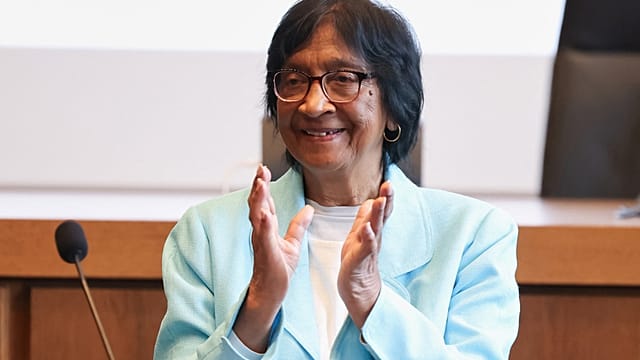
US Slaps Sanctions on International Criminal Court Hours After Its Former Judge Wins Nobel Peace Prize
The White House sanctioned the International Criminal Court just hours after Navi Pillay, a former ICC judge and fierce defender of the court, won the 2026 Nobel Peace Prize. Pillay calls the timing deliberate and the move "shocking."
The Trump administration imposed sweeping sanctions on the International Criminal Court (ICC) on Friday, acting just hours after the Norwegian Nobel Committee awarded the 2026 Nobel Peace Prize to Navi Pillay, a South African jurist and former ICC judge [259116][258421].
Pillay, 85, served on the court's Appeals Chamber from 2003 to 2008. She also presided over the International Criminal Tribunal for Rwanda and served as United Nations High Commissioner for Human Rights from 2008 to 2014 [259116]. The Nobel Committee honored her "for her efforts to promote peace and international law" [259116].
The sanctions target ICC judges involved in investigations of American citizens or allies [259325]. The United States has not signed the ICC treaty and argues the court could unfairly target its citizens [259325].
Pillay said the timing of the sanctions was not an accident [262111]. Speaking via video link from Nuremberg, Germany, at an event at the Nobel Peace Center in Oslo, she described the impact on court staff.
"There are hundreds of employees who feel threatened. Some of the employees from the US have quit," she said. "But most importantly, one country has declared sanctions against judges only because of the legal orders they issue. This is unheard of and unacceptable" [259128].
She called the move "shocking" and said it undermines the court's independence and threatens global justice efforts [259325]. She urged world governments to act together to protect the ICC [261264].
The Nobel Committee warned that "the international legal system is under enormous pressure and its institutions are being attacked" [260049]. The committee noted the world is turning toward "power politics at the expense of legal frameworks and global respect for law and justice" [260049].
Pillay dedicated the prize to survivors of international crimes and called on people to stand together in defense of the rule of law [258939]. Her response to being praised for courage was simple: "Why would it take courage to tell the truth?" [260049].
Her career began during South African apartheid, defending political prisoners. In 1995, she became the first woman of color appointed as a judge on South Africa's High Court [260049]. She later helped establish that rape can constitute genocide through her work at the Rwanda tribunal [260049].
Most recently, she chaired the UN Commission of Inquiry on the Occupied Palestinian Territory, which found "reasonable grounds" to conclude Israel was committing genocide in Gaza [260049]. Her work drew strong criticism from Israel [258421].
The decision to award her the prize has ignited debate about her legacy and the prize itself. Rosa Freedman, Professor of Law at the University of Reading, said Pillay's career represents a remarkable contribution to international law and human rights, but noted her legacy raises difficult questions about political impartiality, particularly in relation to Israel and Gaza [258927].
Freedman said the debate invites examination of whether the prize recognizes individual merit or increasingly serves as a vehicle for political messaging [258927].
The sanctions also targeted UN Special Rapporteur Francesca Albanese and nine ICC judges [260049]. ICC judges involved in investigations of American citizens or allies were specifically targeted [259325].