Justice or Power? Nobel Winner Navi Pillay Says Telling the Truth Now Takes Courage
Part of composite article US Slaps Sanctions on International Criminal Court Hours After Its Former Judge Wins Nobel Peace Prize View full article →
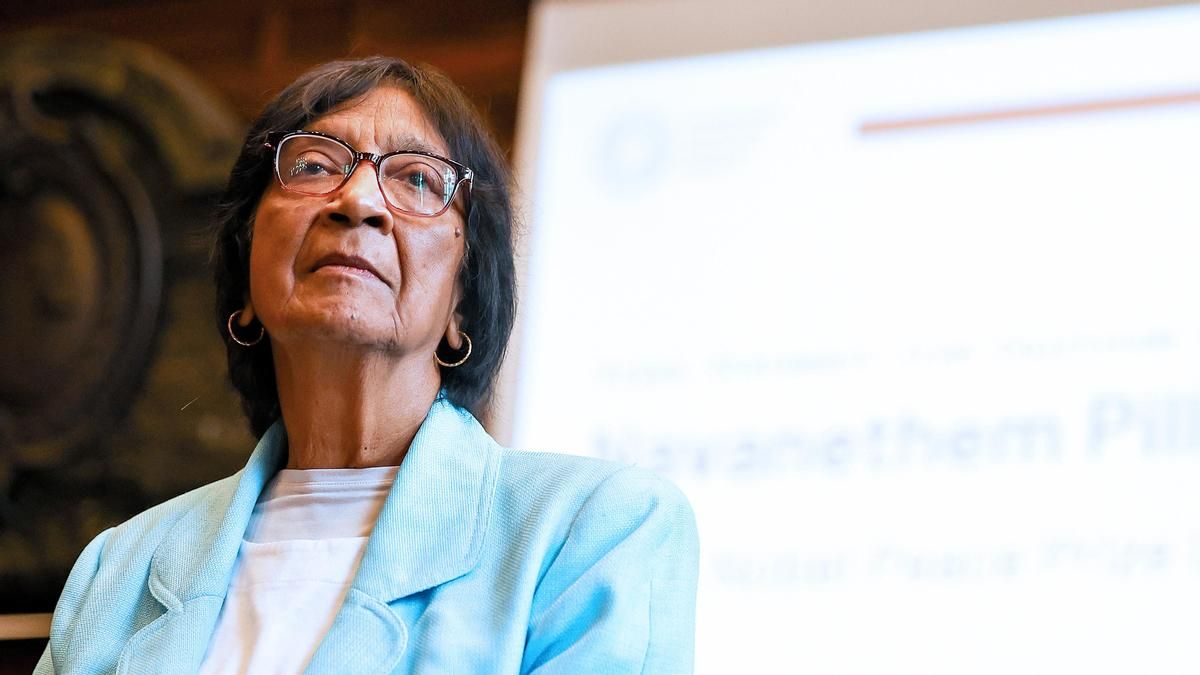
When Navi Pillay received the 2026 Nobel Peace Prize, she was praised for her courage. Her response was simple: "Why would it take courage to tell the truth?"
Pillay, a renowned international jurist, made this statement after leading the United Nations expert group that accused Israel of genocide in Gaza. The Nobel Committee honored her, but also warned that "the international legal system is under enormous pressure and its institutions are being attacked."
**A Life Fighting for Justice**
Pillay's career began during South African apartheid, defending political prisoners. In 1995, she became the first woman of color appointed as a judge on South Africa's High Court.
She later served as a judge and president of the International Criminal Tribunal for Rwanda, where she helped establish that rape can constitute genocide. She went on to serve on the International Criminal Court and as UN High Commissioner for Human Rights.
Most recently, she chaired the UN Commission of Inquiry on the Occupied Palestinian Territory. Under her leadership, the Commission found "reasonable grounds" to conclude Israel was committing genocide in Gaza. She currently serves as an ad hoc judge at the International Court of Justice in a genocide case against Myanmar.
**The Truth Is Now Dangerous**
Pillay assumed that speaking truth to power should not require bravery. But in 2026, it does.
Journalists reporting from Gaza risk their lives. In established democracies, solidarity with Palestine is being criminalized. Professors and students face institutional retaliation. People lose jobs and funding for their political speech.
Even those once considered protected are now targets. UN Special Rapporteur Francesca Albanese and nine ICC judges were sanctioned by the Trump administration.
**A Global Attack on International Law**
This crackdown reflects a broader trend: the normalization of grave human rights violations, including genocide, and open contempt for international law.
UN Security Council resolutions now treat equal rights to self-determination as a privilege to be earned. "Peace plans" legitimize taking territory by force. International institutions built to defend these norms face unprecedented attacks.
Vladimir Putin, Benjamin Netanyahu, and Omar al-Bashir, all wanted by the International Criminal Court, continue traveling the world despite arrest warrants. Europe's silence, and sometimes complicity, is deafening. Arms sales and economic ties with Israel continue largely unchecked, even after the ICJ warned of plausible genocide risk.
**Questioning Law Itself**
What alarms people today is not just rule-breaking. It is a direct attack on the very need for international law.
Trump has said: "I don't need international law," claiming he is limited only by "my own morality." European Commission President Ursula von der Leyen said the rules-based order belongs to "a world that has disappeared and will not return."
For many peoples, including Palestinians, Sahrawis, and indigenous groups, selective law enforcement is nothing new. They have long experienced law as a tool of domination. Yet they still believe international law can be a framework for justice.
**Truth as Resistance**
The Nobel Committee noted that the world is turning toward "power politics at the expense of legal frameworks and global respect for law and justice."
Speaking truth to power is no longer just courage. It is resistance. Pillay never yielded to pressure. May she continue to inspire generations of jurists.