Denmark Warns Russia Could Attack NATO Within Months as Hybrid War Fears Spike Across Europe
Denmark's military intelligence service says Russia may launch a limited military attack on a NATO country within months, while warning that hybrid attacks including sabotage and cyber strikes are already escalating across Europe.
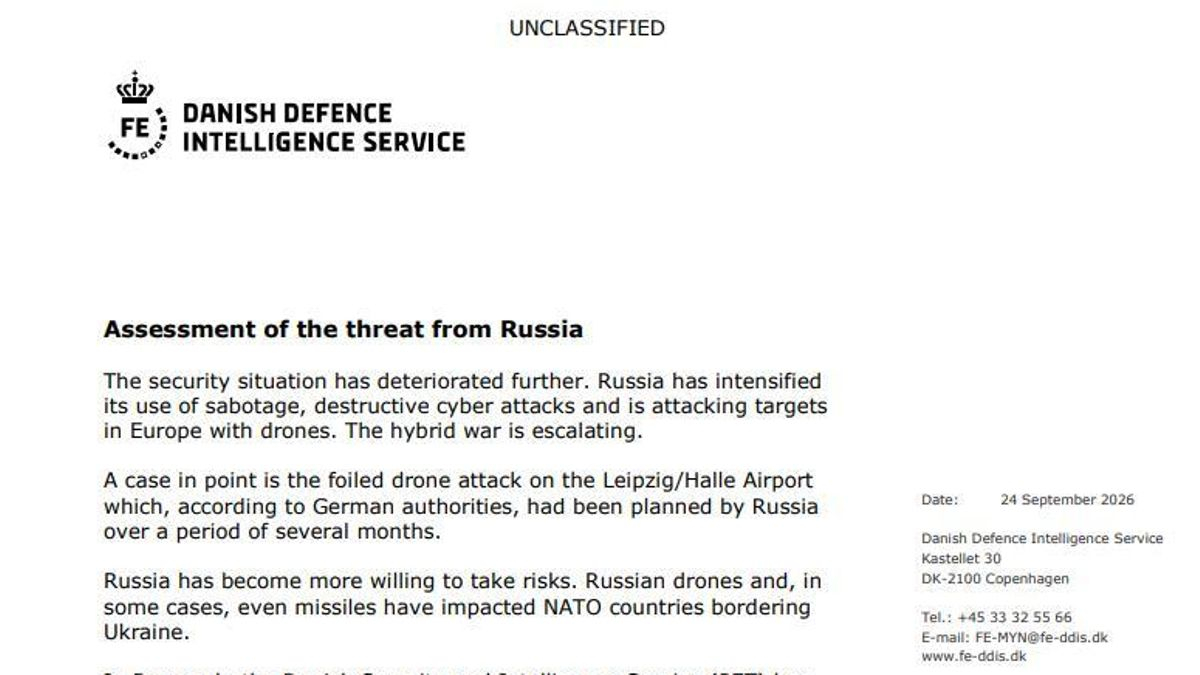
Denmark's military intelligence service has warned that Russia could carry out a limited military attack on a NATO country within months, as spy agencies across Europe raise alarms about escalating hybrid warfare. The Danish Defense Intelligence Service (FE) said in its annual assessment that Russia will intensify "hybrid attacks" against Western countries and NATO members, with these attacks becoming more frequent and causing "greater consequences" than before [249305].
The agency warned of "destructive cyberattacks that paralyze critical social functions, as well as acts of sabotage that carry a high risk of causing casualties" [249305]. Hybrid attacks refer to actions that fall below the threshold of open military conflict, such as cyberattacks, sabotage, and disinformation campaigns.
FE chief Thomas Ahrenkiel told a press conference: "It is unlikely that Russia will launch a real invasion of a NATO country, but we can no longer rule it out" [249305]. The report cites a "growing" but still "low" risk that Russia will carry out limited military attacks against NATO countries, especially those sharing a border with Russia. Such an attack would aim to divert European resources meant to support Ukraine and sow division within NATO if the alliance fails to agree on a collective response [249305].
Separately, the Danish Agency for Security announced it has raised its threat level for a destructive cyberattack from medium to high. "Russia is waging a hybrid war against the West and is taking increasing risks. That is why we have raised the threat level," the agency said in a statement [249305]. The Danish Security and Intelligence Service (PET) also warns of increased Russian espionage, sabotage, and influence campaigns [249470].
A Czech intelligence chief has similarly warned that Russia may attempt a limited incursion into NATO territory within months, though Baltic counterparts urged calm and warned against panic and overreaction [246180].
Polish Prime Minister Donald Tusk said Russia may plan "accidental" drone strikes on NATO countries, warning the tactic could test NATO's response by seeing if the alliance acts when an attack looks like a mistake [245213]. A Washington think tank, the Institute for the Study of War, has linked three separate incidents in Eastern Europe as part of one Russian campaign: drone crashes in Moldova and Romania, a fire at a Starlink station in Poland, and a shutdown at a Berlin airport [249853]. Starlink is a satellite internet service owned by Elon Musk's company SpaceX.
Russia may also launch drone attacks on southern Europe from merchant ships, according to a report by the Spanish newspaper El Mundo. The drones carry small explosive payloads that could temporarily close airports or ports without causing widespread destruction [249869]. French President Emmanuel Macron denied a report that the United States Central Intelligence Agency had warned European governments of possible Russian drone attacks from the Mediterranean [249169].
Estonia's foreign minister said intelligence shows no Russian military buildup for an invasion of NATO territory, despite growing concerns over hybrid attacks [249758].
Lithuania's Prime Minister Mindaugas Sinkevicius said his country is ready to "fight back" if Russia attacks, adding that Lithuanians feel "constantly threatened" by Moscow. He also said Lithuania has evacuation plans in place [248293]. In a separate interview, Sinkevicius said Lithuania faces threats from Russia and Belarus and called for stronger NATO air defense, warning that military spending by itself cannot guarantee security [249898].
Meanwhile, Czech Prime Minister Andrej Babis said his country will not increase defense spending faster, despite pressure from the United States and NATO. Babis reaffirmed the importance of NATO for Czechia but said Prague cannot afford to raise its military budget more quickly [249919].