Fresh Water Is Running Out: 12 Trillion Tons of Ice Gone as Rivers and Lakes Shrink Worldwide
The world's freshwater supplies are shrinking fast, with glaciers melting and underground reserves declining across many regions. Scientists warn this threatens drinking water, farming, and energy production for billions of people.
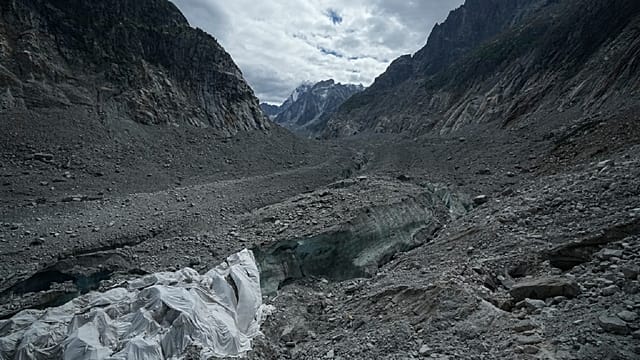
The world's fresh water is drying up, and climate change is the main reason. The World Meteorological Organization (WMO), a United Nations agency that tracks weather and climate, released a new report showing that rivers, lakes, and underground water reserves have declined in many regions [1][2]. Glaciers are also melting faster than before [2].
Freshwater storage means the water kept in rivers, lakes, soil, and underground reservoirs. Glaciers are large masses of slow-moving ice that store water and release it over time [2]. The WMO warns that these changes threaten water supplies for drinking, farming, and energy production [2]. The agency is calling for better monitoring and stronger action to protect the world's water resources [2].
The crisis goes beyond shrinking lakes and rivers. Scientists report that more than 12 trillion tons of ice have disappeared from the polar regions as climate change speeds up melting [3]. This loss directly affects global sea levels. According to scientists, every single centimeter of sea-level rise puts another two to three million people at risk of annual coastal flooding [3].
In Nepal, the consequences turned deadly. A new scientific report confirms that human-caused climate change played a decisive role in the catastrophic rock and ice collapse that struck northern Nepal last month, killing hundreds and leaving more than 1,000 people missing [4]. The study, conducted by scientists from World Weather Attribution and international glaciologists, found that decades of fossil fuel burning raised temperatures around the Himalayan slope by 1 to 1.5 times the global average [4].
The Nepal disaster resulted from multiple factors working together. Melting permafrost weakened the frozen rock over time. The retreat of the Langtang-Lirung glacier removed support from the mountain's base. Water from melting snow and ice seeped into cracks, building pressure. A magnitude 7.8 earthquake in 2015 had already fractured the rock mass [4]. Unusually high temperatures in the three days, two months, and year before the collapse acted as the final trigger [4].
"This event demonstrates that the limits of adaptation are already being reached, and transformative actions are needed at local and global levels to avoid, minimize, and address losses and damages," the authors warned. "Until fossil fuel emissions reach net zero globally, this risk will continue to increase" [4].
The report warns that high mountain regions worldwide face growing danger as climate change creates conditions for similar rock and ice avalanches [4]. Javier Lillo of Rey Juan Carlos University said global warming played "a critical role" in the disaster, noting that the Himalayas sit in a tectonically active area and are experiencing the effects of global warming more severely [4].
The economic toll is also mounting. Heat waves, wildfires, and floods are damaging the global economy, reducing incomes and driving up the cost of basic goods [5]. When extreme weather hits one region, it disrupts supply chains and labor, creating a chain reaction that affects markets everywhere [5].
The WMO's findings and the Nepal disaster point to the same conclusion: the world's water systems are under severe stress, and the effects are already being felt in shrinking reservoirs, rising seas, and deadly mountain collapses.