Climate Change Blamed for Nepal's Deadly Mountain Collapse
Part of composite article Fresh Water Is Running Out: 12 Trillion Tons of Ice Gone as Rivers and Lakes Shrink Worldwide View full article →
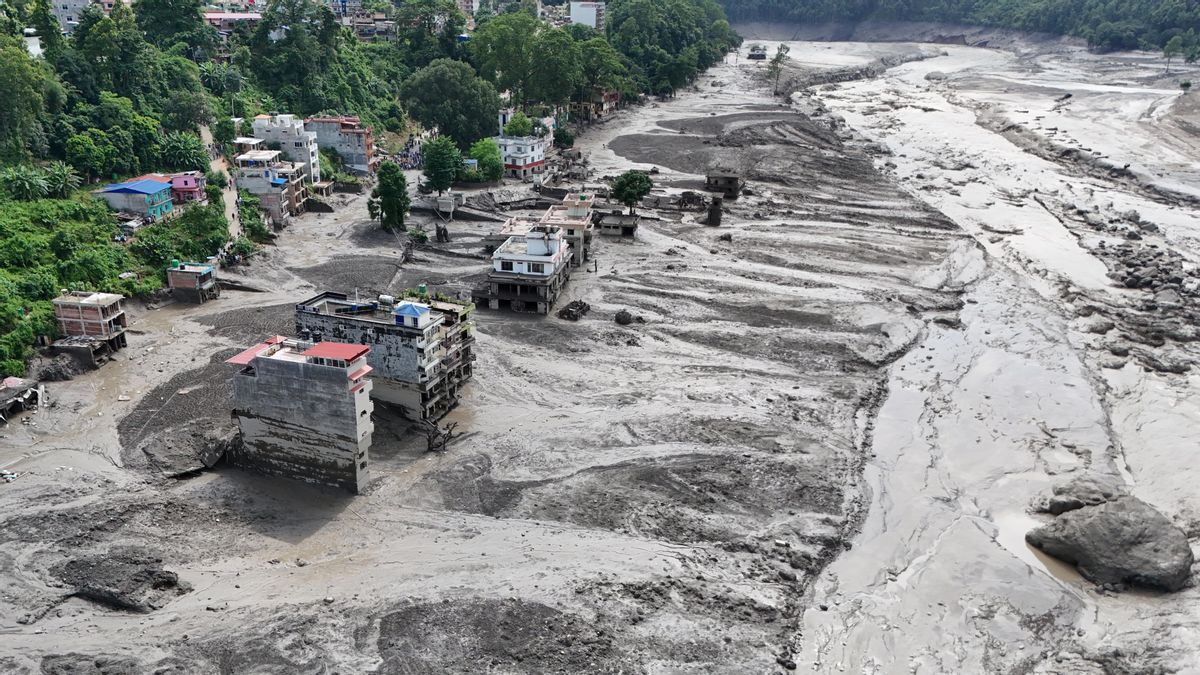
A new scientific report confirms that human-caused climate change played a decisive role in the catastrophic rock and ice collapse that struck northern Nepal last month, killing hundreds and leaving more than 1,000 people missing.
The study, conducted by scientists from World Weather Attribution and international glaciologists, found that decades of fossil fuel burning raised temperatures around the Himalayan slope by 1 to 1.5 times the global average. This warming triggered a chain of events that destabilized the mountain.
Led by researcher Ben Clarke of Imperial College London, the scientists concluded the disaster resulted from multiple factors. Human-caused warming has pushed the freezing threshold about 100 meters higher each decade, thinning glaciers and melting the permafrost that held the mountain together.
The report identifies several contributing factors. Melting permafrost weakened the frozen rock over time. The retreat of the Langtang-Lirung glacier removed support from the mountain's base. Water from melting snow and ice seeped into cracks, building pressure. A magnitude 7.8 earthquake in 2015 had already fractured the rock mass.
Unusually high temperatures in the three days, two months, and year before the collapse acted as the final trigger, according to the authors.
"This event demonstrates that the limits of adaptation are already being reached, and transformative actions are needed at local and global levels to avoid, minimize, and address losses and damages," the authors warned. "Until fossil fuel emissions reach net zero globally, this risk will continue to increase."
The report warns that high mountain regions worldwide face growing danger as climate change creates conditions for similar rock and ice avalanches.
Javier Lillo of Rey Juan Carlos University said global warming played "a critical role" in the disaster. He noted that the Himalayas sit in a tectonically active area and, like other mountain ranges and glacial zones, are experiencing the effects of global warming more severely. The region's geography, where valley floors are the most populated areas, makes it very difficult to reduce vulnerability to such high-magnitude hazards.
Pilar Brufau, a researcher at the University of Zaragoza, said the report treats the Nepal disaster as a cascading phenomenon rather than an isolated event. She explained that debris flows typically develop this way: a triggering factor combines with collapsing ice, rock, and sediment, along with surface water flow, rapidly creating a large volume of water and solids that moves at high speed and grows by dragging material in its path. "This type of flow cannot be treated like the flooding we are used to," she said.
Luis Carcavilla Urquí of the Geological and Mining Institute of Spain emphasized that while multiple factors were involved, "the effects of climate change played a determining role in destabilizing systems and variables that would be key to the catastrophe's development." He said future research must track how known and potential factors behind such compound events evolve in a changing global climate to prevent future tragedies.