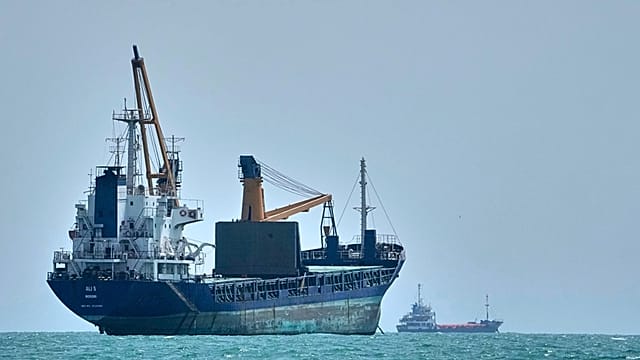
Houthis Seize 2 Yemen Islands, Threatening 12% of Global Trade at Bab el-Mandeb
Houthi forces have captured key islands in the Bab el-Mandeb Strait, giving them control over a waterway that handles about 12 percent of world trade.
Houthi forces have seized strategic islands in the Bab el-Mandeb Strait, tightening their grip on one of the world's most critical shipping lanes. The captures come as traffic through the strait has already dropped sharply to about 26 vessels a day, and as regional tensions push oil prices higher.
The Houthis, a rebel group that controls much of northern Yemen, have captured Mayun Island and Perim Island, along with the coastal locations of Mokha and Dhubab [238331][238433]. These positions sit at the Bab el-Mandeb, a narrow waterway between the Red Sea and the Gulf of Aden that separates Yemen from Djibouti and Eritrea in East Africa [238433].
The strait is only 18 miles (29 kilometers) wide at its narrowest point [238433]. About 12 percent of global trade passes through it, including oil, gas, and consumer goods [238433]. Control of these islands gives the Houthis a new base to monitor and potentially disrupt this traffic [238331].
Traffic through Bab el-Mandeb has fallen sharply to about 26 vessels a day, according to new figures covering July and August [238438]. This marks the second major decline in shipping through the strait since the outbreak of the Gaza war [238438].
If the strait is blocked, ships must take a much longer route around Africa, adding weeks of travel time and raising costs worldwide [238433]. Global markets are watching closely, as any disruption could affect shipping prices, energy costs, and supply chains [238433].
The seizures come amid broader regional tensions over maritime security. The Arab League convened in Cairo to address growing strain over maritime security in the Gulf, particularly after a series of attacks near the Strait of Hormuz [237953]. That strait is a narrow waterway through which about one-fifth of the world's oil passes [237953].
Arab League officials called for restraint from all sides and urged dialogue to prevent further escalation [237953]. The statement stressed the need to protect shipping lanes and regional stability, though it did not specify new measures [237953].
In response to rising hostilities near the Strait of Hormuz, China has re-entered the global oil market as prices climb [238887]. China is the world's largest oil importer, and its return to buying signals concern over possible shortages [238887]. Traders worry that fighting could block tanker traffic [238887].
Iran and Oman are meeting to discuss a new shipping agreement aimed at reducing tensions and reopening the Strait of Hormuz [238862]. The deal is a temporary agreement, and regional states hope it will create a path to ease hostilities [238862]. Iran's Foreign Ministry says Oman will host a regional meeting on Monday to discuss safe shipping routes [238435].
Tehran says it is finalizing an agreement with Oman to open a temporary, safe passage through the strategic waterway [237952]. Officials have not yet released specific terms or a timeline for the proposed corridor [237952]. It remains unclear how Oman will enforce security along the temporary route [237952].
South Korea and France agreed to strengthen defense cooperation and coordinate on security in the Strait of Hormuz following a summit in Paris [239001].