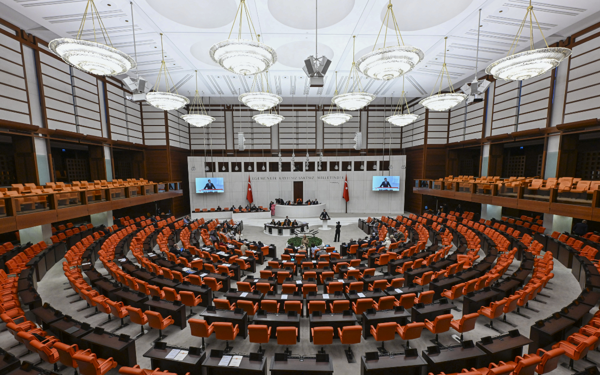
Turkish Parliament Passes Framework Law With 5-Party Backing, 33 Lawmakers Defy Party Line
Turkey’s parliament has approved a framework law to strengthen national solidarity and social cohesion, with five parties voting in favor, two against, and one abstaining—while at least 33 lawmakers broke ranks to vote against their party leadership.
The ruling AK Party, along with the Nationalist Movement Party (MHP), the Democratic Left Party (DSP), the Peoples’ Equality and Democracy Party (DEM Party), and the Democratic Regions Party (DBP) all declared “yes” votes on the proposal [215738]. The Good Party (İYİ) and the Democrat Party voted against it, while the New Welfare Party chose to abstain [215738][215746].
At least 33 members of parliament from the YENİ Party have said they will vote “no,” following their leader Özgür Özel’s announcement that lawmakers should vote according to the wishes of citizens in their own districts [215733]. Özel himself stated he and his party’s leadership would vote in favor, citing “historical coherence and duty” [215739].
Three parties—the New Party, the New Path Party, and the Workers’ Party of Turkey (TİP)—offered conditional support, saying they would back the law only if certain conditions are met [215738]. TİP confirmed its approval with formal reservations, citing concerns over anti-democratic practices, operations against opposition-run municipalities, and the economic crisis [215736].
The framework law sets broad rules, with details to be filled in later [215733]. It is officially titled the “Proposal for the Law on Strengthening National Solidarity and Social Cohesion” [215749].
Turkey’s Vice President, Cevdet Yılmaz, said the courts—not politicians—will decide who qualifies for the law’s provisions [214806]. His comments come amid speculation over whether the law could apply to Selahattin Demirtaş, the imprisoned former co-leader of the pro-Kurdish HDP party, who has been held since 2016 [214806].
AK Party deputy group chair Abdülhamit Gül said the law will benefit groups including the “Diyarbakır Mothers,” “Saturday Mothers,” and “peace mothers” [215734]. The Peace Foundation has called for civil society organizations working in conflict resolution and peacebuilding to be included in a planned Monitoring Commission [215743].
DEM Party co-chair Tuncer Bakırhan addressed Turkish citizens directly, saying, “Nothing is being taken from you in this process. This process will bring prosperity to Turkey” [215741]. He stressed that the Kurdish political movement remains committed to a unified Turkey: “If Kurds wanted to separate, we would not be here” [215741].
The Movement for a Democratic Society warned that the law carries serious flaws, arguing that many provisions cannot be implemented unless Abdullah Öcalan, the imprisoned Kurdistan Workers’ Party (PKK) leader, agrees to coordinate the board the law would create [215757]. Öcalan has been held on İmralı Island since 1999 [215757].
Oğuz Kaan Salıcı, a deputy from the main opposition CHP, said during the debate: “Now is the time for democratization” [215735].