Israel's Water Crisis: How Destroying Gaza's Sewage Plants Backfired
Israel faces weeks of water shortages after an unusual algae bloom shut down most of its desalination plants. Scientists say the crisis is a direct result of Israel's destruction of Gaza's wastewater treatment facilities.
Untreated sewage has poured into the Mediterranean Sea in massive quantities. This pollution has fueled the growth of microalgae that clogged filters at five of Israel's six main desalination plants. The plants were closed for days and now operate below full capacity.
"Pollution does not recognize political borders," said Zalul, an Israeli environmental NGO that protects the country's seas and coasts. "The discharge of untreated wastewater from the Gaza Strip into the sea is worsening the crisis affecting Israeli desalination facilities." The group explained that sewage contains nutrients like phosphorus and nitrogen, which feed microalgae and cyanobacteria.
**A Growing Crisis in Gaza**
Gaza remains in a severe water and sanitation crisis despite a 2025 ceasefire negotiated by the United States. Since Israel destroyed the treatment plants, the Palestinian coastline has been flooded with sewage, and the territory has been overrun by rats.
Since October 7, 2023, Israeli strikes have destroyed 90% of Gaza's water and sanitation infrastructure, according to a report by Doctors Without Borders. Wells, pipes, reservoirs, and desalination plants have all been directly attacked.
Before the war, 80% of Gaza's water came from an aquifer beneath the coastal strip. That aquifer is now contaminated by seawater and sewage and is unfit for human consumption. Most drinking water came from desalination plants and three pipelines controlled by Israel's water authority. These were cut at the start of the war and have only partially reopened.
All five of Gaza's wastewater treatment plants are now out of service, according to Omar Shatat, deputy director of the Water Supply Company for Coastal Municipalities in Gaza. This means 45,000 cubic meters of untreated sewage flow into the Mediterranean every day. Another 15,000 cubic meters seep daily into groundwater from absorption pits, especially in informal camps in al-Mawasi.
"It is a catastrophic situation from an environmental and public health standpoint," Shatat said. "The sea is heavily contaminated, and the first to be affected are Gaza's residents and displaced people, who are in direct contact with the highest concentrations of sewage."
**Daily Life Amid Contamination**
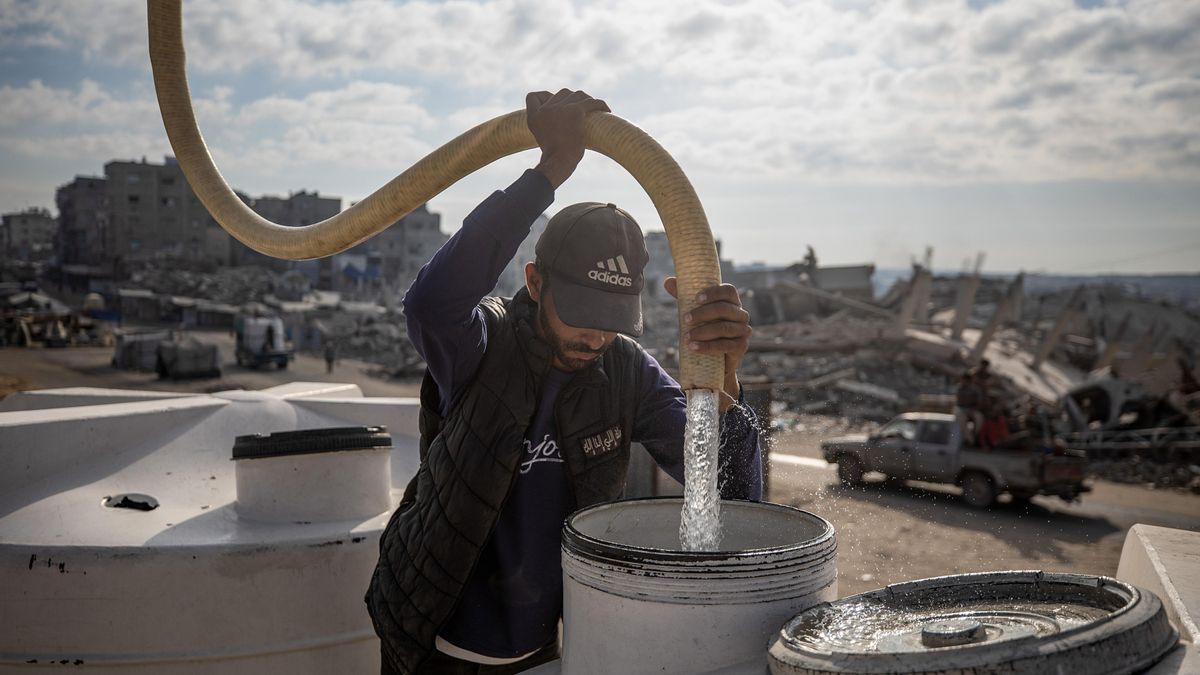
Residents describe a grim reality. "We carry water in jerrycans," said Nas al-Barawi, a 34-year-old mother of five living in Beit Lahia. "We carry heavy containers on foot, or we stand in line for hours. Much of the water is not drinkable, and the children suffer recurring stomach infections, diarrhea, and skin rashes."
Damage to sewage networks and pump failures have caused wastewater to flow between tents and into residential areas, she added.
Shaimaa al-Katari, a 37-year-old displaced woman in the al-Mawasi camp, described the conditions: "We have nowhere to dump the water we use to wash dishes and clothes. We have to let it run into the street, which creates pools of stagnant water. Mosquitoes and algae multiply around us, the streets become filthy, and we suffer from bad smells, mosquitoes at night, flies during the day, and rodents."
**Rats and Disease**
Rats have infested parts of Gaza for months, thriving among untreated sewage and piles of garbage around overcrowded displacement camps. Israeli communities near the Gaza border have also faced an unprecedented rat infestation in their homes and gardens.
"The consequences [of the war] do not stop at the border," said Nada Majdalani, Palestine director of EcoPeace Middle East, an environmental and peace NGO. "We are already seeing an increase in hepatitis A cases in Gaza. I believe we are on the brink of a catastrophe, and a serious outbreak in Gaza does not have to stay within Gaza's borders."
**Impact on Israel**
In Israel, authorities are asking the public to use water "moderately" until the system recovers. Supply has been reduced in the south, and farmers have been ordered to stop irrigation, which could raise food prices.
The NGOs Zalul and EcoPeace have asked Cogat, the Israeli agency that administers Gaza, to help restore the Strip's sewage system and allow its wastewater to be treated in areas controlled by Israel. Cogat did not respond to a request for comment from The Guardian.
"If the pollution continues, the impact may eventually be felt throughout the country," Zalul said. "When the marine environment is contaminated, both people and nature suffer, regardless of which side of the border they are on."