Europe Takes Over Its Own Defense as U.S. Shifts Focus to Asia
NATO defense ministers meet in Brussels on Thursday to finalize a historic shift: European allies will now take over key military roles long filled by the United States.
The move, dubbed “NATO 3.0,” comes as Washington signals it is reorienting its military priorities toward Asia. European diplomats say member states have agreed to a “burden shifting” plan, where Europe will pay for and provide its own defense capabilities in several critical areas.
“The impact of Russia’s invasion of Ukraine and pressure from the Trump administration have finally forced a change in the distribution of burdens,” write Florence Gaub of the NATO Defense College and U.S. Army Colonel Jonathan Heist in Foreign Affairs. They note that NATO has always faced crises but has managed to turn them into momentum.
**What Europe Must Now Cover**
Europe will need to build its own military industry to replace U.S. support in three specific areas: intelligence and surveillance, anti-air and missile defense, and precision deep-strike attacks.
EU diplomatic sources insist there will be no security vacuum. The transition will be gradual and orderly, even as the U.S. continues to pull back troops and close bases. They stress that NATO remains a collective defense alliance, and Washington has no interest in creating dangerous gaps.
However, the shift is not without risk. Paul Taylor of the European Policy Centre warns that the transition “could derail at any moment due to the unpredictability, strategic impatience, and vindictive attitude of President Donald Trump.” He describes NATO as being in a “precarious state of simultaneous military rebalancing and political destruction.”
**Industry and Raw Materials Challenges**
Admiral Pierre Vandier, NATO’s Supreme Allied Commander for Transformation, warns that Europe’s defense industry is not ready for modern warfare. “Today we manufacture extraordinarily sophisticated weapons, but they were designed for a stable world with limited conflicts,” he says. “Now we face prolonged, large-scale wars.”
He also highlights a critical supply chain issue: “If the systems you build depend too much on resources controlled by your adversary, you cannot sustain a long war against them.”
**Tensions Over ‘Buy European’ Policy**
The U.S. is accusing the EU of discriminating against American defense companies by favoring European-made weapons. Brussels admits the U.S. still gets the vast majority of EU defense contracts but says the goal is to reduce that share over time.
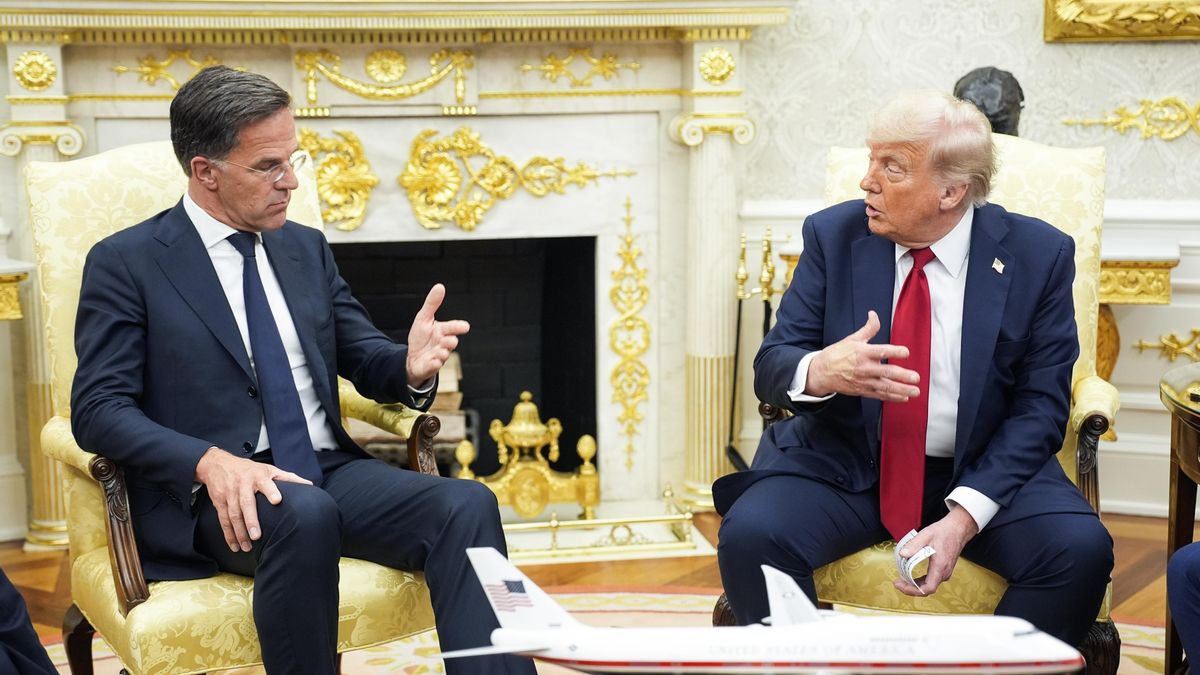
NATO Secretary General Mark Rutte advocates for a transatlantic defense industry, with joint U.S.-European companies. But countries like Spain and Italy prefer a “European preference” approach, while also seeking partnerships with South Korea, Norway, and Turkey.
**A Wider Security Picture**
Thursday’s meeting comes with less tension following a peace deal between the U.S. and Iran. That agreement has cooled friction after the U.S. and Israel attacked Iran without consulting European allies, who refused to join the operation.
Looking ahead, analyst Galip Dalay of Chatham House warns that Europe’s security focus is too narrow. “The debates begin in Russia and end in Ukraine,” he says. “But Europe’s southern neighborhood—Gaza, Syria, the war on Iran—is also redefining security across the Mediterranean and the Middle East.”