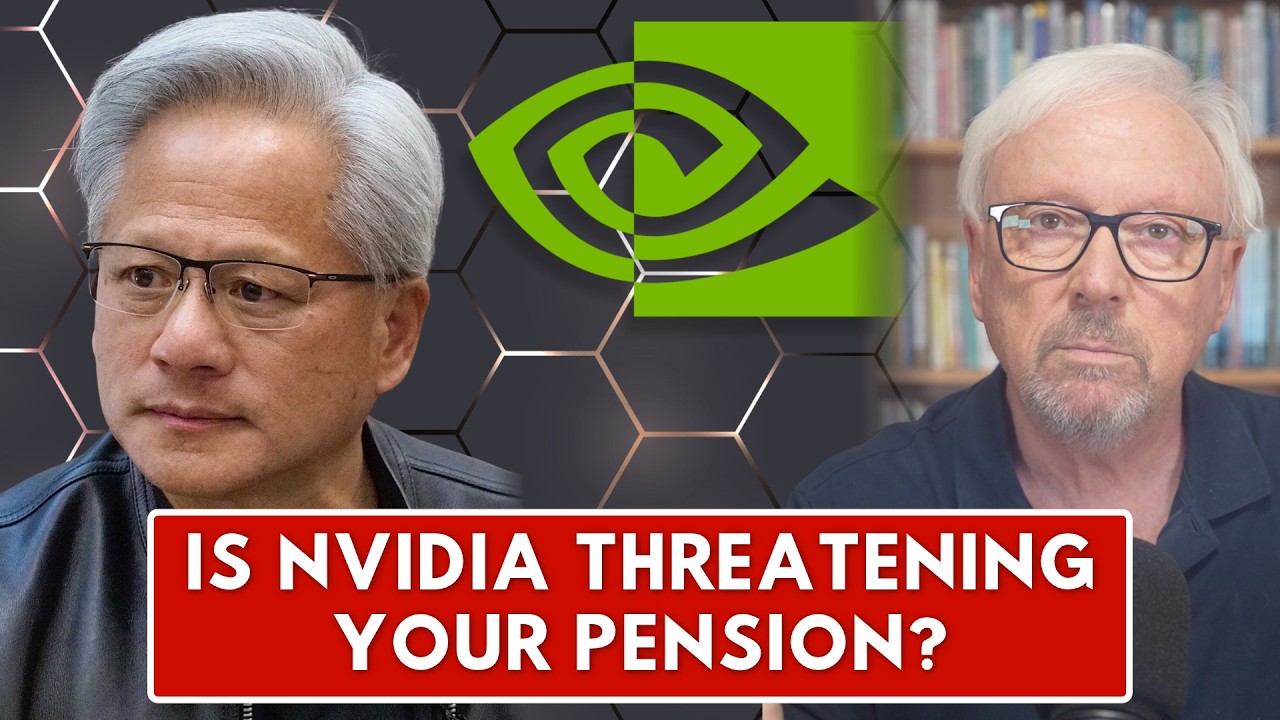
Nvidia’s Governance Crisis Could Put Your Pension at Risk
Most investors cheered when Jensen Huang returned to Nvidia, but the company’s weak corporate governance should worry anyone with a pension. Pension funds are heavily invested in major US corporations, and Nvidia offers a warning of what may be coming to the wider corporate market.
Most investors cheered when Jensen Huang returned to Nvidia, but the company’s weak corporate governance should worry anyone with a pension. Pension funds are heavily invested in major US corporations, and Nvidia offers a warning of what may be coming to the wider corporate market. Corporate accountability in the United States appears to be collapsing. The decision to reinstate a chief executive who, according to US media reports, has been linked to a woman alleged to be a Chinese spy, who has reportedly admitted to a relationship that violated company rules, and whose ethical management has been widely questioned, signals a deeper problem. Pension funds depend on these corporations, and Nvidia lacks a properly functioning board. When the entire structure of American enterprise rests on a cult of a supreme leader, the risks multiply.
This matters because your pension depends on sound corporate behavior and long-term stable returns. Nvidia is among the most valuable corporations in the world. When its shares fell by 30 percent after Huang was sacked, roughly 2.7 trillion dollars was wiped off its value, only slightly less than the entire value of the London Stock Exchange. Share prices depend on confidence and expectations, and corporate misconduct can destroy that confidence. Yet here we see an exception: a cult around an individual, backed by the president of the United States, is creating a bubble where caution should prevail. The company has no governance structure capable of limiting what Huang can do. He holds absolute control, and your future may depend on his good judgment, despite ample evidence that he lacks it in some areas.
So who protects your pension when governance fails? Corporate governance is supposed to protect investors. Limited liability created the need for accountability. You put money into a pension fund, the fund invests in a company, and a divide exists between shareholders and the company itself. Accountability crosses that divide. Directors answer to shareholders, boards control powerful chief executives to prevent abuse, and accounts and audits provide essential safeguards. These protections should make investment safer and pensions more secure. This is a personal issue for everyone with pension savings.
Neoliberalism promised shareholder protection as part of its ideal of shareholder value. It built a political philosophy on the idea that shareholder value and the corporation could deliver well-being for everyone. That philosophy has dominated economic management for 45 years, and it is why your pension is outsourced to private providers rather than mainly provided by the state for most people in the UK. In this environment, profits and share prices become measures of success, and share index movements are reported almost daily. Corporate governance supposedly creates checks and balances to ensure that success is real.
But suppose that is wrong. Suppose strong corporate governance is not in place, and suppose governments interfere. Donald Trump has claimed credit for Huang’s reappointment, saying he demanded that the board reinstate him. Every sign of good corporate governance has failed. The board was overruled, shareholders were ignored except for their short-term interest in the share price, and the government intervened to produce an outcome it had no apparent right to demand. Profit and share price may therefore be undermined as indicators of success, because control of companies is passing to a very small elite.
If corporate governance is failing, the assumptions underpinning how we organize pensions become increasingly questionable. Shareholders may have no influence over companies, no control over boards, and boards may have no control over chief executives. This destroys the whole concept of shareholder value and raises questions for your pension fund.
Corporate accountability has been progressively undermined since the 1990s. Audit requirements have been reduced, especially for smaller companies, and questions about audits elsewhere are increasing daily. We receive less assurance from audit than ever before because audit has been reframed. Accounting increasingly emphasizes financial asset valuations rather than real value created for society through trading. Judgment rather than real value creation often underpins how accounts are presented, so we cannot be sure what value a company actually generates. Existing directors largely control board appointments, cutting shareholders out of controlling companies. In the UK, members of the Nationwide building society tried to appoint a member to the board and failed; the existing board ensured its own choice was made, undermining accountability. Governance codes meant to regulate corporate governance are failing in this way everywhere. Executive power has become increasingly concentrated, and Nvidia exposes this problem.
Huang resigned following revelations about his conduct, the sort that would ensure anyone else in his company was shown the door immediately with no appeal. He broke company rules on affairs and may have undermined US national security, an allegation made by many US newspapers. Yet he was not only reinstated but reinstated with the support of the US president. This shows there is no independent accountability in the company: one rule applies to everybody except the chief executive, who operates to a different standard. The short-term share price rise does not compensate for this problem. Markets may have celebrated Huang’s return, but higher prices do not guarantee long-term security or expected returns. Corporate risks have not disappeared, and pension funds could still suffer substantial market losses. Indeed, the risk increases because the share price has been inflated again. Today’s gains can become tomorrow’s pension losses.
A real conflict of interest is at work. Corporate executives seek rewards and personal power, and this desire is growing. The cult of the chief executive is bigger than ever. Shareholder funds seek short-term financial returns because they are trying to prove they are good corporate managers. But pension savers who entrust money to those fund managers need long-term returns. There is no alignment among the chief executive, the board, the fund managers, and the people who will ultimately benefit from long-term profits. Meanwhile, the corporation tries to capture all gains within its accounts while pushing avoidable costs out into society at large. The problem is that pensioners, the shareholders ultimately served, are the people in society at large. None of this adds up. We are seeing a broken model of corporate management and a broken model of pensions, and your pension could be vulnerable.
Pension funds increasingly depend on financial markets, and technology shares have become incredibly influential within them. Concentrated investments create additional financial risks, now visible in the AI sector. Weak governance makes those risks harder to control, and ordinary people, through their pension funds, ultimately bear the risks and consequences.
We need pension funds and pension arrangements we can trust. That requires corporate governance to provide genuine accountability if investment in shares is to be part of a pension portfolio. Right now, the logic of shareholder value cannot guarantee pension security, if it ever could. Retirement provision needs dependable long-term investment, but it is supplying short-term hype, short-term corruption, and short-term misinformation. We are not getting the information needed to protect people from corporate excess, and that will have long-term consequences when the long term is exactly what we are worried about.
This pension system is going wrong. Should our pensions depend on such a system? Should we be saving this way? Should we look at alternatives? Should our pension arrangements depend on investment in corporate shareholdings? I am not convinced, for good reason: the companies themselves are not evidencing that they are worthy of our trust. They are not creating value. Most are flailing around not knowing what to do most of the time. The only reason stock markets look good is the hype around AI, and we are not seeing long-term value creation.
We do need a better pension system. We cannot completely ignore value creation inside companies, but if companies are to be part of a pension portfolio, we must impose better accounting, better auditing, better corporate governance, and better management systems. We must prevent a situation like this one, where Jensen Huang has returned to Nvidia, in my opinion completely inappropriately. We need a system concentrated on creating long-term value, and we must have a government backstop and guarantee so that people are not left exposed to corporate excess and their futures do not depend on people like Jensen Huang and his obvious fallibilities.
Related Coverage
Norway’s $1.8 Trillion Fund Chief Warns AI Stock Bubble Could Burst
A top global investor is sounding the alarm on artificial intelligence stocks, warning that the rapid rally may be a bubble ready to pop.
Nvidia's Central Role in AI Sparks Warning of Catastrophe If It Falters
A financial expert warns that Nvidia's dominant position in the technology ecosystem means any disruption to the company would have severe consequences. She also describes the global AI race as an economic war with major stakes.
AI Stock Bubble Could Burst: Norway’s $1.8 Trillion Fund and ECB Economists Sound the Alarm
Central banks and the world’s largest sovereign wealth fund are warning that the artificial intelligence stock boom is overheating, with a sharp correction in U.S. tech shares likely to hit global markets.
Nvidia’s $3 Trillion Test: AI Boom Hangs on One Earnings Report as Tech Stocks Slide
Markets are on edge as investors brace for Nvidia’s quarterly earnings, with the chipmaker’s results expected to make or break the artificial intelligence stock rally that has driven Wall Street to record highs.
Nvidia’s $279B Supply-Chain Gamble: Can the AI King Keep Its Crown?
Nvidia, the world’s leading maker of AI chips, is set to release its quarterly earnings this week, a report that will serve as a critical barometer for the artificial intelligence boom that has driven stock markets to record highs.
AI Chip Stocks Tumble as Democratic Midterm Wins Put $500 Billion Data Center Buildout at Risk
A Democratic sweep in key midterm races has rattled investors in artificial intelligence stocks, with chipmakers like Micron falling sharply as markets worry that political shifts could slow government support for AI data centers.
Related Editorials
The Great Discomfort: Why the Middle Class Could Lose Everything
A financial crisis could shatter middle class security within the next two years. Those who believe themselves immune to risk are not.
The Next Financial Crash: Why “Uninvestable” Assets Are the Real Threat
The global financial system is a complex web of interdependencies. When a major shock occurs—like a pandemic or a sudden spike in interest rates—the initial damage is often visible.
The Hidden Debt Crisis Threatening the Future of Artificial Intelligence
Article: The artificial intelligence industry is facing a financial reckoning that most investors and policymakers have yet to fully grasp. While the public conversation focuses on breakthrough capabilities and existential risks, a quieter but equally dangerous problem is building beneath the surfa
October’s Ominous Echo: Why This Autumn Could Rattle Global Markets
As the leaves turn and the trading floors buzz with a familiar anxiety, the question on every investor’s mind is whether history is poised to repeat itself. October has long held a notorious reputation in financial lore, serving as the graveyard for bull markets.
The 50% Wipeout: Why This Market Crash Could Be Different
The warnings are growing louder. According to a growing chorus of financial analysts, the stock market is not merely due for a correction—it is facing a potential collapse that could erase half of its value.
The World’s Best Stock Market Is Also Crashing: What Investors Need to Know
For years, one stock market has been the envy of the world—a relentless bull run that made early investors rich and attracted global capital. But now, that same market is experiencing a dramatic reversal.