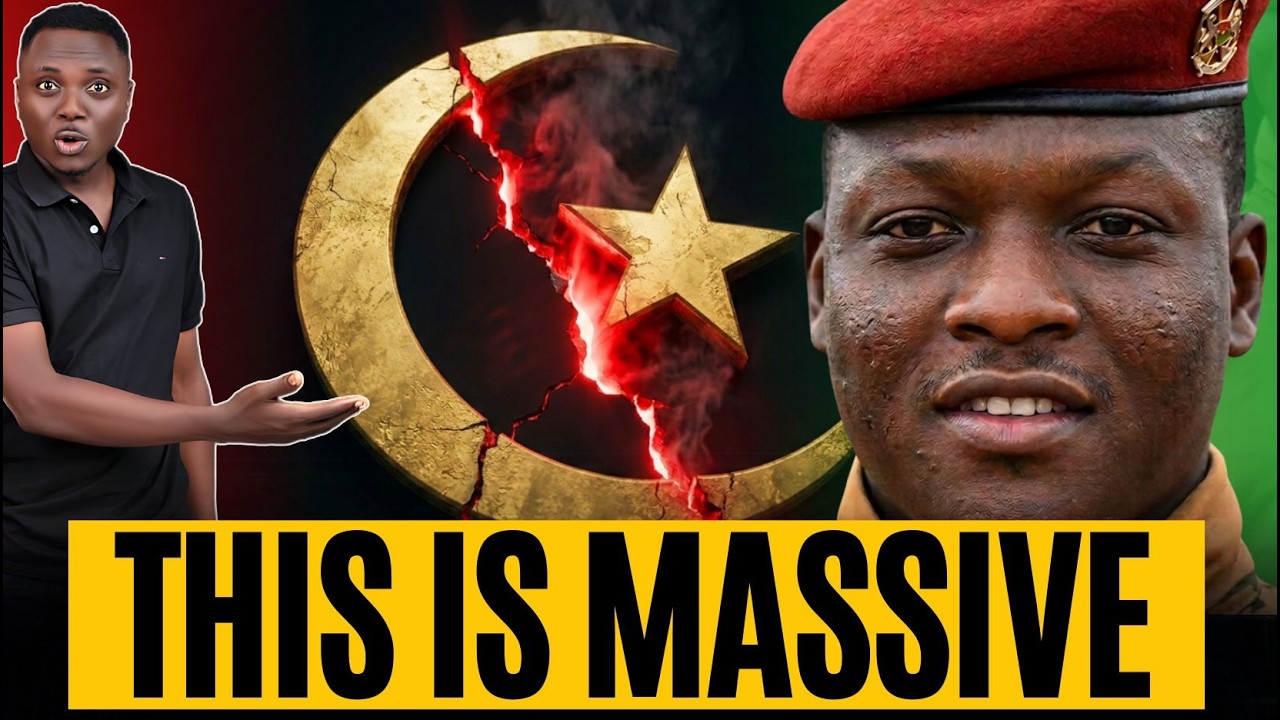
He's Muslim. He Suspends Preachers. He Swears Sharia Will Never Rule Burkina Faso.
Early one morning, a soldier walks through dry grass in the Sahel, the dry belt south of the Sahara where Burkina Faso is fighting a brutal insurgency. He finds a body — another dead fighter, in a war where death has stopped being remarkable.
Early one morning, a soldier walks through dry grass in the Sahel, the dry belt south of the Sahara where Burkina Faso is fighting a brutal insurgency. He finds a body — another dead fighter, in a war where death has stopped being remarkable. Beside the body lies a detail that keeps reappearing: a Quran.
Weeks later, President Ibrahim Traoré — a Muslim himself — stood before the nation's Muslims and told them their hypocrisy was showing. Some people, he said, call things haram, meaning forbidden under Islamic law, simply because non-Muslims created them. Yet the same people drink every day from water that flows through pipes built by non-Muslim engineers. Nobody questions that water.
Then came the actions. Traoré suspended preachers. His government arrested one of the country's most respected imams, or prayer leaders. It banned prayer inside government buildings. It even went after Christian pastors, calling out fake miracle cures. And it raised a subject so sensitive that few African leaders say it in public: the slave trade carried out by Arab powers centuries ago.
A leader fighting for his country's survival does not usually pick a second fight — especially with the faith most of his people practice. Either Traoré made a serious mistake, or he sees something everyone else has missed.
The War and the Pulpit
In a mid-July speech, Traoré argued that extremist preaching is one of the biggest drivers of terrorism in Burkina Faso. According to local press coverage of the address, he said his intelligence services had identified many imams preaching messages that help radicalize young people. Every one of them, he said, would be suspended. No exceptions.
That is not the language of a villain, his defenders would argue. It is the language of a commander whose soldiers keep finding religious texts in insurgent camps. For Traoré, the ideology and the war are the same fight wearing two different uniforms.
The threat is not abstract. Armed groups in the region have killed civilians and justified it through religion — a justification the vast majority of Muslim scholars reject outright. Some groups declare that anyone who leaves Islam should be killed. Others have destroyed centuries-old Sufi shrines, sacred sites of a mystical tradition within Islam, in neighboring Mali, after a fringe group labeled them idol worship.
But then the story complicates.
Who Defines "Extreme"?
A few weeks before that July speech, in late May, the head of the country's association of Sunni scholars — Sunni Islam being the largest branch of the faith — criticized a new religious freedom bill. Within days, he was arrested. When worshippers gathered to demand his release, authorities shut down the largest Sunni mosque in the capital. The symbolism was stark: the most senior Sunni cleric in the country ended up behind bars.
So the question stops being whether Traoré opposes extremism — everyone claims that. The real question is who decides what counts as extreme, and what happens to people who disagree with the definition.
Beneath all of this sits a quiet current that runs back decades. Gulf money, mostly Sunni money, has funded mosques, imam training, and religious scholarships across West Africa for years. Many local imams in Burkina Faso look to that model.
Eight Hundred Missing Files
Then came the detail almost nobody was discussing. According to reporting by Daily Trust, a West African newspaper, Traoré's government wants to bring home more than 800 Burkinabè students studying religion in Arab countries. His own embassies, he said, cannot tell him exactly what they study, or how and why they left Burkina Faso.
Eight hundred citizens, and the state cannot say what they are learning.
Traoré went further. Students who refuse to return will lose their citizenship, whether they were born in Burkina Faso or not. That raises a hard question: what kind of government threatens its own citizens over school records it cannot read?
Here is the specific fear, in Traoré's own words: "There will never be Sharia law in this country." Sharia is Islamic law drawn from religious texts. The 800 students, it turns out, are not just studying religion in general. They are studying Sharia and Islamic law specifically — mostly in Saudi Arabia.
And the fear is not hypothetical. Traoré has pointed to a real case: Iyad Ag Ghali, a Malian musician with long-standing ties to Saudi Arabia, who returned home and became the leader of al-Qaeda's largest branch in the Sahel. That is the nightmare scenario sitting behind every one of those 800 files.
An Old Law, Enforced at Last
Much of the coverage frames this as Traoré inventing an aggressive new religious policy out of nowhere. Half of that is true — and it is the boring half.
Burkina Faso's 1991 constitution already declares the country secular under Article 31. Secular means the state and religion are officially separate. The same law requires public schools to stay secular.
France split church from state in 1905. The United States wrote its version into the First Amendment in 1791. Burkina Faso wrote its version in 1991. So is enforcing a 35-year-old law radical — or is it simply the first time anyone bothered? Imagine scolding a neighbor for finally mowing the lawn after ignoring the notice for three decades.
The comparison gets sharper. Saudi Arabia, the country many point to as the model of strict religious rule, has its own record. Sheikh Saleh al-Talib, a former imam of the Grand Mosque in Mecca and one of the most respected voices in the Muslim world, criticized the government's entertainment authority in a 2018 sermon. He was arrested that year. In 2022, according to Middle East Eye reporting, after an earlier acquittal was overturned, a court sentenced him to ten years in prison.
A Saudi imam received a decade in prison for criticizing a concert policy. Meanwhile, Burkina Faso is widely called authoritarian for suspending preachers its own government accuses of feeding a war that has already killed thousands. The contrast does not tell readers what to conclude. It asks them to notice which country usually gets labeled repressive — and which one usually does not.
Beyond Islam
If the story ended here, it would look like a dispute inside Islam only. That would be the lazy answer. Traoré did not stop with Muslims.
He called out extreme practices inside some Christian communities. Some fringe churches teach that going to a hospital shows weak faith — that prayer alone should cure life-threatening illness. People have died because of that belief. Other preachers sell "blessed" items, promising wealth and cures for every disease, and charge desperate people for them. Some leaders claim to speak for God, and no one is allowed to question them. In some congregations, members cut off relatives who believe differently, and followers hand over property. In one case the president referenced, a woman carried 10 million CFA francs — her husband's money — and gave it to her pastor.
Giving to a church is not the issue, Traoré argues. The issue is any teaching that tells people to stop thinking. His fight, in short, is against unchecked authority hiding inside religion — the kind that says: do not reason, just obey.
A saying across West Africa captures the danger: a chicken that forgets who raised it forgets where it comes from. People can be talked out of remembering their own roots if someone tells the story convincingly enough. That is exactly the weakness extremist preachers exploit, on both sides of the religious divide.
The 500-Year Argument
None of this happened by accident. Long before French colonial rule, the Sokoto jihad of the early 1800s swept through West Africa, replacing existing African kingdoms with new Islamic rule. Then missionaries arrived behind colonial administrations. Africans were told their own gods were demons. Children were beaten at school for speaking their own languages. Systems that had held communities together for centuries were suddenly labeled witchcraft.
This raises an uncomfortable question for families across the Sahel today: did their grandparents actually choose their faith freely — or did it arrive with survival, depending on which colonial line their village happened to fall on?
Every major civilization kept and grew its own belief system. China did. Europe did. Africa's was taken apart twice — once by the Sokoto expansion, once by colonial missionaries. Much of the fighting across the Sahel and northern Nigeria today still runs through those same old cracks.
That is the real weight behind Traoré's speech. He is not just managing a security problem in 2026. He stands at the end of a 500-year argument over who gets to define Africa's spiritual identity. For once, an African leader is holding the pen.
What He Is Building
So what is the plan? Traoré wants Burkina Faso to fund its own religious education, so imams and pastors stop depending on foreign money with foreign agendas. He wants government approval required before students leave to study religion abroad. And underneath it all runs one repeated argument: his country needs engineers, scientists, and builders — not another generation shipped abroad to study an ideology nobody at home can even name.
The logic is strategic. A generation of Africans raised to build things is a far harder target for extremist recruiters than a generation raised only to memorize grievances. Radicalization needs idle hands and unanswered anger. Give people something real to build, and you shut down the pipeline at its root — instead of arresting middlemen one imam at a time.
Return to the beginning. A Quran beside a body in the grass. A president who shares that faith, standing up to tell his own people their hypocrisy is showing. Underneath it all sits a fight over who controls the story religion tells. Money crossing borders quietly for decades. Eight hundred citizens no one can fully account for. A law that sat untouched in a drawer for 35 years. A wound that opened long before anyone alive was born.
And here is the bigger question. Africa's belief systems were taken apart once already, by outside power. What makes anyone think it cannot happen again — quietly, through a scholarship, a sermon, a bank transfer, with no one watching?
If that is true, the real task is not picking a side in this argument. It is building the schools, the universities, and the local funding that ensure the next chapter of Africa's story is written by Africans, on purpose — not by whoever is paying that month.
Related Editorials
Algeria’s Silent War: How Fighter Jets Answered the AES’s Declaration of Hostility
In the shifting sands of the Sahel, diplomatic rhetoric has given way to the roar of jet engines. After the Alliance of Sahel States (AES)—a military junta-led bloc comprising Mali, Burkina Faso, and Niger—formally labeled Algeria an "enemy," the North African powerhouse responded not with a press
Niger’s Silent Coup: Why the Junta’s Own Soldiers Turned on General Tiani
Article: In a dramatic turn of events that has sent ripples through the Sahel region, Niger’s military junta faces its most significant internal challenge yet. Reports from Niamey confirm that a faction of the country’s own armed forces has moved against General Abdourahamane Tiani, the man who sei
Russia’s Silent Takeover: How Moscow Is Replacing France in the Sahel
In a dramatic geopolitical shift, Russia is quietly but decisively expanding its military and political influence across West Africa’s Sahel region. Recent developments in Mali, Burkina Faso, and Niger signal a coordinated effort by Moscow to fill the vacuum left by departing Western powers—particu
The Coup That Exposed the West's Hidden Hand in Africa's Resource Wars
Burkina Faso's young leader Ibrahim Traoré has done what few African presidents dare: he named the foreign powers quietly profiting from the continent's instability. His evidence is forcing a global reckoning.