# The Real AI Threat Isn’t What You Think
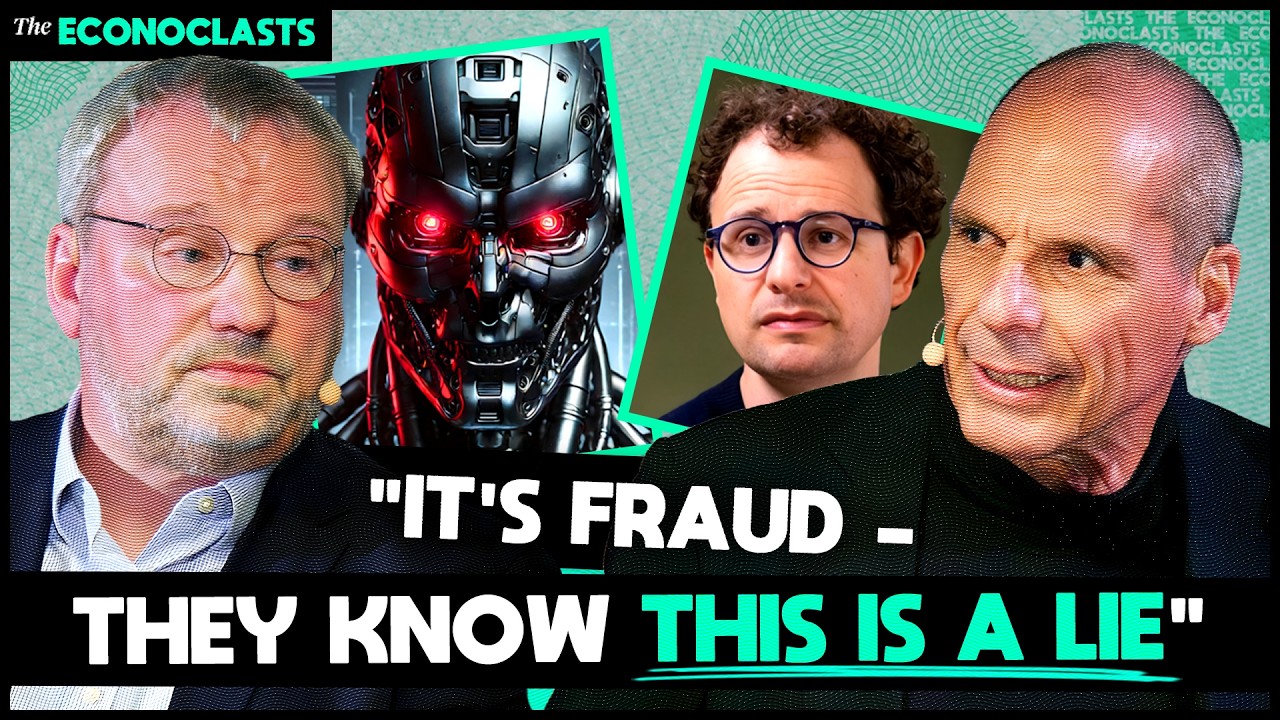
Yanis Varoufakis and Wolfgang Münchau argue the danger isn’t robots taking over—it’s the private seizure of the digital commons. Politicians and pundits warn endlessly about artificial intelligence turning on humanity.
Yanis Varoufakis and Wolfgang Münchau argue the danger isn’t robots taking over—it’s the private seizure of the digital commons.
Politicians and pundits warn endlessly about artificial intelligence turning on humanity. That conversation misses the point. The genuine threat is not a machine rebellion but a massive, quiet transfer of power and wealth into a handful of private hands. That was the central argument of economists Yanis Varoufakis and Wolfgang Münchau in a recent episode of The Econoclasts.
AI Is Not a New Species
Varoufakis rejects the popular metaphor of AI as an alien intelligence. He compares it instead to a parrot—a system that mimics human expression without understanding it. The technology is remarkable, but it is not conscious, and it is not a new life form. Treating it as one distorts the debate.
The Cloud Rentiers
The real problem, Varoufakis argues, is the business model behind AI. He calls the dominant players “cloud rentiers.” These companies do not primarily sell products; they extract rent from a resource they have enclosed: the digital space where human activity now occurs.
The mechanism is subtle. Users generate data, attention, and content for free. The cloud rentier captures that value, processes it, and sells it back as a service. The more people participate, the more the rentier profits—without producing anything comparable in return.
A New Form of Primitive Accumulation
Varoufakis frames this as a modern version of “primitive accumulation”—the historical process by which common land was enclosed and turned into private property. Today, the commons being enclosed is not physical land but the digital domain. Every search, message, and transaction feeds a privately owned infrastructure that no citizen consented to create.
The result is a new class structure. A small number of firms control the essential infrastructure of economic and social life. Everyone else becomes a tenant on that infrastructure, paying rent in money, data, or attention.
Why This Matters More Than Job Losses
The usual anxiety about AI focuses on unemployment. Varoufakis and Münchau suggest this is a secondary concern. The deeper issue is who owns the means of computation. If a handful of companies control the cloud, they control the terms on which everyone else—businesses, governments, individuals—can operate.
That concentration of power is not inevitable. It is the product of political choices: lax antitrust enforcement, permissive data rules, and public investment in research that was handed to private firms. The threat is not the technology itself but the ownership regime built around it.
What Can Be Done
The conversation points toward a different approach. Instead of treating AI as an uncontrollable force, policymakers could treat the digital infrastructure as a public utility. That would mean:
- Enforcing antitrust rules to break up cloud monopolies.
- Giving citizens ownership or compensation for the data they generate.
- Funding public alternatives to private cloud infrastructure.
- Regulating rent extraction rather than merely praising innovation.
None of these ideas are radical in themselves. They simply apply familiar principles of competition and public interest to a new domain.
The Choice Ahead
Varoufakis and Münchau do not predict inevitable doom. They describe a fork in the road. One path continues the current trajectory: a few firms accumulate unprecedented power, and the rest of society becomes dependent on them. The other path treats computation as a shared resource, governed in the public interest.
The debate about AI, they argue, should not be about whether machines will become our masters. It should be about whether we will allow a small group of people to become ours.
Related Coverage
AI Doomsday Warnings Hit Congress as Tech Giants Demand Rules They Once Fought
Tech leaders warn AI could kill us all, but Washington can't agree on what to do about it.
The AI Boom Is a Power Grab: How Compute, Debt, and Geopolitics Are Redrawing the Global Order
The artificial intelligence boom is not a neutral technological revolution. It is a geopolitical and economic battleground where control over chips, data, and capital is reshaping the balance of power between states and corporations, while workers and global financial markets absorb the shockwaves. The most immediate threat to the global economy is not AI itself, but the debt being piled up to build it, as massive borrowing by tech giants to construct data centers creates a bubble that central banks and Norway's $1.8 trillion sovereign wealth fund warn is overheating [1][2].
AI's Power Grab: How the Fight Over Chips, Safety, and Energy Is Redrawing Global Control
As artificial intelligence races forward, the real battle isn't about technology—it's about who controls the compute, who bears the costs, and who gets left behind.
AI Firms Cry ‘Apocalypse’ Right Before Their $1 Trillion Stock Debuts
AI companies like Anthropic and OpenAI are warning the public about the dangers of their own technology while simultaneously preparing for blockbuster stock market debuts that could value them at over $1 trillion [170924][169730].
AI Could Kill Us All Within 10 Years, Top Researchers Warn as US and China Race to Act
Researchers and world leaders are sounding the alarm that artificial intelligence could threaten human survival, with some warning of extinction within the decade. Governments and AI companies are now scrambling to create safety rules before it's too late.
AI Fight Brews: Is 'Distillation' Smart Innovation or Straight-Up Theft?
A once-obscure artificial intelligence technique called "distillation" has exploded into a major fight between Silicon Valley and Washington, while economists warn the AI boom could be bigger than the Industrial Revolution and push for a plan to share the wealth with everyone.
Related Editorials
Title: The Hidden Debt Crisis Threatening the Future of Artificial Intelligence
Article: The artificial intelligence industry is facing a financial reckoning that most investors and policymakers have yet to fully grasp. While the public conversation focuses on breakthrough capabilities and existential risks, a quieter but equally dangerous problem is building beneath the s
# Why America Will Probably Nationalise AI
The United States stands at a crossroads with artificial intelligence. While the technology has been driven by private enterprise, a growing consensus among policymakers, economists, and national security experts suggests that the federal government may soon take direct control of the most advanced
Title: The Invisible Fault Line: How an AI Crash Could Unravel the Global Economy
Introduction Artificial intelligence is no longer a futuristic concept confined to research labs. It is the silent engine powering modern finance, logistics, and communication.
Title: The Hidden Cost of Circular AI Financing: A Convenient Myth or a Looming Debt Trap?
Introduction In the rush to fund the artificial intelligence boom, a new buzzword has entered the boardroom lexicon: "circular AI financing. " On its surface, the term suggests a sustainable, self-feeding economic loop—where profits from AI fund more AI, creating a virtuous cycle of innovation.