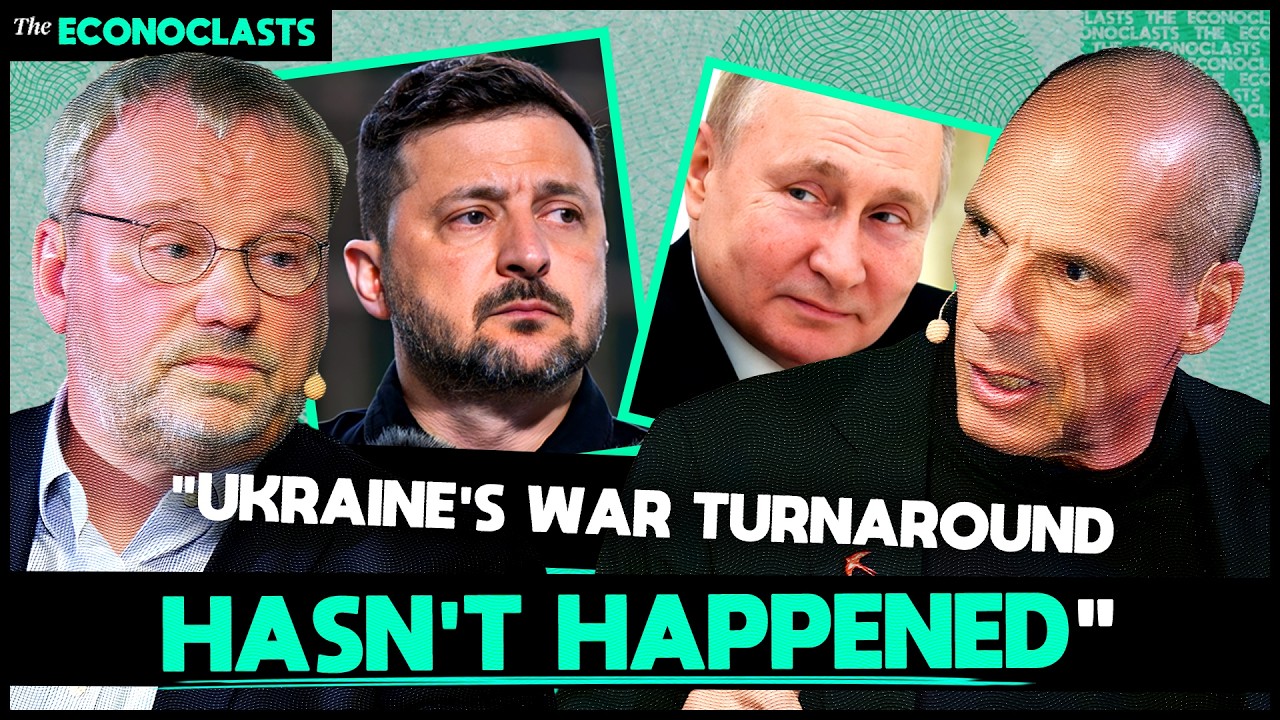
### The Ukraine War is Not What It Seems: A Battle for the Global Order
Introduction The war in Ukraine, now entering its third year, is widely portrayed as a straightforward conflict between a sovereign nation and an imperial aggressor. Yet, according to two of Europe’s most incisive economic and political thinkers, this narrative conceals a far more complex reali
Introduction
The war in Ukraine, now entering its third year, is widely portrayed as a straightforward conflict between a sovereign nation and an imperial aggressor. Yet, according to two of Europe’s most incisive economic and political thinkers, this narrative conceals a far more complex reality. In a recent discussion, former Greek Finance Minister Yanis Varoufakis and Financial Times columnist Wolfgang Münchau argued that the conflict is not merely a territorial dispute or a struggle for democracy. Instead, they contend it is a proxy war with profound implications for the structure of global capitalism, the future of the European Union, and the very nature of international relations.
The Economic Engine of the Conflict
Varoufakis and Münchau begin by dismantling the common assumption that this war is primarily about NATO expansion or Russian revanchism. They argue that the deeper driver is economic. The United States, they suggest, views the conflict as an opportunity to cripple a major geopolitical competitor—the European Union—by severing its cheap energy ties with Russia and forcing it into a state of permanent dependency on American liquefied natural gas (LNG) and military hardware.
“The war is not about Ukraine,” Varoufakis states bluntly. “It is about de-industrializing Europe.” He points to the sharp rise in energy costs following sanctions, which has shuttered factories across Germany and forced European manufacturers to relocate production to the United States, which offers cheaper energy and massive subsidies through the Inflation Reduction Act. This, he argues, is a strategic victory for Washington, achieved at the expense of its European allies.
The Illusion of European Unity
Münchau reinforces this point by highlighting the internal contradictions within the EU. While European leaders publicly champion a unified front against Russia, the economic pain is unevenly distributed. Germany, once the industrial powerhouse of Europe, has been hit hardest. The loss of Russian pipeline gas has not only raised costs but also destroyed the business model for key sectors like chemicals and automotive.
“The European project is crumbling from within,” Münchau warns. He notes that the war has accelerated a trend of “national selfishness,” where member states prioritize their own economic survival over collective solidarity. The EU’s response—borrowing jointly to fund defense and energy transitions—merely masks the underlying fracture. The bloc is now more divided than at any point since the eurozone crisis.
The Real Target: Russia’s Economic Model
Varoufakis and Münchau also challenge the narrative that the West seeks to “weaken” Russia. Instead, they argue the goal is to dismantle Russia’s unique economic model, which they call “petro-state capitalism with Chinese characteristics.” Russia, they explain, has managed to maintain a degree of sovereignty by controlling its own energy resources and avoiding the full embrace of Western financial markets. The war is a means to force Russia into a corner, either by collapsing its economy through sanctions or by triggering a regime change that would open its resources to Western corporations.
However, they caution that this strategy is backfiring. Russia has successfully pivoted its energy exports to China and India, while the ruble has recovered. The sanctions, rather than crippling Moscow, have accelerated the creation of a parallel global financial system that bypasses the dollar.
The Global South’s Rejection
A key insight from the discussion is the failure of the West to win the narrative war. Varoufakis and Münchau point out that the vast majority of the world’s population—in countries like India, Brazil, South Africa, and Indonesia—has refused to condemn Russia or join sanctions. This is not out of sympathy for Moscow, but because they view the conflict as a war of the rich against the rest.
“The Global South sees this as a war about keeping the dollar as the world’s reserve currency,” Varoufakis explains. “They are not fooled by the rhetoric of democracy and sovereignty. They see the West using Ukraine as a battering ram to preserve a system that has systematically impoverished them.”
Conclusion: A War Without an Exit
The conversation ends on a sobering note. Both analysts agree that there is no easy off-ramp. The United States has no incentive to stop the war, as it serves its strategic interests. Europe is trapped, unable to advocate for peace without appearing weak. Russia, meanwhile, cannot afford to lose without risking internal collapse.
“We are witnessing the birth of a new world order,” Münchau concludes. “But it is being born in fire and blood, and the West is not the one writing the rules.”
For readers seeking to understand the war beyond the headlines, Varoufakis and Münchau offer a necessary, if uncomfortable, corrective. The conflict in Ukraine is not what it seems—and its resolution will reshape the global balance of power for decades to come.
Related Coverage
Global Politics in Crisis: War, Migration, and Economic Strain Reshape a Fractured World Order
From the battlefields of Ukraine to the borders of Europe and the polling stations of Africa, this week’s developments paint a picture of a global system buckling under the weight of conflict, climate stress, and economic inequality. Old alliances are fraying, new pacts are forming, and ordinary citizens are bearing the brunt of decisions made by political and financial elites. The convergence of these crises reveals a world where the pursuit of geopolitical power and corporate profit increasingly collides with fundamental human needs and rights.
Power, Profit, and a Planet in Peril: How Conflict and Financial Warfare Are Reshaping Global Politics
The global order is buckling under the weight of converging crises, where the pursuit of geopolitical power and corporate profit is colliding with fundamental human needs. From the closed oil routes of the Strait of Hormuz and the escalating aerial war in Ukraine to drought-parched rivers across Europe and famine-stricken regions of Africa, a cascade of interconnected emergencies is diverting public resources away from social welfare and toward conflict, leaving the world's most vulnerable populations to bear the heaviest burden of inflation, displacement, and violence [1][2]. This systemic shift, driven by financial warfare, a militarization boom, and an overheating artificial intelligence (AI) debt bubble, is redrawing the map of global politics, forcing nations to choose sides and citizens to fight for survival [1][2].
Power, Profit, and a Planet in Peril: How Conflict and Financial Warfare Are Reshaping Global Politics
The global order is buckling under the weight of converging crises, where the pursuit of geopolitical power and corporate profit is colliding with fundamental human needs. From the closed oil routes of the Strait of Hormuz and the escalating aerial war in Ukraine to drought-parched rivers across Europe and famine-stricken regions of Africa, a cascade of interconnected emergencies is diverting public resources away from social welfare and toward conflict, leaving the world's most vulnerable populations to bear the heaviest burden of inflation, displacement, and violence [1][2].
Endless War, Fragile Peace: How a Global System Built for Conflict Fuels Crisis and Profiteering
A historic diplomatic breakthrough between the United States and Iran that briefly promised to unlock vital global oil routes is collapsing under renewed violence, even as wars in Ukraine and Gaza intensify and a record-breaking climate disaster threatens worldwide hunger. At the core of this interconnected crisis lies a global economic system that prioritizes military spending and corporate profit over human welfare, funneling public resources into endless conflict while ordinary citizens bear the costs of soaring prices, displacement, and deepening inequality.
# Power, Profit, and a Planet in Peril: How Financial Warfare, Climate Collapse, and the AI Boom Are Reshaping Global Politics
The global order is buckling under the weight of converging crises, where the pursuit of geopolitical power and corporate profit is colliding with fundamental human needs. From the closed oil routes of the Strait of Hormuz and the escalating aerial war in Ukraine to drought-parched rivers across Europe and famine-stricken regions of Africa, a cascade of emergencies is diverting public resources away from social welfare and toward conflict, leaving the world's most vulnerable populations to bear the heaviest burden of inflation, displacement, and violence [1][2].
Title: Power, Profit, and a Planet in Peril: How War, Climate Chaos, and Financial Greed Are Redrawing the Global Order
**Summary:** From the battlefields of Ukraine and the besieged Strait of Hormuz to Europe’s drought-parched rivers and the polling stations of Africa, a cascade of interconnected crises is exposing a global system where the pursuit of geopolitical power and corporate profit increasingly collides with fundamental human needs.