Netanyahu Vows West Bank Crackdown After 2 Soldiers Killed Days Before Election
Israeli Prime Minister Benjamin Netanyahu is threatening a massive military operation and a full closure of the occupied West Bank after Palestinian gunmen killed two Israeli soldiers near Hebron, just days before the October 27 election.
Israeli Prime Minister Benjamin Netanyahu has threatened a military operation in the occupied West Bank on a scale not seen in decades, along with a possible full closure of the territory, after Palestinian gunmen killed two Israeli soldiers near Hebron on Friday [269618][269041]. The attack came just days before the October 27 legislative election, and Netanyahu said a first step would involve displacing residents, searching homes, and destroying what he called "terrorist infrastructure" [269618]. He also said Israel is considering a "full closure" of the West Bank, without providing further details on what measures that would involve or when a decision would be made [269041]. The militant group Hamas did not claim responsibility for the attack but praised it [269618].
The escalation comes as Netanyahu, a hawkish leader whose political future depends on the upcoming vote, has chosen a strategy of war and isolation for his country, casting Israel as a besieged warrior entrenched in its fortress [268487]. He is currently in a tight race for a new term in Tuesday's vote [269618]. Former Israeli Prime Minister Ehud Barak has warned that Netanyahu will do "whatever it takes" to stay in power, describing him as acting "like a wounded animal" and criticizing the current government as "ultra-religious, ultra-nationalist, messianic" and "racist," saying it is leading the country "toward the abyss" [268338].
Netanyahu's main challenger, Gadi Eisenkot, is the only Israeli politician who can take power from the prime minister, campaigning with a friendly face and a hard line — but his policies look much like the current prime minister's [269207]. Eisenkot, 66, is the opposition's most popular figure before the election, though he has no guarantee he can form a governing coalition with other parties in the anti-Netanyahu bloc [269207]. His main credential is his military record: he served as chief of staff of the Israel Defense Forces (IDF) from 2015 to 2019, a period during which the army violently suppressed the Great March of Return protests at the Gaza border, where about 200 Palestinians died [269207]. He was also a key architect of the "Dahiye doctrine," which calls for a disproportionate response to any attack [269207].
Eisenkot opposes an independent Palestinian state, but does not want to follow the current government's path toward de jure annexation of occupied territories, recently saying that annexing the West Bank, with more than 3 million Palestinians, and Gaza, with another 2 million, would be "a disaster for the State of Israel" [269207]. One of his main promises is an official commission of inquiry into Hamas's October 7 attack, in which more than 1,200 people were killed and 251 taken hostage — probably his biggest difference with Netanyahu, who has resisted any commission investigating what went wrong [269207].
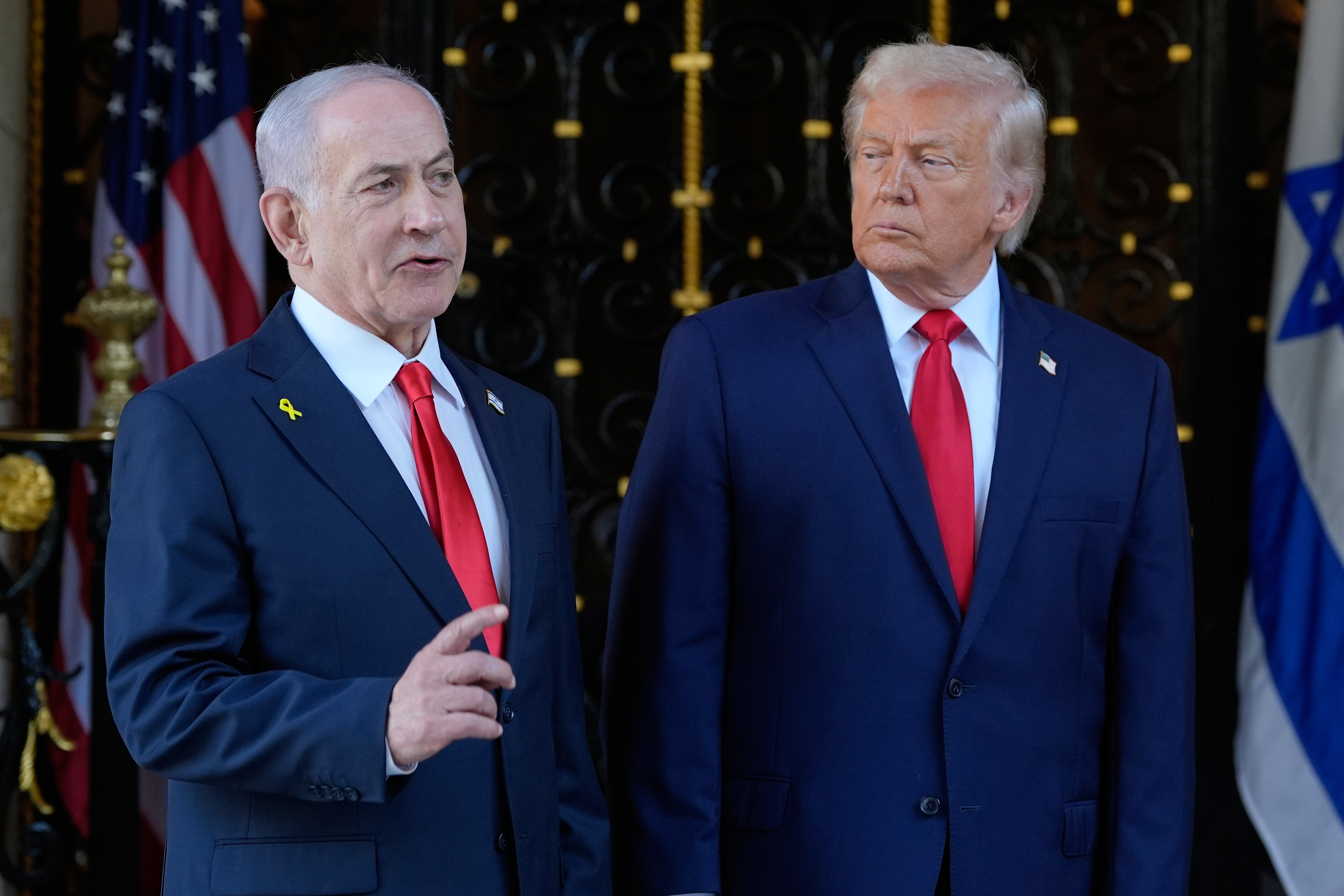
Former U.S. President Donald Trump has publicly endorsed Netanyahu for reelection, praising him in a social media post as "a Great Warrior Prime Minister" and "an even greater Partner for Peace," and highlighting his role in opposing the Islamic Republic of Iran [265982]. The endorsement comes as Netanyahu faces a challenging reelection campaign [265982].