Ceuta Migrant Crisis: Police Fire Shots as 1,700 Get Beds but Hundreds Left on Beach
Spanish authorities struggle to shelter thousands of migrants in the North African enclave as transfers continue amid tensions.
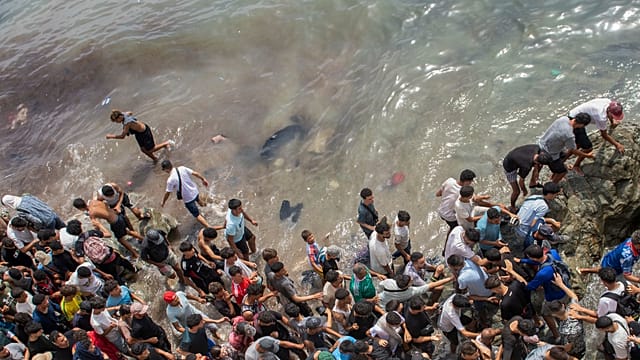
Police fired shots into the air in Ceuta on Friday morning as officers moved migrants away from beaches and struggled to control crowds pushing to get places at a tented site, with no injuries reported [244975]. The tense scenes came as authorities transferred 1,700 migrants to a new government camp at the port, though the operation barely reduced the size of beach settlements, leaving hundreds without shelter [244725].
The Spanish territory on the coast of North Africa has been grappling with a migration crisis that began more than 45 days ago. On July 30 and 31, more than 70,000 people crossed into Ceuta in an unprecedented and deadly rush, with most returning to Morocco within hours [240856]. Police moved a group of migrants to a temporary camp in the port area on Friday, leading to tense scenes between officers and the migrants [244648].
The transfer of 1,700 people to the port camp ended, but police told those left behind that the camp was full. Many had waited for hours in the sun without water or food [244725]. Ahmed, a Moroccan man in a wheelchair due to an infected leg wound, said he needed shelter but could not run like others. His friend Annas stayed with him instead of rushing to the camp, saying there should be room for sick people who cannot run [244725].
Kamal, who sleeps at the Trampolín beach settlement, woke at 4 a.m. to walk to Benítez and waited for hours, but police pushed some back and told them there was no space. It was his third failed attempt to enter a government center [244725]. After the transfer, settlements at Trampolín and Benítez looked much the same, with some tents standing empty after neighbors succeeded in entering the camp [244725].
Spain's National Court ruled Thursday that the government can open the temporary migrant reception camp at the port of Ceuta, rejecting a police union's request to halt the project [243418]. The court's three judges denied the urgent suspension sought by the Unified Police Union (SUP), which wanted construction stopped until safety, emergency and workplace conditions were guaranteed. The camp will occupy about 16,000 square meters of public land at the port and is designed to hold up to 1,700 people [243418].
The court said the Transport Ministry's decision was a temporary permit to use the land, requested by the Secretary of State for Migration. The Interior Ministry will decide security conditions for officers, migrants and other staff [243418]. The SUP had argued for alternatives such as a temporary hotel ship, warning that makeshift sites could create new security problems, and pointed to recent fires at migrant settlements as proof that fire and evacuation risks must be assessed first [243418].
Earlier, the Spanish government moved 839 people from the streets of Loma Colmenar to a new temporary shelter in the Rosales neighborhood, 45 days after the migration crisis overwhelmed the city [240963]. The goal is to clear the streets and identify thousands of migrants still living outdoors. According to Minister Ángel Víctor Torres, the government plans to complete these transfers in the coming days, with the ultimate objective of returning those whose asylum requests are denied [240963].
At 7:30 a.m., the group began a 40-minute walk to the new camp, escorted by police. The government chose walking over buses to reduce panic, with ministry sources explaining that migrants might think they were going to the border if taken by bus [240963]. The new facility, managed by the NGO CEPAIM, has 864 beds in large tents. While the transfer was mostly peaceful, some migrants at the front of the line were hit with police batons when they pushed too close to officers [240963].
Authorities plan to move migrants from other informal settlements, such as the beach at El Trampolín and the warehouses of El Tarajal. The government is also building a new camp at the port of Ceuta with space for 1,700 people, though this has sparked protests from local residents [240963]. Unaccompanied minors remain in a desperate situation, with hundreds of children still sleeping on the streets. While the law requires the city to protect them, many are turned away from adult centers [240963].
The situation in Ceuta is becoming more serious every day, with thousands of migrants wandering the streets with nowhere to go. Local leader Vivas has not responded to a formal request to move 500 minors to the mainland, and critics say the right is using every tool available to undermine the legitimate coalition government [244763].
Two dozen migrants say Spanish soldiers patrolling Ceuta beat and humiliated them, and the group has filed a complaint describing repeated abuse by troops on patrol in the Spanish enclave [243459].
Meanwhile, the 1,700 who entered the port camp lined up to receive identification bracelets and be searched before entering. One young man shouted "Hala Madrid" — a sign of joy at finally having a safe place to sleep, more than a month after the migration crisis began [244725].