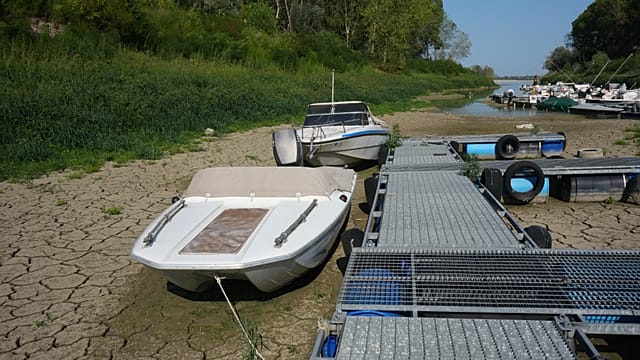
Title: Europe's Rivers Are Drying Up—Rhine Shipping Grinds to Halt as Drought Wipes Out Billions
Western Europe is in the grip of its hottest June-July on record, with soil moisture levels already lower than during the 2022 drought and major rivers like the Rhine and Danube hitting record lows, threatening agriculture, shipping, and energy production.
The Rhine, Germany's main shipping artery, has fallen to a new record low near the town of Kaub, forcing cargo vessels to carry only a fraction of their normal load [217505]. Some shipping operators have suspended services entirely, disrupting supply chains for goods like fuel and chemicals [216869]. Industry leaders warn the low water could erase Germany's economic growth for the year, with damages potentially reaching billions of euros [214477][217505].
The crisis extends beyond Germany. Romania may be forced to take its final functioning nuclear reactor offline as the Danube River drops to critical levels, cutting off cooling water for the Cernavoda power plant [216242]. The drought has also exposed dozens of Nazi-era shipwrecks in the Danube near the Serbian-Romanian border, some still containing unexploded ordnance [214819].
The European Union is projected to lose roughly 1% of its economic output this year—a blow that could erase over $200 billion in growth [216239]. The UK is bracing for its worst harvest season on record, while farmers across the continent report significant losses [216239][214710].
According to the EU's climate service, Copernicus, both June and July have broken all previous temperature records [215411]. The World Meteorological Organization (WMO) reports that the warming climate is making heatwaves more frequent, more intense, longer-lasting, and more widespread [217469]. Scientists warn that a strengthening El Niño could push global temperatures even higher later this year [215726].
The extreme heat has fueled devastating wildfires across several countries and pushed ecosystems to their limits [215411][217469]. Authorities are urging residents and industries to conserve water as the continent braces for more extreme weather [215726].