Russia’s Fuel Crisis Deepens: Drone Strikes Knock Out 42% of Refining Capacity, Sparking QR Code Rations and 18-Hour Gas Queues
Ukraine’s sustained drone campaign has crippled 42% of Russia’s oil refining capacity, causing $13.5 billion in damage and forcing the government to ration gasoline via QR codes as drivers face 18-hour waits and fistfights at the pump.
Russia’s domestic fuel supply has collapsed under the weight of a coordinated Ukrainian drone offensive that has systematically targeted oil refineries and fuel depots across the country. Ukraine’s military reports it has knocked out 42% of Russia’s refining capacity since August 2025, inflicting $13.5 billion in total damage [189845]. The strikes have hit refineries up to 1,100 kilometers inside Russian territory, including the Omsk refinery in Siberia—which processes roughly 10% of Russia’s total crude oil and supplies half of Siberia’s fuel—where a fire broke out after a drone attack [190927].
The damage has forced the Russian government to impose strict fuel rationing. Drivers in cities including Samara, Pskov, Irkutsk, and Sevastopol must now scan a QR code at the pump, which links to their vehicle’s registration and limits how much fuel each car can buy [190912][188833]. In some regions, drivers must enter a digital lottery just for the chance to purchase gasoline [188833].
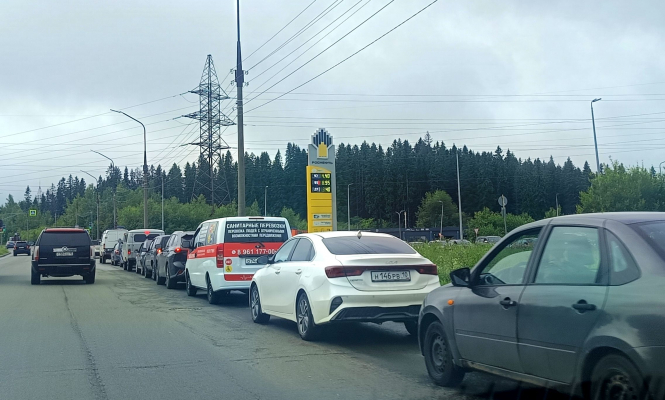
The shortages have created chaos at gas stations across the country. Alyona, a Russian driver, joined a queue for petrol at 11 p.m. and did not get served until 5 p.m. the next day—an 18-hour wait [190825]. Long lines stretch for blocks, and frustration has turned violent, with motorists reportedly breaking into fistfights while waiting for fuel [190826].
The crisis extends beyond consumer inconvenience. Regional governors are negotiating with the Kremlin over jerry-can quotas—limits on how much spare fuel residents can store—and some regional assemblies have voted not to convene, effectively suspending legislative work [188833]. The attacks have also hit an oil terminal in St. Petersburg, further straining supply routes [189625].
Ukraine’s military says the campaign, which it calls “long-range sanctions,” is designed to cut off the fuel that powers Russia’s military operations [189845]. The strikes have pushed fuel rationing into Moscow itself, forcing the Russian government to restrict gasoline and diesel supplies to civilians [189845].