Ukraine’s Front-Line Librarians: ‘Putin Is a Force of the Old’
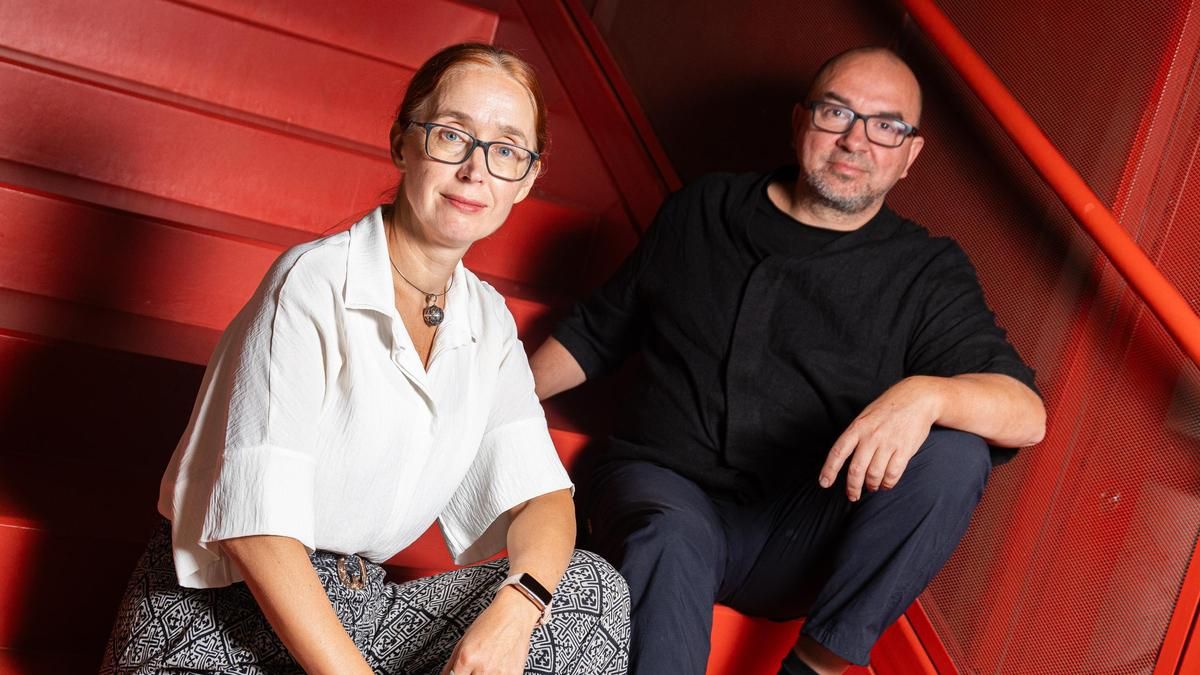
In villages just kilometers from the front line, Ukrainian writers Tetyana Ogárkova and Volodímir Yermólenko deliver books to people living under constant fire. Through these trips, they discovered that culture is not a luxury—it is central to Ukraine’s resistance.
“It is something central to our resistance,” Ogárkova says. In some villages, neighbors under bombardment asked the couple if they could recite their own poetry. In the southern city of Kherson, young people requested books for underground shelters where they were building libraries after Russian attacks destroyed most of the originals.
These journeys form the backbone of *La vida en el límite. Ser ucraniano hoy* (“Life at the Limit: Being Ukrainian Today”), a book Ogárkova wrote with her husband Yermólenko, a philosopher and president of PEN Ukraine. Published in Spain by Libros del Asteroide, it blends chronicle and essay—what the authors call “philosophical reporting.”
The book draws on testimony, including the story of eight-year-old Rita, who was reading in her garden in eastern Ukraine when a Russian cluster bomb killed her. These accounts interweave with philosophical reflections and fragments from Ukrainian writers, focusing not only on destruction but on what allows life to continue during invasion.
**Why did you write this book?**
**Volodímir Yermólenko:** I could not not write it. We are people of literature, of words. We traveled to the front and tried to capture what we saw and heard. We started with a diary, but realized a diary was not enough. It became a book of reflection—a natural continuation of our travels and volunteer work.
**Tetyana Ogárkova:** It is not a reporting book. It combines reporting and philosophy—we call it “philosophical reporting.” It is a journey through the landscape, because we have been to almost every point on the front line. But while traveling geographically, we also traveled in time. We read Ukrainian authors, modern and from the 19th century, trying to make sense of this war. This conflict did not begin in 2022 or 2014. It began long before we were born—this Russian imperialist view of Ukraine goes back much further.
**You explore the concept of “limit.” What does it mean?**
**T. O.:** The term has two meanings here. First, the limit of the life we know. What does it mean when you travel and see no people, no young people, no daily life, no homes? What is the limit between life and death? Between construction and destruction? But also, when we say “Ukraina,” in our language “Krai” means “limit” or “edge.” Historically, Russians referred to Ukraine as marginal, peripheral, something unimportant. The central idea of our book is that the Ukrainian struggle is now at the center of the European problem. What we defend in Ukraine is not residual—it is fundamental for every European capital: democracy, freedom, human dignity, the way of life you value as much as we do. Our “limit” is becoming the center of what is happening on the European continent.
**You say words lose their meaning in war. How has war transformed language?**
**V. Y.:** The Ukrainian writer Victoria Amelina wrote that we live in a reality “as if language were dismantled by a shell.” In cultures with long periods of peace, one of the great treasures is how writers interact with texts already written. During war, you experience silence—language becomes inadequate for what you see and feel. Language as a vehicle for meaning has lost its power. Writers try to recover that force, so their language is different. There are many experiments with form. Our attempt to mix empirical reality with ideas is one way. Poetry is another—there is much documentary poetry. Theater plays an important role. This gives culture a great push, forcing it to seek new expressions.
**Victoria Amelina, killed in a Russian attack, is a major presence in the book.**
**T. O.:** For us it is a very personal story. We met Victoria during the war. Before, we had seen each other a couple of times, but we were not friends. When the war started, we began traveling to the front together. The story of Volodímir Vakulenko united us—we traveled to see his mother, Olena. Victoria was the first to arrive after the liberation of the Izium area in autumn 2022. We arrived a couple of weeks later. Olena was not sure what was happening. Her son had disappeared, but she told me: “I feel in the depths of my heart that he is still alive.” Then they discovered the bodies in the cemetery outside Izium.
Victoria was deeply involved and found the diary. I remember how happy she was that it would be published for the Kyiv Book Arsenal. Her last public appearance was at the Arsenal, reading her poems while Volodímir played piano. She was going to Paris—she had a fellowship. She was talking about school for her son, about renting an apartment. There was a Colombian delegation, and they decided to go east. She was injured on my birthday, June 27. I got a call from a mutual friend saying she was seriously wounded, in a coma, transferred to Dnipro. We went and spent a day at the hospital. She died on July 1, Volodímir Vakulenko’s birthday.
In the diary’s prologue, she wrote that as long as someone keeps reading a writer, that writer has won. She concluded: “Volodímir Vakulenko won.” Then PEN Ukraine had to translate an unfinished manuscript of Victoria’s. The title was *Looking at Women, Looking at War*. Those of us in her circle have a responsibility to make her victory possible, because for a writer it is extremely important to be published. With the war, she found new inspiration for what she called “documentary poetry.” It was also published after her death. In a way, we can say it is Victoria’s victory, but unfortunately she is no longer with us.
**Books are a recurring element. Some have called this a “war against books.” Why are they important to Russians?**
**V. Y.:** Because Russians believe that what makes Ukrainians Ukrainian is culture and language—and therefore books. That is why in the 19th century they tried to ban the Ukrainian language. It was banned in public life for about 40 years in the Russian Empire. Later, during the Soviet Union, it was not banned but was artificially brought closer to Russian through dictionaries and editors. The goal was to turn Ukrainian into something that was not a real language but simply a ridiculous version of Russian.
They achieved much this way, because their idea is an assimilationist empire—what we call the empire of uniformity. They want everyone to be the same, with no differences. They want to exterminate the Ukrainian nation, but that does not mean killing every Ukrainian. They want to exterminate those who are the main bearers of Ukrainian identity, including writers. This happened in the 1930s. Now they destroy books so people read less. Because in Ukraine right now there is a kind of renaissance of reading: people read a lot, write a lot, buy books. Russians understand that this is one of the fundamental things preventing Ukrainians from becoming Russians.
**T. O.:** We know that when Russians occupy a town, one of the first things they do is go to the school and take all textbooks, replacing them with Russian books. We know because we have been there and spoken with people. For them it is important to simply erase Ukrainian identity and turn Ukrainian children into Russian children. If occupation lasts, new babies will be born in these territories and receive Russian education, Russian books, Russian language.
**You accuse Russia of genocide, linked to the destruction of culture.**
**V. Y.:** Yes. If we look at how the concept of genocide was formulated by Raphel Lemkin—a Polish Jew who studied in Lviv, in western Ukraine—he formulated the idea of how a group is exterminated. One way is to kill all its members or most of them. Another is to annihilate the group’s consciousness of identity, so that the group stops recognizing itself as such. Lemkin wrote extensively about this. Thanks to him, the concept of genocide exists internationally. But not as he wanted, because it is understood mainly as physical extermination. These cultural aspects were removed from international law by the Soviets.
**Preserving a language becomes a form of resistance. Many Russian-speaking Ukrainians switched to Ukrainian after the invasion.**
**T. O.:** We have often seen in territories near the front line that even older people who lived in the Soviet Union and spoke Russian began to learn and speak Ukrainian just to differentiate themselves from Russian, because Russian is like a trigger. It is the language of the occupier. Sometimes, when Volodímir and I are abroad and hear Russian, it is like an imminent signal of danger. Many people understand that we should do everything possible to speak our language, even for security reasons.
**You say Putinism has “all the features of fascism except one”: it is an ideology of the old, not the young.**
**V. Y.:** Fascism attracted the young. We see in Europe now that it attracts the young. In Russia, the dynamic is different—it is an ideology of the elderly, of those who were young in Brezhnev’s time, in the 1970s. Russia has never had democracy, so describing Russia as fascist is partly correct because it has many elements of fascism, but it lacks that component of carrying out “a conservative revolution against democracy.” It is a very old inertia of Russian imperialism. People outside Russia do not really understand that Putin is a force of the old.
**You argue that “the criticism of the left has been impotent before Russian imperialism.” Why?**
**V. Y.:** Outside Ukraine, the left has a mistaken perception of the country. It simply does not understand a very important element of Ukrainian identity: Ukraine was born as an idea from left-wing ideas. You cannot understand Ukraine without considering the left-wing political movements of the 19th and early 20th centuries. Our key 19th-century thinkers, like Kostomarov or Drahomanov, were more left-wing. They dreamed of equality and a society without great hierarchies. In the 19th century, the idea of an independent Ukraine was conceived not by a right-wing thinker but by a Marxist thinker: Yulian Bachynsky.
The idea of an independent Ukraine came from the left, not the right. Why? Because the idea of the nation was a left-wing idea in the 19th century—it was contrary to monarchies, empires. When Ukraine became independent in 1917 and 1918, it was a left-wing republic. It was called the Ukrainian People’s Republic. In the language of the time, “people’s” meant left-wing, because it came from the grassroots. Of course, different ideological currents shaped Ukraine, especially in the 1930s, which were more right-wing because the idea of a left-wing Ukraine collapsed in the Soviet Union. What much of the Western left does not understand about Ukraine is that imperialism, which they associate with capitalism, does not always exist only in capitalism.
**In what sense?**
**V. Y.:** Imperialism can also exist in socialism. The Soviet Union itself was socialist imperialism or communist imperialism. Imperialism is not limited to one ideology. There can be liberal imperialism, left-wing, right-wing. One of the greatest paradoxes is that Russia attracts some left-wing movements in Europe. But Russia is the opposite: a very hierarchical system, no equality, savage capitalism, highly militarized, not pacifist at all. The European left is focused on criticizing capital—which is good, it should—but Putin’s Russia makes this capitalism even worse because it is an oligarchy in the full sense.
This posture seems a bit lazy. There are many left-wing people in Europe with a very accurate position on Ukraine. But those who simply reproduce old stereotypes about anti-Americanism seem lazy to me—and, well, now the United States and Russia are allies. They lack the will to think.
**What do you think of the White House’s shift on Russia and Ukraine?**
**T. O.:** Trump is a huge problem for Ukraine. But this is not limited to Ukraine. Trump is a threat to Europe. He is trying to exclude Ukraine from the geopolitical equation about the future. But in doing so, he also tries to exclude Europe. By speaking directly with Putin, by making concessions, they are trying to decide things without Europe and without Ukraine. This is the worst possible scenario, because they are trying to decide the course of the war as superpowers, without considering us. It is extremely dangerous for everyone.
Trump is trying to destroy NATO. The old geopolitical order has come to an end. You Europeans are used to the security umbrella the United States has provided since the end of World War II. It is over. We must realize that we must defend ourselves. In this context, Ukraine is no longer a problem—perhaps it is part of the solution. When we speak with soldiers, they tell us that what happened in 2022 resembled the wars of before. But it is no longer just tanks, artillery, and maneuvers. Now it is a very different war, and unfortunately Ukraine has become a laboratory for this new type of war. Some European leaders still try to keep Trump inside and hope he will leave and be replaced, but it could be a long-term change.
**The book says the war will not end by satisfying Russian ambitions. How will it end?**
**V. Y.:** We believe in our victory. It must be understood that if Russia does not destroy Ukraine, that is already a victory for us. Of course, we are going through difficult moments. But difficult moments forge strong people.