Ukraine's Front-Line Librarians: 'Putin Is a Force of the Old'
Ukrainian writers Tetyana Ogárkova and Volodímir Yermólenko describe how books and culture have become central to Ukraine's resistance in their new book, "Life at the Limit: Being Ukrainian Today."
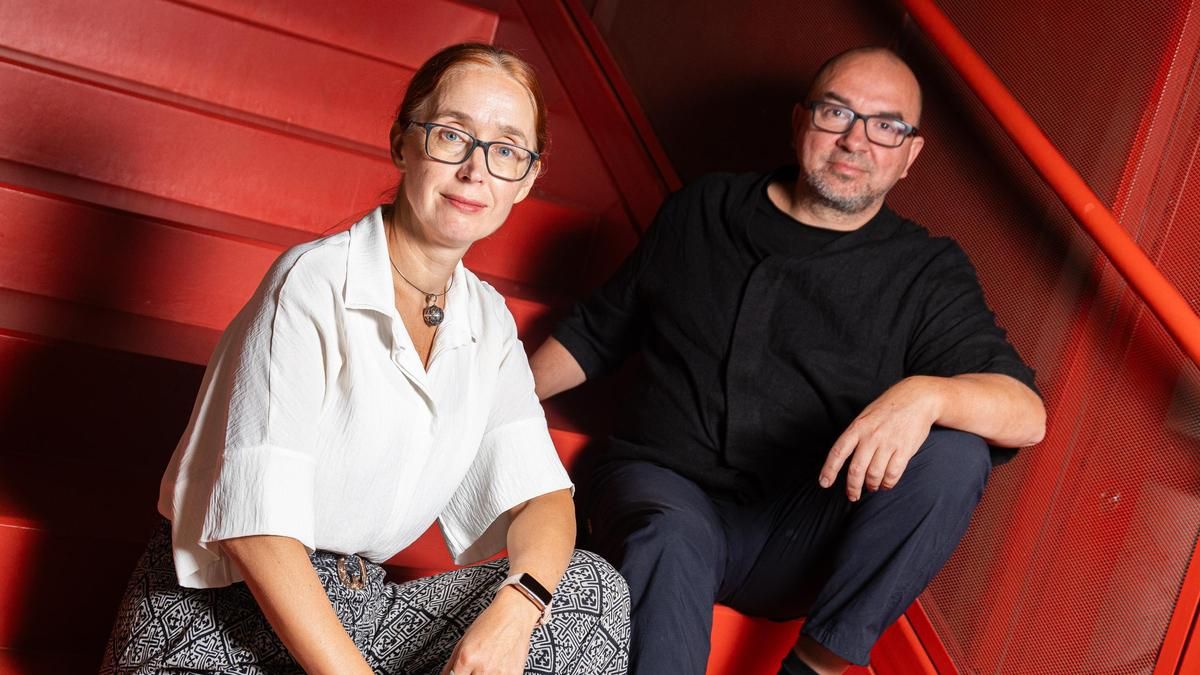
In villages just kilometers from the front line, Ukrainian writers Tetyana Ogárkova and Volodímir Yermólenko deliver books to people living under constant fire. Through these trips, they discovered that culture is not a luxury—it is central to Ukraine's resistance [1].
"It is something central to our resistance," Ogárkova says. In some villages, neighbors under bombardment asked the couple if they could recite their own poetry. In the southern city of Kherson, young people requested books for underground shelters where they were building libraries after Russian attacks destroyed most of the originals [1].
These journeys form the backbone of *La vida en el límite. Ser ucraniano hoy* ("Life at the Limit: Being Ukrainian Today"), a book Ogárkova wrote with her husband Yermólenko, a philosopher and president of PEN Ukraine. Published in Spain by Libros del Asteroide, it blends chronicle and essay—what the authors call "philosophical reporting" [1].
The book draws on testimony, including the story of eight-year-old Rita, who was reading in her garden in eastern Ukraine when a Russian cluster bomb killed her. These accounts interweave with philosophical reflections and fragments from Ukrainian writers, focusing not only on destruction but on what allows life to continue during invasion [1].
Yermólenko said he felt compelled to write the book. "I could not not write it. We are people of literature, of words," he said. "We traveled to the front and tried to capture what we saw and heard. We started with a diary, but realized a diary was not enough. It became a book of reflection—a natural continuation of our travels and volunteer work" [1].
Ogárkova described the work as a blend of reporting and philosophy. "It is a journey through the landscape, because we have been to almost every point on the front line," she said. "But while traveling geographically, we also traveled in time. We read Ukrainian authors, modern and from the 19th century, trying to make sense of this war. This conflict did not begin in 2022 or 2014. It began long before we were born—this Russian imperialist view of Ukraine goes back much further" [1].
The authors explore the concept of "limit," which carries two meanings in their work. "The term has two meanings here. First, the limit of the life we know," Ogárkova said. "But also, when we say 'Ukraina,' in our language 'Krai' means 'limit' or 'edge.' Historically, Russians referred to Ukraine as marginal, peripheral, something unimportant. The central idea of our book is that the Ukrainian struggle is now at the center of the European problem. What we defend in Ukraine is not residual—it is fundamental for every European capital: democracy, freedom, human dignity" [1].
The book also addresses how war transforms language. Yermólenko cited Ukrainian writer Victoria Amelina, who wrote that Ukrainians live in a reality "as if language were dismantled by a shell." He said that during war, "language becomes inadequate for what you see and feel. Language as a vehicle for meaning has lost its power. Writers try to recover that force, so their language is different" [1].
Amelina, killed in a Russian attack, is a major presence in the book. Ogárkova described their friendship and collaboration during the war, including their work to document the story of Volodímir Vakulenko, a writer killed during the Russian occupation. "Victoria was deeply involved and found the diary," Ogárkova said. "Her last public appearance was at the Arsenal, reading her poems while Volodímir played piano" [1].
Amelina was injured on Ogárkova's birthday, June 27, and died on July 1, Vakulenko's birthday. In the diary's prologue, she wrote that as long as someone keeps reading a writer, that writer has won. She concluded: "Volodímir Vakulenko won" [1].
The authors argue that Russia targets Ukrainian books and culture as part of a broader campaign against Ukrainian identity. "Russians believe that what makes Ukrainians Ukrainian is culture and language—and therefore books," Yermólenko said. "That is why in the 19th century they tried to ban the Ukrainian language. It was banned in public life for about 40 years in the Russian Empire. Later, during the Soviet Union, it was not banned but was artificially brought closer to Russian" [1].
Ogárkova added that when Russians occupy a town, "one of the first things they do is go to the school and take all textbooks, replacing them with Russian books. For them it is important to simply erase Ukrainian identity and turn Ukrainian children into Russian children" [1].
Yermólenko accused Russia of genocide, citing the work of Raphel Lemkin, a Polish Jew who studied in Lviv and formulated the concept of genocide. "One way is to kill all its members or most of them. Another is to annihilate the group's consciousness of identity, so that the group stops recognizing itself as such," Yermólenko said. "These cultural aspects were removed from international law by the Soviets" [1].
The authors noted that many Russian-speaking Ukrainians have switched to Ukrainian since the invasion. "We have often seen in territories near the front line that even older people who lived in the Soviet Union and spoke Russian began to learn and speak Ukrainian just to differentiate themselves from Russian, because Russian is like a trigger. It is the language of the occupier," Ogárkova said [1].
Yermólenko argued that Putinism has "all the features of fascism except one": it is an ideology of the old, not the young. "Fascism attracted the young. We see in Europe now that it attracts the young. In Russia, the dynamic is different—it is an ideology of the elderly, of those who were young in Brezhnev's time, in the 1970s," he said. "People outside Russia do not really understand that Putin is a force of the old" [1].
The authors also criticized parts of the Western left for misunderstanding Ukraine. "Outside Ukraine, the left has a mistaken perception of the country. It simply does not understand a very important element of Ukrainian identity: Ukraine was born as an idea from left-wing ideas," Yermólenko said. "The idea of an independent Ukraine came from the left, not the right. Why? Because the idea of the nation was a left-wing idea in the 19th century—it was contrary to monarchies, empires" [1].
He added that imperialism is not limited to capitalism. "Imperialism can also exist in socialism. The Soviet Union itself was socialist imperialism or communist imperialism. Imperialism is not limited to one ideology," he said [1].
Regarding the shift in United States policy under President Donald Trump, Ogárkova said Trump is "a huge problem for Ukraine. But this is not limited to Ukraine. Trump is a threat to Europe. He is trying to exclude Ukraine from the geopolitical equation about the future. But in doing so, he also tries to exclude Europe" [1].
She warned that the old geopolitical order has ended. "You Europeans are used to the security umbrella the United States has provided since the end of World War II. It is over. We must realize that we must defend ourselves. In this context, Ukraine is no longer a problem—perhaps it is part of the solution" [1].
Despite the challenges, Yermólenko expressed confidence in Ukraine's eventual victory. "We believe in our victory. It must be understood that if Russia does not destroy Ukraine, that is already a victory for us. Of course, we are going through difficult moments. But difficult moments forge strong people" [1].