Trump's Grip on Congress at Stake: The Midterms That Could Halt His Agenda
Donald Trump returned to the White House in January 2025 with many promises. All of them centered on one goal: testing the limits of presidential power and governing above the other branches. He has done this with everything — from a unilateral trade war using legislative shortcuts, to an executive order attempting to end birthright citizenship, to deportations without judicial guarantees, to military actions without congressional approval.
**Congress Is Up for Grabs**
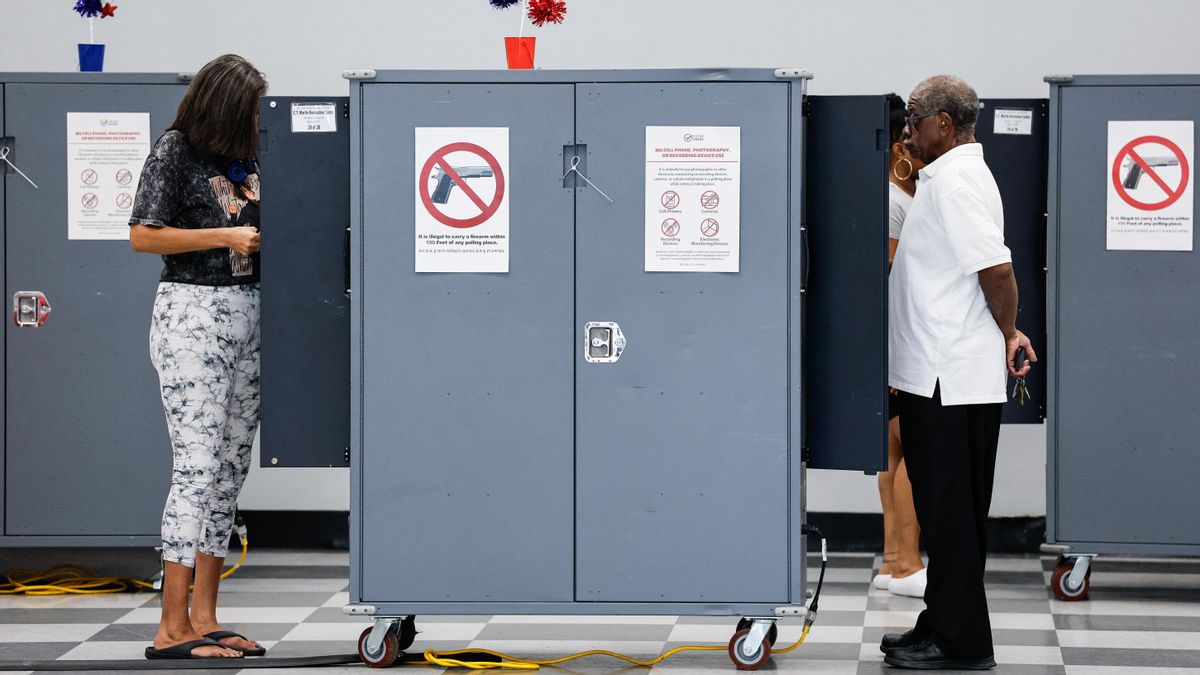
The US president holds narrow majorities in the House of Representatives (218-214) and the Senate (53-47). On Tuesday, voters will decide all 435 House seats and 35 Senate seats. Polls suggest Trump is about to lose control of the House, while he may keep the Senate, though with a smaller margin than before.
If Trump loses just one chamber, he will struggle to pass legislation, which requires approval from both. A House controlled by the opposition also means two years of hearings, investigative committees, and oversight of government overreach — including agencies like ICE, Trump's enforcement arm for immigration crackdowns.
The House could also launch impeachment proceedings. Even if such a move would likely fail — it requires 67 senators to remove a president — it would put the White House under intense pressure during the second half of a presidency whose leader cannot run for reelection.
In short, a shift in Congress would not only block Trump's far-right agenda but also strengthen checks on his authoritarian drift. It could also block budgets with excessive military spending and pass resolutions limiting the president's war powers.
**Trump's Electoral Tricks**
The president has spent months working to prevent an electoral upset. He has pushed redistricting processes to benefit Republicans (*gerrymandering*) in various parts of the country.
In North Carolina, for example, a new electoral map split a district with a large African American population — mostly Democratic — and distributed its voters across several districts. This dilutes their electoral weight and favors Republicans.
In other words, without changing votes, electoral borders are redrawn to influence who wins seats. About one-third of electoral districts have changed between 2025 and this year, and most changes have favored Republicans.
**What Can We Expect?**
Historically, in midterm elections, American voters tend to punish the president's party by voting against it. Trump knows this, which is why he has tried to frame these elections as a referendum on himself. However, with approval ratings at just 30%, making voters think he is on the ballot may hurt Republican candidates more than help them.
**Campaign Themes**
Among voters' main concerns are the immigration crackdown — which has led to the killing of US citizens by federal agents, such as Renée Good and Alex Pretti in Minneapolis earlier this year — and the rising cost of living (*affordability*), driven by unilateral tariffs and an illegal war against Iran launched on February 28 that is disrupting global energy trade.
Corruption — Trump's wealth has grown by two billion euros since he became president — and the genocide in Gaza, in a context marked by US support for Benjamin Netanyahu, have also generated deep distrust.
**Key Senate Battles**
Among the most contested Senate races are those in Michigan, Ohio, Alaska, Maine, and Texas. New Hampshire, Iowa, South Carolina, and Kansas also have close contests, though to a lesser degree.
The seat most likely to flip from Republican to Democrat is in North Carolina, where former Republican Party chairman Michael Whatley and former Democratic governor Roy Cooper are competing for the seat of Republican Thom Tillis, who is retiring.
In Ohio, incumbent Republican Senator Jon Husted and former Democratic Senator Sherrod Brown are competing in a special election to complete the term of the seat left vacant when JD Vance became vice president in January 2025.
In Alaska, Republican Senator Dan Sullivan seeks reelection against Democratic candidate and former congresswoman Mary Peltola. These elections have been surrounded by controversy over Democratic maneuvers to run an independent candidate with the same name as the Republican in order to split the vote. The Justice Department has filed a lawsuit to block the results if the Republican incumbent loses. However, a federal judge in Alaska dismissed the lawsuit, warning that ordering authorities to investigate voter intent would violate the constitutional right to a secret ballot.
The Michigan battle is also highly significant. Progressive Democratic candidate Abdul El-Sayed is trying to keep the seat for Democrats against Republican Mike Rogers. If El-Sayed wins, he would be the first Muslim elected to the US Senate. The race was disrupted in its final stretch after Democratic primary loser Haley Stevens confirmed her official support for Republican Mike Rogers, appearing with him at a church service in Detroit. El-Sayed called the move a "betrayal," while Trump applauded it.
In Texas, Democrat James Talarico has also been insulted by Trump. He is running against a Republican backed by the president, Ken Paxton, who has been embroiled in corruption cases and was impeached as Texas attorney general by his own party in 2023 over suspicions of bribery and abuse of power.
In Maine, Republican Senator Susan Collins faces a tough battle against Democrat Troy Jackson, recruited at the last minute after progressive Graham Platner resigned over sexual harassment allegations.
Iowa and Kansas, until now Republican strongholds, are being threatened by Democrats. In Kansas, Democrat Adam Hamilton leads by a narrow margin over Republican Roger Marshall. In Iowa, Democrat Josh Turek is in a tight race with Republican Ashley Hinson.
In New Hampshire, there is a slight tilt toward Democrats in the contest between Chris Pappas and Republican John E. Sununu. In South Carolina, which leans Republican, there is a tough fight between Republican Darline Graham and Democrat Annie Andrews.
In Florida, the electoral battle features emerging candidates such as progressive Democrat Angie Nixon (DSA), who is running to unseat Republican Ashley B. Moody. For the House, Democrat Eliott Rodríguez is challenging María Elvira Salazar, who publicly broke with Trump during her campaign to criticize his immigration policies amid eroding support among her electorate.
**The Progressive Wave**
The DSA (Democratic Socialists of America) aims to multiply its representation in the House from two to seven candidates: Alexandria Ocasio-Cortez (New York) and Rashida Tlaib (Michigan) could be joined by Melat Kiros (Colorado), Darializa Ávila Chevalier (New York), Claire Valdez (New York), and Chris Rabb (Pennsylvania).
The momentum of this wave comes from the influence of the genocide in Gaza on current electoral dynamics. Beyond a political agenda to the left of the Democratic establishment, it is characterized by a refusal to accept funding from corporations and lobbying groups.
The risk for the progressive wave lies in a hypothetical defeat of El-Sayed in Michigan. His victory would prove that candidates can win by moving left in a *purple state* — sometimes Republican, sometimes Democratic. But his defeat would mean Democrats lose a Senate seat in a tight battle to regain the chamber, feeding criticism of the party's progressive wing.