Trump’s $5,000 Check Promise: A Desperate Bid to Buy Votes?
Part of composite article Trump’s Midterm Meltdown: Court Losses, $5,000 Bribes, and a Fed He Called ‘Hostile’ View full article →
With 50 days until the midterm elections, President Trump is making a bold promise: $5,000 for every American adult if Republicans win on November 3. The announcement, made at the Republican convention, raises a simple question — why would a president who claims the economy is booming need to offer such a massive cash incentive?
The timing is telling. The war in Iran has pushed diesel prices above $6 a gallon in the U.S., and Trump’s approval rating has hit historic lows. Only one-third of American adults approve of his job performance, according to a July poll by The Associated Press-NORC Center. That is down from 42% when he took office.
At the convention, Trump framed the midterms as a personal referendum. “On election day, November 3, you have to do me a favor,” he told the crowd. “You have to go out and vote, and imagine I am on the ballot. Because, in a way, I am on the ballot.”
He also joked about cheating. “I promise I will try to cheat like hell, just like they do,” he said, while asking supporters to raise their right hands in a pledge of loyalty to him.
The $5,000 payment — which Trump calls “Trump dividends” — would cost over $1.3 trillion if paid to all 270 million American adults. The Treasury already runs an annual deficit of nearly $1.8 trillion, and national debt has passed $40 trillion this year. Interest payments alone for fiscal year 2026 will reach about $1.27 trillion — roughly the same as the cost of Trump’s proposal.
This is not the first time Trump has promised checks. He previously said savings from the Department of Government Efficiency (DOGE) and tariff revenues would fund payments of $2,000 or more. None of that money was ever distributed.
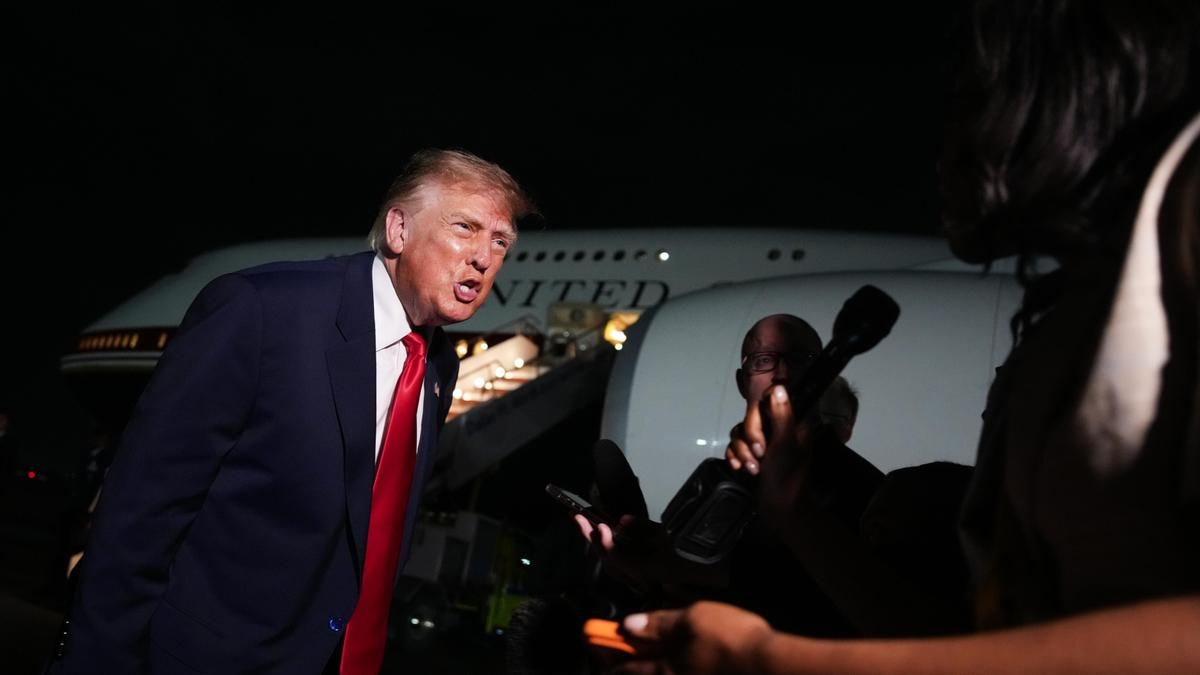
Trump now says Congress may not need to approve the payments. “We think we don’t,” he told CBS, though he did not explain how he could spend over a trillion dollars without legislative approval. Later, at an airport in Dallas, he denied the money was meant to mobilize voters — despite having said it would be paid “if Republicans win.” He described it instead as a “reward” for citizens who endured Joe Biden’s presidency.
The economic backdrop is difficult. Inflation sits at 3.4%, and the Federal Reserve may raise interest rates at its September 16 meeting. Trump has spent months demanding rate cuts. Oil prices have again topped $100 a barrel. Consumer confidence remains low as gasoline prices rise and wages struggle to keep up with inflation.
Meanwhile, courts are pushing back on Trump’s election-related actions. On Thursday, an appeals court upheld a block on his decree limiting mail-in voting, agreeing that the president lacks authority to regulate state election policy. The Supreme Court is already reviewing the same case. In a separate lawsuit in Washington, D.C., Democrats and civil rights groups are also trying to stop the decree.
In another blow, the Supreme Court rejected a new electoral map for Missouri that Trump and his allies had supported. They hoped the map would help Republicans win an extra seat on November 3.
Trump has promised to campaign hard for Republicans in tight races over the coming weeks. But his popularity may be a double-edged sword. Loyalty to Trump can help in Republican primaries, where his supporters hold strong influence. In a general election, however, it could hurt candidates — especially if Trump’s approval numbers do not recover.
A Quinnipiac University poll released Thursday found that 46% of registered voters believe the Democratic Party is more in touch with the concerns of most Americans. Only 35% said the same about the Republican Party.
Trump’s response to these numbers is more Trump. He has turned the midterm elections into a plebiscite on himself, asking voters to imagine his name on the ballot. And in return for their vote, he offers a $5,000 check — but only if his party wins.
Even if it means putting a price on the vote.