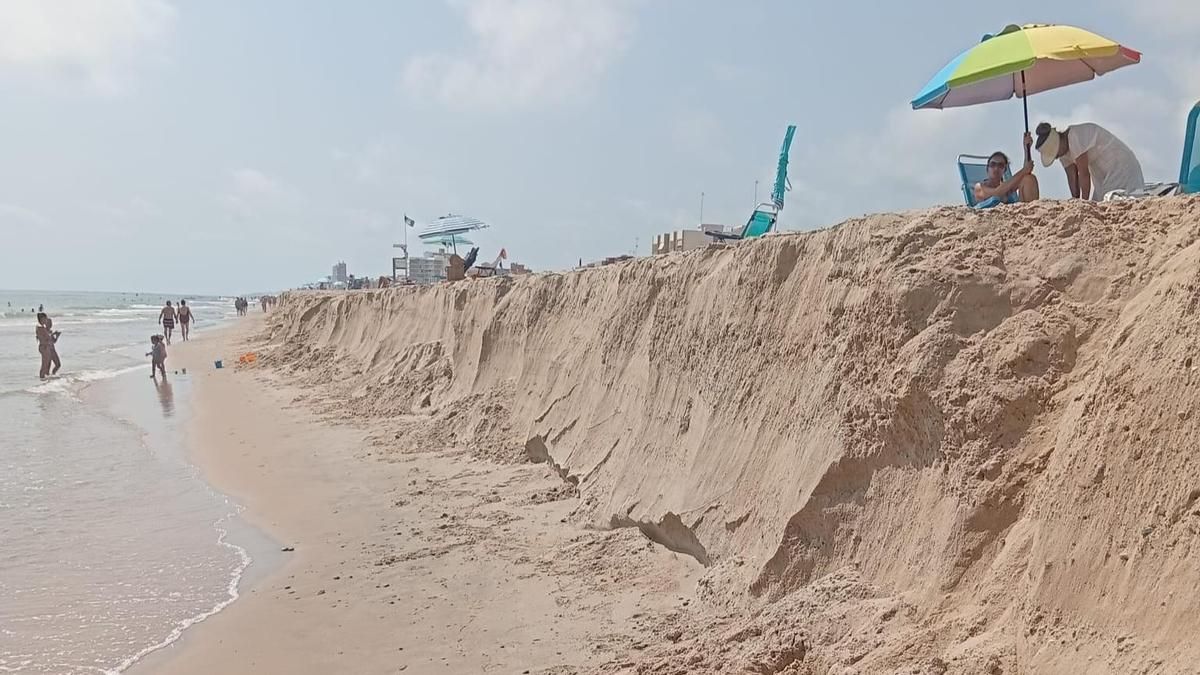
Valencia’s “repaired” beaches are collapsing into 5-foot sand cliffs
VALENCIA, Spain — Tourists and locals heading to the beach this summer are finding a new obstacle: walls of sand up to 1.5 meters (nearly five feet) high that block the path to the water.
The steep drops, caused by recent storms, have appeared along several recently regenerated beaches in the Valencia region, creating a serious safety and access problem for elderly people, children, and those with reduced mobility.
The most striking case is at Playa del Perelló, in the Socarrat area. There, the sea has carved a nearly vertical sand cliff stretching about 40 meters. Many bathers are forced to walk long distances to find a safe entry point into the water.
Local officials say the problem stems from a lack of maintenance by Spain’s central government. The Perelló city council claims it lacks both the technical expertise and legal authority to fix a project carried out by another administration.
Perelló is not alone. The nearby municipality of Sueca has seen the same issue return just one month after workers fixed a similar cliff at Motilla beach.
The problem is even more severe south of the Port of Valencia. At La Garrofera, near El Saler, a large sand ledge has formed in an area that was part of one of Spain’s largest beach restoration projects.
The Ministry for Ecological Transition poured over 3.2 million cubic meters of sand into the beaches of l’Arbre del Gos, El Saler, and La Garrofera, at a cost exceeding €35 million, aiming to restore the coastline to its 1960s state.
The new cliffs have reignited a political dispute over the expansion of the Port of Valencia. Environmental impact studies point to the port as a major cause of coastal erosion in the southern beaches, which also threatens the nearby Albufera Natural Park. Adding to the issue, the Turia River now carries far less sediment to the coast than it once did, meaning the beaches receive less natural sand to replace what the waves wash away.
The finger-pointing continues: city councils demand that the national Coastal Authority (Costas) solve the problem, while Costas insists that local municipalities are responsible for maintaining and ensuring access to their beaches.
Sueca’s council suspects that the massive volume of new sand—up to 700,000 cubic meters—may be behind the recurring cliffs, and says the problem reappears after every intervention.
In Perelló, the council has begun smoothing some areas with its own equipment, but stresses that its resources are limited. Costas, meanwhile, argues that storm-formed sand steps can occur on any beach, even those that were never restored.
For now, the debate continues—while beachgoers face a new summer reality: towering sand walls at the shoreline, forcing them to scramble for a way down to the sea.