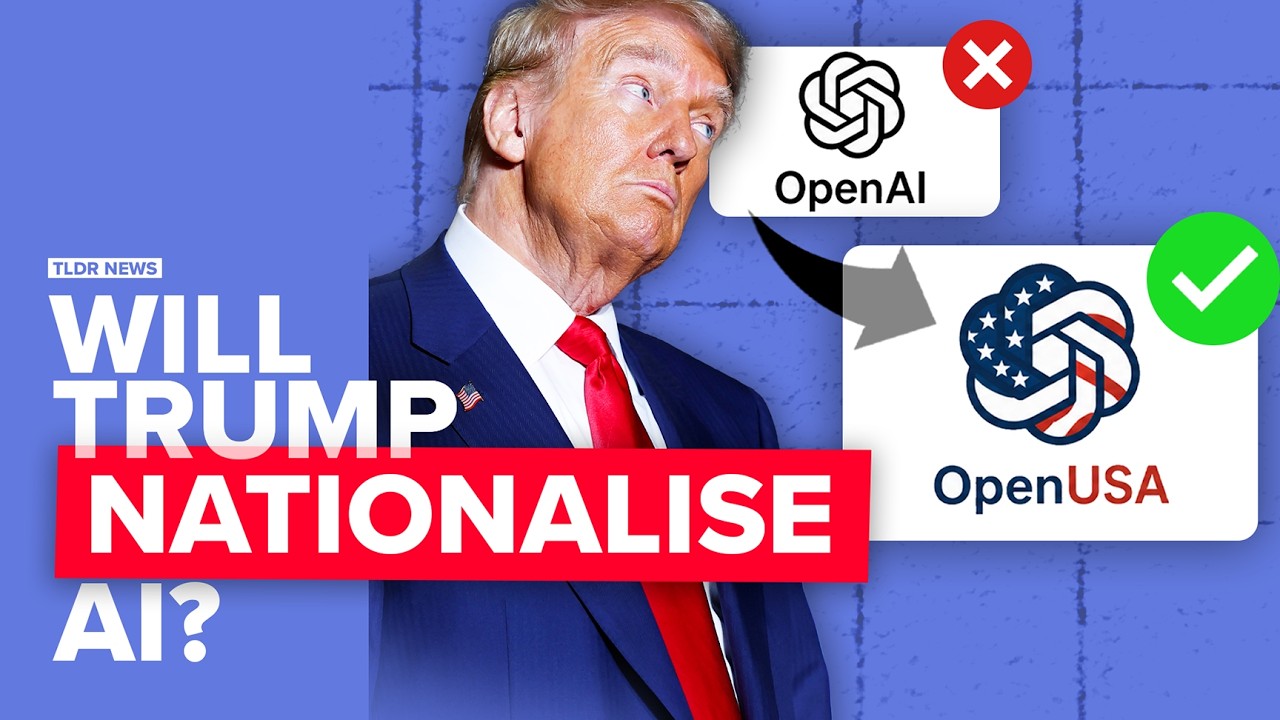
Why America Will Probably Nationalise AI
The United States stands at a crossroads with artificial intelligence. While the technology has been driven by private enterprise, a growing consensus among policymakers, economists, and national security experts suggests that the federal government may soon take direct control of the most advanced
The United States stands at a crossroads with artificial intelligence. While the technology has been driven by private enterprise, a growing consensus among policymakers, economists, and national security experts suggests that the federal government may soon take direct control of the most advanced AI systems. This is not a fringe conspiracy theory; it is a logical outcome of three converging pressures: national security, economic stability, and the unique nature of AI itself.
The National Security Imperative
The primary driver for nationalisation is the strategic importance of AI. Unlike previous technologies—such as the internet or smartphones—AI poses a direct threat to national security if controlled by a single corporation or a hostile state. The U.S. government has already classified advanced AI chips and models as dual-use technologies, subject to export controls. But many analysts argue that export controls alone are insufficient.
If a private company develops an AI system capable of designing novel bioweapons, automating cyberattacks, or destabilising financial markets, the government cannot afford to rely on corporate goodwill for oversight. The logic mirrors the nationalisation of nuclear technology during the Manhattan Project: when a technology becomes too dangerous for private hands, the state must step in.
The Economic Stability Argument
The second pressure is economic. AI has the potential to disrupt labour markets on an unprecedented scale. Studies from Goldman Sachs and McKinsey estimate that generative AI could automate up to 300 million jobs globally. In the United States, this could lead to mass unemployment, social unrest, and a collapse in consumer demand.
Private companies have no incentive to manage these negative externalities. Their goal is profit maximisation, not social stability. The government, by contrast, must ensure that the benefits of AI are distributed broadly—or at least that the costs of disruption do not tear society apart. Nationalisation would allow the government to slow or redirect AI deployment, retrain workers, and implement universal basic income funded by AI-generated revenues.
The Unique Nature of AI
AI is not like other technologies. It exhibits what economists call "increasing returns to scale": the more data and compute power a model has, the smarter it becomes. This creates a natural monopoly. In many industries, monopolies are tolerated or regulated. But with AI, the monopoly holder could eventually surpass human intelligence in every domain.
If one company achieves artificial general intelligence (AGI)—an AI that can perform any intellectual task better than a human—it would have unprecedented power. It could manipulate elections, control information flows, and even design new forms of warfare. No democracy can allow such power to remain in private hands. The only responsible option is to bring AGI development under public ownership and democratic control.
Historical Precedents
Nationalisation of critical technologies is not unprecedented. The U.S. government created the Tennessee Valley Authority to manage electricity, the National Aeronautics and Space Administration (NASA) to lead space exploration, and the Defense Advanced Research Projects Agency (DARPA) to develop the internet. In each case, the private sector was either unwilling or unable to bear the risks and long-term investments required.
AI is the next frontier. The cost of training frontier models now exceeds $100 million, and the most advanced chips are produced by a single company, Nvidia. The government already funds much of the basic research through agencies like the National Science Foundation and the Department of Energy. Taking full ownership would be a natural extension of existing policy.
The Likely Timeline
Most experts predict that the U.S. will not nationalise all AI, but rather the most capable systems—those approaching or exceeding human-level intelligence. This could happen within the next five to ten years. The trigger might be a major AI-related disaster, such as a financial crash caused by algorithmic trading or a bioweapon leak from an AI-designed molecule.
Once the political will exists, the mechanism is straightforward. The government could invoke the Defense Production Act to seize AI data centres and model weights, citing national security. Alternatively, it could create a public corporation, similar to Amtrak or the U.S. Postal Service, to develop and operate frontier AI systems. Private companies would still compete in narrow, low-risk applications like customer service chatbots or image generation.
Objections and Counterpoints
Critics argue that nationalisation would stifle innovation. They point to the Soviet Union's failure to develop competitive technology under state control. But the comparison is flawed. The U.S. has a robust tradition of public-private partnerships, not central planning. A nationalised AI agency could license its technology to private firms, creating a competitive ecosystem while maintaining ultimate control.
Others worry about government abuse. An AI controlled by the state could be used for mass surveillance or political repression. This is a legitimate concern, but it is not unique to nationalisation. Private companies already sell surveillance tools to governments. The difference is that a democratically accountable AI agency would have oversight from Congress, the courts, and the public. A private corporation has no such accountability.
Conclusion
The nationalisation of AI in America is not a question of if, but when. The combination of national security risks, economic disruption, and the natural monopoly characteristics of advanced AI make private control untenable in the long run. The government already intervenes in markets for food, drugs, and finance. AI is far more consequential.
The debate should not be about whether nationalisation will happen, but about how to design the institutions that will manage it. The stakes could not be higher. If done poorly, nationalisation could create a surveillance state. If done well, it could ensure that the most powerful technology in human history serves the public interest. The next decade will decide which path America takes.
Related Coverage
AI's Power Grab: How the Fight Over Chips, Safety, and Energy Is Redrawing Global Control
Big tech's race to build superintelligent machines is colliding with an energy crunch, a US-China export war, and warnings of catastrophe — and ordinary people are footing the bill.
AI’s Grip Tightens: How a Handful of Firms and Two Superpowers Are Dividing the World’s Compute
The AI boom has entered its most consequential phase—not about how smart machines become, but who controls them, who profits, and who pays. As Washington and Beijing refuse global rules and a few companies lock in chips, data centers, and energy, workers and households absorb the costs.
AI's Power Grab: How the Fight Over Chips, Safety, and Energy Is Redrawing Global Control
As artificial intelligence races forward, the real battle isn't about technology—it's about who controls the compute, who bears the costs, and who gets left behind.
US Blocks AI; Nations Race to Build Their Own
The United States has restricted foreign access to advanced artificial intelligence models, triggering a global rush among nations to develop their own independent AI systems and form new alliances to break free from American and Chinese dominance.
# The AI Power Grab: How Compute, Debt, and Geopolitics Are Redrawing the Global Order
The artificial intelligence boom is not a neutral technological revolution—it is a geopolitical and economic battleground where control over chips, data, and capital is reshaping the balance of power between states and corporations, while workers and global financial markets absorb the shockwaves.
The AI Power Play: How Compute, Debt, and Geopolitical Rivalry Are Reshaping Global Control
The artificial intelligence boom is not a neutral technological revolution; it is a geopolitical and economic battleground where control over chips, data, and capital is redrawing the balance of power between states and corporations, while workers and global financial markets absorb the shockwaves. The most immediate threat to the global economy is not AI itself, but the debt being piled up to build it, as massive borrowing by tech giants to construct data centers creates a bubble that central banks and sovereign wealth funds warn is overheating [1]. Meanwhile, China is executing a carefully calibrated strategy to build its own AI ecosystem independent of American technology, positioning itself as a global rule-maker and forcing smaller nations to choose sides in a contest that will shape the world's technological future [2].
Related Editorials
The Invisible Fault Line: How an AI Crash Could Unravel the Global Economy
Artificial intelligence is no longer a futuristic concept confined to research labs. It is the silent engine powering modern finance, logistics, and communication.
The Hidden Debt Crisis Threatening the Future of Artificial Intelligence
Article: The artificial intelligence industry is facing a financial reckoning that most investors and policymakers have yet to fully grasp. While the public conversation focuses on breakthrough capabilities and existential risks, a quieter but equally dangerous problem is building beneath the surfa
The AI Bubble Is Inflating Faster Than You Think
The artificial intelligence industry is experiencing a surge of exuberance that bears striking resemblance to the dot-com era. Recent market movements, product launches, and investor behavior suggest that the AI sector has entered what many analysts describe as a "bubbly" phase—a period of rapid va
Trump’s Shadow Over Brazil: Is the U.S. Pushing Mastercard and Visa on a Sovereign Nation?
By [Your Name/Editorial Staff] Date: [Current Date] A quiet but consequential battle is unfolding in Brazil’s financial sector. The question at its center is deceptively simple: Is a former—or future—U.
The Real AI Threat Isn’t What You Think
Yanis Varoufakis and Wolfgang Münchau argue the danger isn’t robots taking over—it’s the private seizure of the digital commons. Politicians and pundits warn endlessly about artificial intelligence turning on humanity.
Is Corporate Power Losing Its Grip on Politics?
For decades, the prevailing narrative in political economics has been one of inevitability: global corporations, wielding vast financial reserves and lobbying networks, have tightened their stranglehold on democratic institutions. From trade agreements drafted in boardrooms to regulatory bodies sta