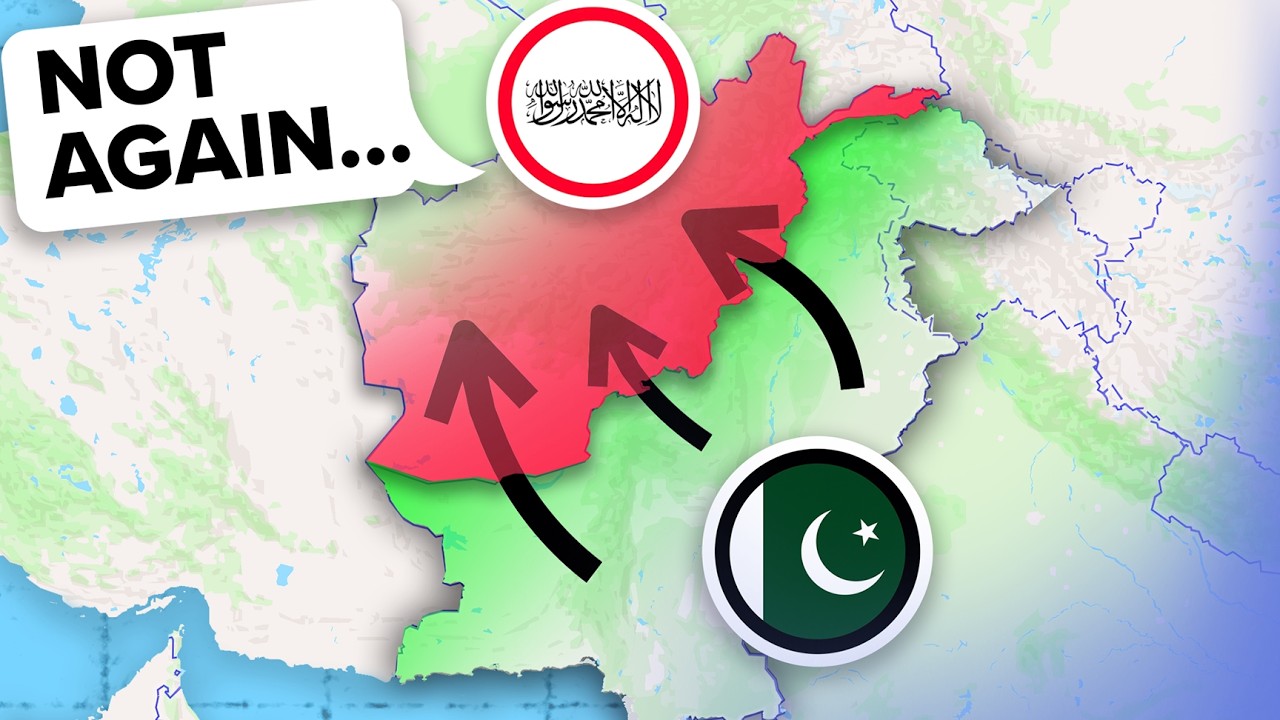
The Afghan-Pakistan War Restarts: How Does This End?
The fragile peace along the Afghanistan-Pakistan border has shattered. A new phase of conflict, distinct from the two-decade American occupation, is now underway.
The fragile peace along the Afghanistan-Pakistan border has shattered. A new phase of conflict, distinct from the two-decade American occupation, is now underway. This is not a war between nations, but a brutal insurgency and counter-insurgency campaign fought between the Taliban government in Kabul and the Pakistani state. To understand how this ends, one must first understand how it began again.
The current escalation stems from a fundamental strategic disagreement. The Taliban, now in control of Afghanistan, views the Tehrik-i-Taliban Pakistan (TTP)—a militant group also known as the Pakistani Taliban—as ideological brothers. Pakistan, however, sees the TTP as a direct existential threat. The TTP has long used Afghan soil as a sanctuary to launch attacks inside Pakistan, targeting military posts and civilian populations.
For years, Pakistan attempted to negotiate a truce. In 2022, Islamabad brokered a ceasefire with the TTP, hoping to separate the group from its Afghan hosts. The ceasefire collapsed. The Taliban in Kabul refused to expel TTP leaders, arguing that the group is a Pakistani internal matter. This refusal was the breaking point.
Since the ceasefire’s collapse, the conflict has intensified. Pakistan has launched airstrikes inside Afghan territory, targeting suspected TTP hideouts. The Taliban has responded by shelling Pakistani border posts. The violence is no longer a low-level border skirmish; it is a sustained military exchange. Both sides are now entrenched in a cycle of attack and retaliation.
The core question—how does this end—has no simple answer. Three scenarios are plausible, each with significant consequences.
Scenario One: Escalation to Open War
This is the most dangerous path. A major TTP attack inside Pakistan, killing dozens of soldiers, could trigger a full-scale Pakistani invasion of eastern Afghanistan. Such a move would be a strategic disaster. Pakistan’s military is already stretched thin by economic crisis and internal instability. An open war would likely bog down its army in a mountainous, hostile terrain, replicating the very quagmire that defeated the Soviet Union and the United States. Furthermore, it would unite the fractured Taliban factions against a common external enemy, strengthening the very group Pakistan seeks to weaken.
Scenario Two: A Managed Cold War
This is the most likely outcome. Both sides recognize the catastrophic cost of all-out war. Instead, they will revert to a state of managed conflict. Pakistan will continue to conduct precision airstrikes and operate special forces raids inside Afghanistan. The Taliban will continue to harbor the TTP but will publicly deny its presence. The border will remain a zone of low-intensity warfare—noisy, violent, but contained. This scenario benefits neither side but avoids the total collapse of diplomatic relations. It is a stalemate.
Scenario Three: A Diplomatic Settlement
This is the least likely outcome. It requires the Taliban in Kabul to make a painful concession: expelling or disarming the TTP. For the Taliban, this is a matter of ideological purity and internal cohesion. Betraying the TTP would fracture their own movement. For Pakistan, it would require accepting a permanent, hostile neighbor on its western flank. A settlement would also need a third-party guarantor—likely China or Qatar—to enforce the terms. Given the current level of mistrust, this path is almost impossible in the short term.
The Human Cost
Beyond the strategic calculus, the real victims are the civilians living in the borderlands. The Pashtun communities, split by the Durand Line, are caught between two fires. Airstrikes and shelling have already displaced thousands. The return of large-scale conflict threatens to create a new humanitarian crisis in a region already exhausted by four decades of war.
Conclusion
The Afghan-Pakistan war has restarted because neither side can afford peace. Pakistan cannot tolerate a sanctuary for its enemies. The Taliban cannot afford to alienate its most loyal fighters. The conflict will likely settle into a bloody equilibrium—a war of attrition that neither side wins, but neither side can abandon. The only real variable is time. Eventually, exhaustion, economic pressure, or a catastrophic event may force a change. Until then, the border will remain a front line in a war without a clear end.
Related Coverage
Trump’s Ceasefire Collapses as Israel Strikes Beirut, Iran Fires Missiles Back
Israel bombed southern Beirut and Iran responded with ballistic missiles, shattering a fragile U.S.-brokered truce and pushing the region toward a new open war.
Trump Demands Ceasefire as Iran and Israel Trade Strikes
The fragile ceasefire between Iran and Israel has collapsed, with both sides launching direct attacks on each other's territory for the first time in months.
Iran War 2.0: Asia Braces for $20 Trillion Shock as Oil Prices Explode
The collapse of the US-Iran ceasefire is set to unleash a second wave of economic chaos across Asia, with analysts warning the next global financial crisis could be four times worse than the dot-com crash, wiping out up to $20 trillion in market value.
Global Conflicts Intensify as Iran-Israel Ceasefire Collapses and Ukraine Strikes Deep Inside Russia
A fragile U.S.-brokered ceasefire between Iran and Israel has collapsed, triggering direct missile exchanges and a regional crisis, while Ukraine’s war with Russia reaches a new phase of long-range strikes and economic warfare.
Iran and Israel Trade Direct Missile Strikes, Ceasefire Collapses
Iran and Israel have launched direct military strikes against each other for the first time since April, shattering a fragile ceasefire and raising fears of a wider regional war.
Iran and Israel Trade Strikes as Ceasefire Collapses, Oil Prices Spike
Iran launched its first missile attacks on Israel since a ceasefire was agreed in April, calling the strikes the start of "a full week" of operations, which pushed oil prices higher as markets reacted to the renewed conflict [167961]. Israel retaliated with air strikes on Iran, testing the fragile two-month truce [167976]. The direct exchanges mark the collapse of the ceasefire and have sparked fears of a wider regional war [168078].
Related Editorials
The Saudi-Houthi Truce Shatters: A Return to Yemen’s Endless War
The fragile calm that had settled over Yemen’s front lines has evaporated. After months of relative quiet and tentative diplomatic overtures, the truce between the Saudi-backed coalition and the Houthi movement has collapsed, plunging the region back into active conflict.
Title: The Sahel’s Hidden War: Why Mali’s Conflict Is Far Larger Than Reported
For years, the war in Mali has been framed as a remote insurgency—a localized struggle between government forces and Tuareg rebels in the country’s vast northern desert. But new evidence suggests that this framing is dangerously incomplete.
Title: West Bank Erupts: The Unseen Escalation Reshaping the Middle East
Introduction The world’s gaze has been fixed on Gaza, but a second, equally volatile front has been quietly igniting. Across the West Bank, violence has surged to levels not seen in nearly two decades, threatening to destabilize the entire region.
Myanmar’s War Reaches a Crossroads: Can the Junta Survive?
For years, the civil war in Myanmar has been a brutal, grinding stalemate. But recent months have seen a seismic shift in the balance of power.
The Sahara Just Became the World’s Most Expensive Warzone
For decades, the Sahara Desert has been a harsh, sparsely populated expanse—a natural barrier for trade, migration, and conflict. That reality has changed.
# The Iran Trap: Why Trump Cannot Afford a Second War in the Middle East
Introduction In the final months of his first term, President Donald Trump authorized the assassination of Iranian General Qassem Soleimani, bringing the United States and Iran to the brink of open conflict. Now, as he prepares for a potential second term, many analysts warn that a return to th