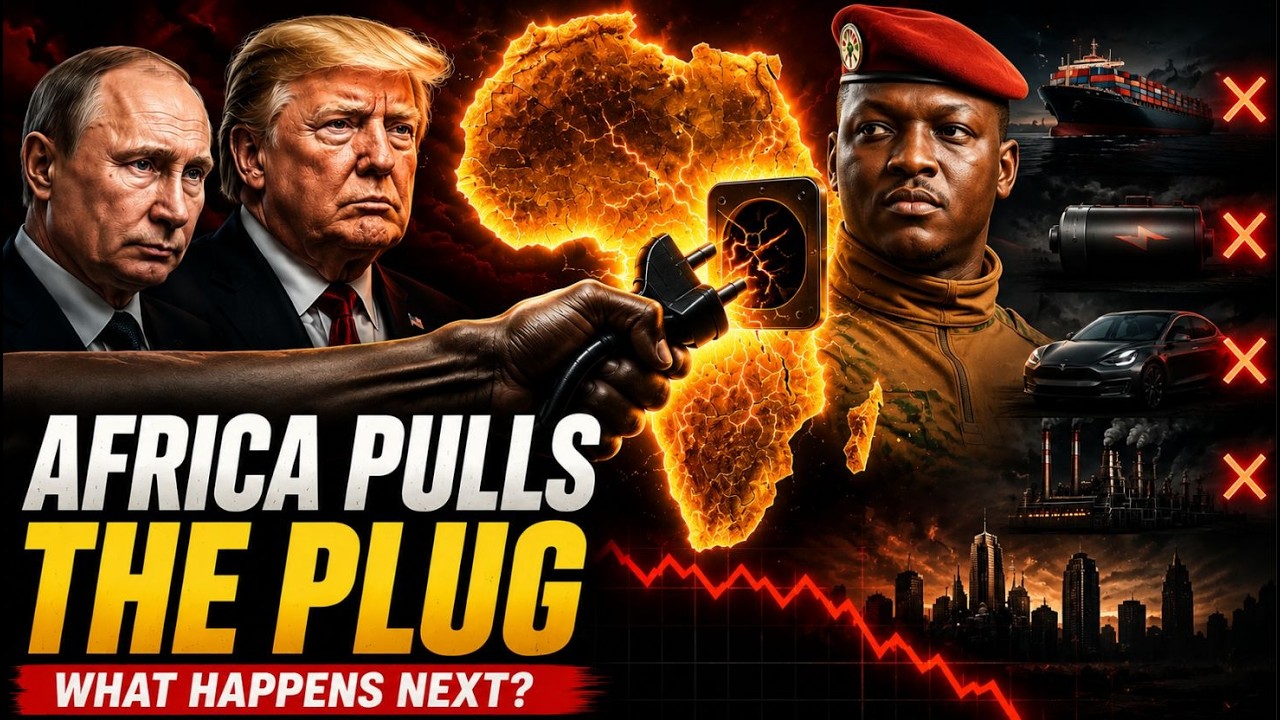
The Hidden Leverage: How a Global Pause in African Exports Would Trigger a Worldwide Crisis
The global economy runs on a fragile web of supply chains, and no continent is more central to its survival than Africa. Yet, the world often overlooks this dependency.
The global economy runs on a fragile web of supply chains, and no continent is more central to its survival than Africa. Yet, the world often overlooks this dependency. Imagine a scenario where Africa ceased all exports tomorrow. The result would not be a mere inconvenience; it would be a systemic collapse. From the lithium in your smartphone to the cobalt powering electric vehicles and the uranium fueling nuclear plants, Africa provides the raw materials that modern civilization depends on. This article examines the staggering consequences of such a shutdown, revealing a continent whose economic leverage is far greater than most realize.
The Mineral Backbone of Modern Technology
Africa is not a marginal supplier; it is the dominant force in several critical mineral markets. The Democratic Republic of Congo alone supplies over 70% of the world’s cobalt, a metal essential for rechargeable batteries in phones, laptops, and electric vehicles. Without it, the global tech industry would grind to a halt within weeks.
Similarly, South Africa and Zimbabwe control nearly 90% of the world’s known platinum group metals (PGMs). These elements are not just for jewelry; they are vital for catalytic converters in cars and for hydrogen fuel cells. A halt in supply would paralyze the automotive industry, particularly in Europe and North America, where emission regulations are strict.
Even the green energy transition would stall. Africa holds over 50% of the world’s manganese reserves, used in steelmaking and battery chemistry, and significant deposits of graphite and lithium. A sudden cutoff would send the price of renewable energy technologies soaring, making climate goals unattainable in the short term.
Energy and Fuel: The Immediate Shock
Beyond minerals, Africa is a major energy supplier. Nigeria and Angola are among the top oil exporters to Europe and Asia. Libya provides high-quality crude that many European refineries are designed to process. A full export ban would cause oil prices to spike instantly, triggering a global recession.
Natural gas is equally critical. Mozambique and Nigeria are key suppliers to the liquefied natural gas (LNG) market. Without African gas, many countries—particularly in Southern Europe—would face severe energy shortages, forcing industrial shutdowns and heating crises during winter months.
Agricultural and Food Security Collapse
The impact would not be limited to industry. Africa supplies a significant portion of the world’s cocoa (Ivory Coast, Ghana), coffee (Ethiopia, Uganda), and cashews. But the most dangerous disruption would be in fertilizers. Morocco alone controls about 70% of the world’s phosphate rock reserves, a key ingredient in synthetic fertilizers. Without Moroccan phosphates, global agricultural yields would plummet, leading to food shortages and skyrocketing prices.
The world would also lose major sources of tropical fruits, palm oil, and cotton. This would destabilize supply chains in retail, fashion, and food processing.
The Domino Effect on Global Finance
The shockwaves would hit financial markets. Many African nations are large debt holders. A sudden halt in exports would trigger defaults, causing a banking crisis in Europe and China, which hold much of this debt. The London Metal Exchange and commodity trading desks in Geneva would face unprecedented volatility.
Moreover, the shipping and insurance industries would be disrupted. The Suez Canal, which connects Europe to Asia, relies on traffic passing through the Red Sea. If African ports shut, global shipping routes would be paralyzed, increasing costs for every imported good.
Conclusion: A Continent of Strategic Power
The idea of Africa cutting off supplies seems extreme, but it highlights a fundamental truth: the world has built its prosperity on African resources without fully acknowledging the risk. Africa’s leverage is not in military might but in its monopoly over critical inputs. As global demand for green technology and electronics grows, so does the continent’s strategic importance. Understanding this dependency is not about fear-mongering; it is about recognizing that global stability requires a stable, respected, and economically integrated Africa. The next global crisis may not start in a financial capital—it may start in a mine in the Congo or a port in Morocco.
Related Coverage
# Power, Profit, and a Planet in Peril: How Financial Warfare, Climate Collapse, and the AI Boom Are Reshaping Global Politics
The global order is buckling under the weight of converging crises, where the pursuit of geopolitical power and corporate profit is colliding with fundamental human needs. From the closed oil routes of the Strait of Hormuz and the escalating aerial war in Ukraine to drought-parched rivers across Europe and famine-stricken regions of Africa, a cascade of emergencies is diverting public resources away from social welfare and toward conflict, leaving the world's most vulnerable populations to bear the heaviest burden of inflation, displacement, and violence [1][2].
Power, Profit, and a Planet in Peril: How War, Debt, and Climate Collapse Are Reshaping Global Politics
The global order is buckling under the weight of converging crises, where the pursuit of geopolitical power and corporate profit is colliding with fundamental human needs. From the closed oil routes of the Strait of Hormuz and the escalating aerial war in Ukraine to drought-parched rivers across Europe and famine-stricken regions of Africa, a cascade of interconnected emergencies is diverting public resources away from social welfare and toward conflict, leaving the world's most vulnerable populations to bear the heaviest burden of inflation, displacement, and violence [15692][15698].
Power, Profit, and a Planet in Peril: How Conflict and Financial Warfare Are Reshaping Global Politics
The global order is buckling under the weight of converging crises, where the pursuit of geopolitical power and corporate profit is colliding with fundamental human needs. From the closed oil routes of the Strait of Hormuz and the escalating aerial war in Ukraine to drought-parched rivers across Europe and famine-stricken regions of Africa, a cascade of interconnected emergencies is diverting public resources away from social welfare and toward conflict, leaving the world's most vulnerable populations to bear the heaviest burden of inflation, displacement, and violence [1][2].
Ceasefires Collapse, Wars Escalate: How a Global Arms Trade Fuels a World on Fire
A fragile global order is fracturing as a cascade of collapsing ceasefires, escalating wars, and a deepening climate emergency converge, pushing energy markets into chaos and leaving millions of ordinary people to bear the costs of a system that prioritizes military spending and corporate profit over human welfare. From the Middle East to Ukraine, and from Europe to Africa, the machinery of war is diverting trillions of dollars away from healthcare, housing, and climate resilience, fueling a cycle of displacement, poverty, and death.
# Global Power Plays and a Planet in Peril: How Financial Warfare, Climate Collapse, and the AI Boom Are Reshaping World Politics
The global order is buckling under the weight of interconnected crises, where the pursuit of geopolitical power and corporate profit is colliding with fundamental human needs. From the closed oil routes of the Strait of Hormuz and the escalating aerial war in Ukraine to drought-parched rivers across Europe and famine-stricken regions of Africa, a cascade of emergencies is diverting public resources away from social welfare and toward conflict, leaving the world's most vulnerable populations to bear the heaviest burden of inflation, displacement, and violence [1][2]. At the center of this turmoil lies a massive arms trade and militarization drive that escalates global insecurity for the benefit of a few, while the financial system itself teeters on an artificial intelligence debt bubble that central banks and sovereign wealth funds warn is overheating [3].
Ceasefires Collapse, Wars Escalate: A World on the Brink as Conflict and Climate Crisis Converge
The fragile global order is fracturing under the weight of collapsing peace deals, escalating wars, and a worsening climate emergency, while a financial system that prioritizes military spending and corporate profit leaves millions of ordinary people to bear the heaviest costs. From the Middle East to Ukraine, and from Europe to Africa, a cascade of interconnected crises is reshaping global politics and pushing the world’s most vulnerable populations to the brink.
Related Editorials
What Happens If Africa Stops Supplying the World
Imagine a world without smartphones, electric cars, or modern medicine. Now imagine that world arriving in a matter of weeks.
The Next Financial Crash: Why “Uninvestable” Assets Are the Real Threat
The global financial system is a complex web of interdependencies. When a major shock occurs—like a pandemic or a sudden spike in interest rates—the initial damage is often visible.
The Gathering Storm: How a Continental Shift Is Threatening South Africa’s Regional Dominance
A quiet but seismic shift is underway in African geopolitics. For decades, South Africa has operated as the continent’s economic and diplomatic anchor, wielding influence from Cape Town to Cairo.
The Invisible Fault Line: How an AI Crash Could Unravel the Global Economy
Artificial intelligence is no longer a futuristic concept confined to research labs. It is the silent engine powering modern finance, logistics, and communication.
Namibia’s Rare Earth Gambit: How a Tiny African Nation Is Rewiring the Global Tech Supply Chain
For decades, the narrative of China–Africa relations has followed a predictable script: Beijing finances massive infrastructure projects in exchange for raw commodities, leaving African nations as passive suppliers in a global system they do not control. Namibia, a sparsely populated country in sou
Africa’s Silent Giant: The $5 Billion Megaproject Reshaping the World’s Economy
While global attention fixates on trade wars and energy crises, a quiet revolution is underway in North Africa. Morocco has just completed a project that analysts are calling the most consequential infrastructure development for the continent in decades—yet it has barely made headlines.