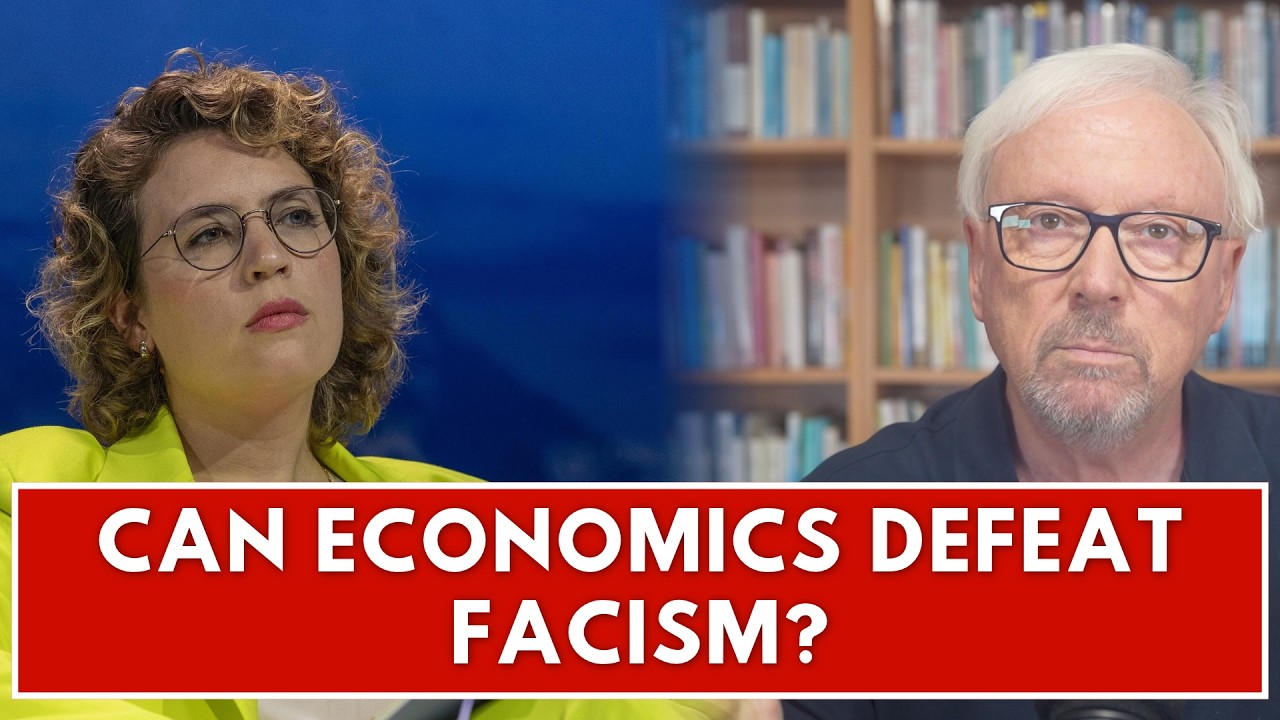
The Economics of Fascism: Why Unaffordable Essentials Are Destroying Democracy
Isabella Weber, professor of economics at the University of Massachusetts Amherst, argues in her new book Anti-Fascist Economics that the rise of authoritarianism is not merely a political problem but an economic one. When governments fail to provide economic security and essentials become unafford
Isabella Weber, professor of economics at the University of Massachusetts Amherst, argues in her new book Anti-Fascist Economics that the rise of authoritarianism is not merely a political problem but an economic one. When governments fail to provide economic security and essentials become unaffordable, democracy itself is imperiled. In this interview, Weber explains how market fundamentalism creates the conditions for fascism and outlines a practical program to reverse course.
Richard Murphy: Your book asks why supposedly democratic economies are creating conditions in which authoritarianism can flourish. Let us start with the obvious but important question: what is fascism?
Isabella Weber: Fascism is complex and difficult to define. I am not a fascism scholar but a concerned economist. In writing this book, I looked into the literature and was struck that many fascism scholars shy away from giving a clear definition. As a working approximation, I identify three key elements. First, a promise to restore a mythical past where everything was glorious. Second, an insistence on a clear hierarchy between us, the chosen ones, and you, the ones who do not belong. This distinction can run along racial, religious, or other lines, but there is always a clear separation between those naturally supposed to rule and those to be excluded and ostracized. Third, an insistence on irrationalism. When you try to debunk fascists by pointing out that what they say makes no sense, you fall into their trap. They are not trying to make sense. By being utterly irrational, they demonstrate their power because they do not have to obey any laws of logic. This irrationalism is part of a glorification of strength and violence as values in themselves. When these three elements are in place, we can start talking about fascist tendencies, which take different forms in different times and places.
How does fascism differ from neoliberalism? Are their social Darwinist roots the same, and does one inevitably lead to the other?
The common element is social Darwinism, but the way it is spelled out differs. At its core, neoliberalism is about market subordination. It is not per se about markets but about the idea that markets ought to rule. Behind the metaphor of markets, you find firms, and firms pursue profit. Ultimately, it is a profit-fundamentalist way of thinking about the economy and society. Market competition as the organizing principle is supposed to divide those who are capable, strong, and smart from those who are less capable. When states intervene to protect those losing out, this is seen as unjustified intervention into market subordination. Those who lose out in competition are treated as collateral damage.
Under neoliberalism, collateral damage of livelihoods is an unfortunate fact. Under fascism, it is a welcome outcome. Fascism sees it as a cleansing mechanism to erase surplus populations. Under neoliberalism, you have to accept it because intervening only makes things worse. This is what Karl Polanyi called the fascist virus. He used the example of Malthusian economics, which argued that population tends to multiply while food grows linearly, creating an imbalance. If you intervene in food prices to make food affordable, you keep people alive who ought to die, creating more surplus population in the future. This logic contains an anti-democratic kernel because people will always fight back. They will demand that their government ensure they can eat and protect them when their livelihoods are at stake. Enforcing market subordination must go up against this democratic impulse, and that is where Polanyi sees the fascist virus: extreme forms of market subordination becoming a stepping stone for fascist logic.
You provide a narrative about classical economics and ideas about intervention in famines. How much of what we need to understand about that era is about reframing the language we use?
To be clear, anti-fascist economics is not an economics against a fascist economics. It is an economics trying to safeguard democracy rather than be complicit in the rise of extreme right and anti-democratic forces. I am not saying neoliberal economics is already fascist. I am saying there are points of convergence that make sliding over possible, and those points are baked into the logic of market fundamentalism or profit fundamentalism.
On famine prevention, we cannot go without mentioning Mike Davis's Late Victorian Holocaust. He demonstrates, based on India, China, and Brazil, that colonial administrators put Malthusian principles into practice by insisting that famine prevention would reside in these excess populations and imposing market order. This benefited colonial powers because it meant exporting grain in the middle of a famine. It amounted to excess deaths in the millions. Davis goes as far as calling this a late Victorian holocaust, a form of market-imposed holocaust. That is stark language, but it is a stark reminder that this logic was already present in the 19th century, not in the same way as the Nazis, but the basic logic was there.
You define two pivotal moments when fascist economics became more apparent: 2008 and 2020. Is that when the beast became uncontained?
I am thinking of the 2008 global financial crisis and the recent inflation crisis as tipping points in the rise of the extreme right. They were at their core crises of economic insecurity and were settled in an extremely unequal way, thus increasing inequality. We were already in an inequality emergency before both. They contribute to two enabling factors for the rise of the extreme right. On one hand, there is a sense that the status quo is so unbearable and my life so insecure that I will go for anyone promising an alternative. On the other hand, there are extreme forms of concentration of corporate and private economic power that render democracy meaningless because it is clear that a small handful of people in corporations rule over the economy. Once extreme right leaders get into power and a small number of oligarchs change sides, you get a closing of ranks that is incredibly powerful. The unbalancing can happen enormously quickly. That is what happened when Trump was reelected. On inauguration day, the tech oligarchs had a front row seat in front of the elected officials. This was the tip of the iceberg. I was at the World Economic Forum at that moment, and it was striking to see widespread excitement across the business elite about the reelection of Donald Trump and how he would finally bring deregulation they had been waiting for. On the European side too, there was this idea that Trump would help crack open regulations holding them back.
Your book explains the causes of fascism and economic fascism. You spend less time on the economic practices of actual fascist regimes. Is that because we have not truly reached that point and need to pull back now with an alternative narrative?
As I write in the introduction, this is a book for people who think fascism has not won yet, that there is hope of defeating it. One instructive thing from the midterms and from the re-election of Lula in Brazil is that in both cases they gained ground when they stopped talking about the far right and started talking about their own agenda and why a different economic playbook was necessary. In the 2024 Harris campaign, she called Trump a fascist, so she was clear on the warning, but she was extremely vague on confronting corporate power, speaking up against price gouging, and offering an alternative. She had a strong moment when she promised a price gouging ban on food, a modest proposal saying that amid an emergency, companies are not allowed to price gouge on food. Then she rolled back on this because of pushback from influential economists and corporate elites, and leaned into the authority of economists from Goldman Sachs and big investment banks, as if that is what people were looking for. She lost on this narrative.
What is drastically different in the midterms is that people ran with concrete messages like Medicare for all, we are going to build housing, we are going to address the affordability crisis, we are going to fight the oligarchy on your behalf. In Brazil, affordability was core to the second round debates when Lula defeated Bolsonaro. One key message Brazilians have shared with the world is: do not spend your time debunking your counterpart. Spend your time setting your own agenda. That is the spirit of the book.
I do spend time on the history of thought because it was important to establish that an economics of never again, an anti-fascist economics, is not something I pulled out of my head. It was once a key concern for economists across schools of thought. It was a mainstream question that everybody had to have a stance on. I am trying to revive that and call on the responsibility of economists to ask how their policy advice is contributing to or harming the project of saving democracy at its most fragile moment since the Second World War.
You discuss Keynes, Abba Lerner, Polanyi, Klein, and even Hayek, who thought he was fighting fascism.
It was important to bring Hayek in because I tried to give the best faith reading of his text. One way of thinking about it is that his neoliberalism was genuinely meant as a bulwark against the return of fascism. What we see is that in the last decades, where we have come as close as one probably can toward implementing his ideals, the extreme right is returning and fascist forces are on the march. In that sense, the philosophy of The Road to Serfdom has failed in being that bulwark. We need to revive the arguments of Hayek's opponents. In the 1940s, Hayek was a marginal voice, a fringe view with backing from corporate elites and from Churchill, who released wartime paper to print The Road to Serfdom. But his logic of market subordination as the only way of preventing subordination under other men was really out there because after the war it was commonplace to say that planning had worked better than anyone expected on the side of democratic powers. The question was how planning could serve peace if it had done so well in serving the war.
In chapters nine and ten, you outline solutions, including ten elements of an economics of essentials. What is your biggest priority?
The basic goal of this economic playbook is to suggest that we can put a floor under people's livelihoods and a ceiling on extreme forms of concentration of power on the part of corporations and private individuals. We can tackle both sides that contribute to the rise of the extreme right through policy. The starting point is the essentials, the stuff that people and industry cannot do without. If Hayek tells us the economy is endlessly complex and the only way to have a rational economy is to rely on universal markets, I am saying no, we can make a clear distinction between what is essential and what is not. For the essentials, we can work out solutions based not on profit primacy but on designing the essentials to genuinely serve a dignified life for all.
The essentials broadly are housing, food, energy, transport, healthcare, and all forms of care. We can debate whether there are emerging essentials in our digital age, but on the most basic level, these five are almost universal. Even within these, there is a subgroup of the most basic stuff. Take food: it could mean imported French luxury cheese or 50-year-old champagne, or it could mean basic cheese, eggs, bread, butter, and fresh produce. We have to start from the food staples, the basket of basic food items that a nutritious diet requires. Most countries' social benefit authorities already define such baskets because they have to define social benefits based on people being able to afford them. This is not a new concept.
In the short run, you need stabilization measures for these essentials. In Mexico, the government implemented a basket policy where they struck an agreement between large food companies and the government to keep the price of this basket stable. The president negotiates on behalf of the people with the companies and holds them accountable by holding regular press conferences reporting on how well companies are living up to the agreement. Under neoliberalism, we tell people democracy is the greatest system but when it comes to your most basic needs like affording a healthy diet, there is nothing we can do but subordinate you to corporations. That makes democracy unattractive. In contrast, the Mexican president is saying it is my job as head of state to make sure you can afford the stuff you cannot live without. These short-run price stabilization measures buy time for deeper transformative measures. Since we are in a cost of living crisis, time is of the essence.
Deeper transformation policies must tackle the enormous concentration of corporate power in the food industry, which is extremely unequal, with power on the side of food processing, wholesaling, and retailing, and very little power on the side of farmers and consumers. At both ends of the food chain, people are subjected to the power of corporations. To change that, we need a basket of policies. There is no one policy that will do the trick. We need public options, like Mamdani's public grocery stores, antitrust to hold companies accountable and break them up where needed, and measures to tackle financialization. The largest food commodity traders, the ABCD companies, control 70 to 90 percent of global food commodity trading and are also massive shadow banks betting on their own operations in financialized markets where they have massive information advantages. We need to make sure these companies cannot be a bank and the business operating the stuff the bank is betting on at the same time.
We also need the food sector to become greener because food and agriculture is a massive contributor to climate change, which is already a major driver of the affordability crisis. With each shock that hits agriculture, prices spike in ways that benefit food commodity traders and large corporations but harm consumers, creating an affordability crisis in the global north and a hunger crisis in the rest of the world. In 2022-23, global food prices shot up and about a decade of progress in the fight against malnutrition was reversed in just a year, on the back of price increases, not even an actual global shortage. Climate shocks end up being the best of times for the largest corporations and the worst of times for farmers and consumers.
I personally think CO2 pricing does not work well in farming. Even the EU, which is most committed to CO2 prices, does not apply them to farming, and there are good reasons. Fine-grained government-mandated regulation is complicated for farming because farmers are relatively small businesses with limited bureaucratic capacity. Instead, we need to cultivate the lever of public procurement, which can take the form of public buffer stocks. Stock holding systems stabilize prices by buying when prices collapse and selling when they shoot up, stabilizing demand and supply. This is good for resilience to shocks and prevents repeating the inflation crisis. Public procurement can also set standards for what kind of crops are bought and what production methods are incentivized. This could extend to fertilizers, an important element of the fossil-fuel-based food system. Mamdani's grocery stores could also be a procurement lever, buying things that fulfill green standards and labor standards. With public procurement and the state as market participant, you have a powerful mechanism to help transform the food system in ways that serve affordability and fight climate change at the same time.
The same logic of combining short-run stabilization with deeper transformation applies to every sector. For housing, it means rent controls in the short run, building out public housing in the medium run, limiting private equity's access to the housing market, limiting financialization, and limiting the power of large private real estate companies in local markets. The same principle applies to energy and transportation. The care sector is different. There we mainly need a massive expansion fueled by public investment and public job creation because we are living in societies that are severely overworked and undercared, and we are walking into a possible massive employment crisis, especially in the service sector, in the wake of AI taking over jobs. Massive public job creation in the care sector would make a huge amount of sense, not least to create space for human connection and spaces of hope and fulfillment that are too often missing.
What you describe is a massive government intervention program requiring funding and intervention almost unknown among current Western governments. What is the macroeconomic framework that permits this?
I do hint at how this adds up to a macroeconomic framework in various places, but you are probably right that I should have written a whole chapter spelling that out. The basic logic is that the current stabilization paradigm responds to a global oil price shock by hiking interest rates. Energy prices go up, which burdens people at the bottom of the income distribution much more than those at the top, who end up being beneficiaries of windfall profits. It is a redistribution shock from the bottom to the top. We then respond by putting pressure on the labor market and have the declared goal of throwing people out of work who are already suffering from a cost of living crisis.
Our inflation research shows that a small handful of sectors are systemically significant for inflation, presenting the greatest points of vulnerability for overall inflation when their prices spike. These are basically the same essential sectors I talked about, plus wholesale trade and chemicals. If you were to implement this stabilization and transformation program for essential sectors, you would no longer rely on hiking interest rates to respond to supply-driven inflation. You could decouple the employment question and the monetary stabilization question because you now have a separate toolbox to address monetary stability, giving you space to pursue a full employment policy. Right after the war, many economists thought this was feasible because they had seen that more direct forms of stabilization could get to very high levels of employment. Roosevelt's promise of a right to a decent and meaningful job, articulated in response to fascism as a safeguard against its return, becomes possible if you have this alternative stabilization regime, especially in a world of shocks and turmoil like the one we are living in now.
On the fiscal side, I am of the opinion that debt-to-GDP ratios are not a good measure to understand what government spending is doing in the economy and whether it is harmful for debt sustainability or inflation. You could have a government with a rising debt-to-GDP ratio because they cut taxes on the rich, or you could have a temporarily rising ratio because they invested in pre-K child care. Those two things would do very different things to the structure of your economy, the sustainability of your debt, and your inflation prospects. I am a fiscal case-by-case person. The measures I map out would need to be spelled out in concrete terms for every economy to figure out the employment implications, resource use implications, fiscal requirements, and macroeconomic outcomes.
I argue for a gradualist approach, which is often seen as reformist or cautious, but what I mean is that with first steps that are implementable with the state capacity we have in the here and now, you can restore trust on the part of voters that the state can actually do things in their interest, and restore trust on the part of state institutions that they can do things effectively. We are coming out of a situation where, over decades, states have been told they are dumb and incompetent by neoliberals and then have been made dumb and incompetent by outsourcing, so the capacities and knowledge that used to exist often are not there anymore. That has to be built up step by step but ambitiously with a clear direction.
You mention Stephanie Kelton and MMT only once. You do not address the capacity of the government to create money and spend without taxing and borrowing. Do you see the state as having this fundamental power over the marketplace?
MMT has had a massive impact on the policy debate in recent years in a good way, freeing us from the deficit myth. But the debates have often gotten hung up on very technical monetary policy questions. What I am doing is turning things around and saying, let us suppose we do not have to worry so much about the monetary side. What is the stuff we should be doing? The ability of the state to act is something I take as a given, and I am trying to spell out what programs we could implement if the state has that ability.
Of course the state has a capacity to create money. Otherwise I would not be proposing these programs. I am referencing Abba Lerner and functional finance, spelling out that the state has the capacity to create money and that this frees the state from the austerity dictum that classical economics implies. I also discuss Michal Kalecki because it is important to move beyond the question of what is technically possible to the question of political constraints. Kalecki's discussion of the political aspects of full employment is important in pointing out that this is not just a technical insight on the ability of states to create money. It is a political question where insisting on the inability of the state to create money is a way for capital to discipline states, launch capital strikes, control investment, and ultimately control employment.
I acknowledge that in theory the state has that capacity, which is almost a commonplace between Keynes, Lerner, and Kalecki. But the real constraint is political. The second point is the difference between center and periphery countries. Having spent time talking to Brazilian policymakers, if you tell them the state has the capacity to create money, just go do it, they are in a peripheral situation where the threat of capital flight is very real and the difference in interest rates between their central bank and the central banks of the US and Europe is a binding constraint. That is something we often miss when we focus on MMT as it might play out in the US context. The third element, which is a key part of Lerner's and Kalecki's thinking that is underappreciated, is commodity price volatility. Massive commodity price volatility can be inflationary in detrimental ways, which means you have to manage your currency system also by managing commodity volatility. This is incredibly important for the global south. I am trying to bring this element of the Bretton Woods discussions back to the table. Money has to realize its value in exchange, and the exchange between money and commodities is important for inflation, for the terms of trade between the global south and the global north, and especially for commodity-dependent developing countries.
Should the World Bank lend in local currency rather than dollars? Do we need a Bancor-like system?
Bancor was linked to a commodity buffer stock idea and a commodity-backed currency idea, and that is explicitly what I am advocating for. I think we need to start this more on the regional level and possibly country blocks. At this point in history, it would be very difficult to do this on the global level. I have written a report with Jayati Ghosh and others for the T20 food security task force spelling out how a regional food buffer stock could work for the African Union. The next step would be to link this to the currency question with more diversified buffer stocks that are not just in one type of commodity. If we look at global currency hierarchies, possibly the worst outcome for everybody including China is for the renminbi to just take over the role of the US dollar. It would be much more desirable to have an international commodity-backed currency as the target, with multilateral management of commodity buffer stocks that contribute to commodity price stability and can be the assets against which an international currency is issued. This was a proposal that Zhou Xiaochuan, the former governor of the People's Bank of China, put into the debate in the context of the 2010 financial crisis. Even though this might sound outlandish, leading central bankers have been discussing it not so long ago. It could even start from so-called virtual buffer stocks where central banks start by trading in futures and spot markets for commodities and build up capacity in commodity trading that way.
Why should someone go out and buy your book?
Joan Robinson said the purpose of studying economics is not to be bamboozled by economists. Anti-Fascist Economics is a shortcut to free you from thinking that economics is the exclusive terrain of economists. Everybody should have a say because the way we structure our economy is foundational to how our society and ultimately our democracy works. The job of economists is to help realize goals that we are setting democratically rather than to dictate how our economy should be run. In that spirit, I hope everybody goes out and reads the book and becomes part of the larger conversation of how economic policy can help safeguard democracy.
Related Coverage
War, Tariffs, and Oil at $100: How a World Built on Profit Is Breaking the Global Economy
A cascade of escalating military conflicts, surging energy prices, and a breakdown in global trade is pushing the world economy to its breaking point, with ordinary citizens bearing the costs of a system that prioritizes corporate profit and military spending over human welfare.
Oil at $95 and Rising: How War, Blockades, and a System Built on Profit Are Crushing the Global Economy
A cascade of collapsing ceasefires, escalating military conflicts, and a rapidly accelerating climate emergency is shattering the global economic order, pushing energy markets into chaos and leaving millions of ordinary people—especially the world’s poorest—to bear the costs of a system that prioritizes military spending and corporate profit over human welfare.
War and Profit: How a Militarized World Is Crushing the Global Economy and the Vulnerable
A cascade of collapsing ceasefires, escalating wars, and a deepening climate emergency is converging to reshape the global order, pushing energy markets into chaos and leaving millions of ordinary people to bear the costs of a system that prioritizes military spending and corporate profit over human welfare.
War, Oil, and a Burning Planet: How a System Built on Profit Is Breaking the Global Economy
A cascade of escalating military conflicts, surging energy prices, and accelerating climate disasters is shattering the global order, pushing the world economy to the breaking point while millions of ordinary people bear the costs of a system that prioritizes military spending and corporate profit over human welfare.
Ceasefires Crumble, Wars Escalate: How a Broken Global Economy Fuels a World on Fire
A fragile global order is fracturing as a cascade of collapsing ceasefires, escalating wars, and a deepening climate emergency converge, pushing energy markets into chaos and leaving millions of ordinary people to bear the costs of a system that prioritizes military spending and corporate profit over human welfare.
Oil, War, and a Planet in Flames: How a System Built on Profit Is Crushing the Global Economy
A cascade of collapsing ceasefires, escalating military conflicts, and a deepening climate emergency is shattering the global order, pushing energy markets into chaos and leaving millions of ordinary people—especially the world’s poorest—to bear the costs of a system that prioritizes military spending and corporate profit over human welfare.
Related Editorials
# The Unraveling of Democracy: How Economic Insecurity Is Reshaping American Politics
A growing body of research suggests that financial precarity—not ideological polarization—may be the driving force behind democratic backsliding in the United States. For decades, political scientists assumed that citizens who felt economically secure would be more likely to participate in demo
The AI Boom Will Not Crash Europe. Europe Is Already Crashing Itself.
By Yanis Varoufakis and Wolfgang Munchau Two unconventional thinkers on the future of capitalism, the AI race and why Britain's economic model is running on empty. The global economy is being reshaped by two forces that dominate every conference, every boardroom and every finance ministry: the arti
# The Silent Tax: How Inflation Quietly Robs You Every Day
## What Inflation Really Is—and Why It Matters More Than You Think Inflation is one of the most misunderstood forces in modern economics. It shapes the price of groceries, the value of your savings, and the stability of entire nations.