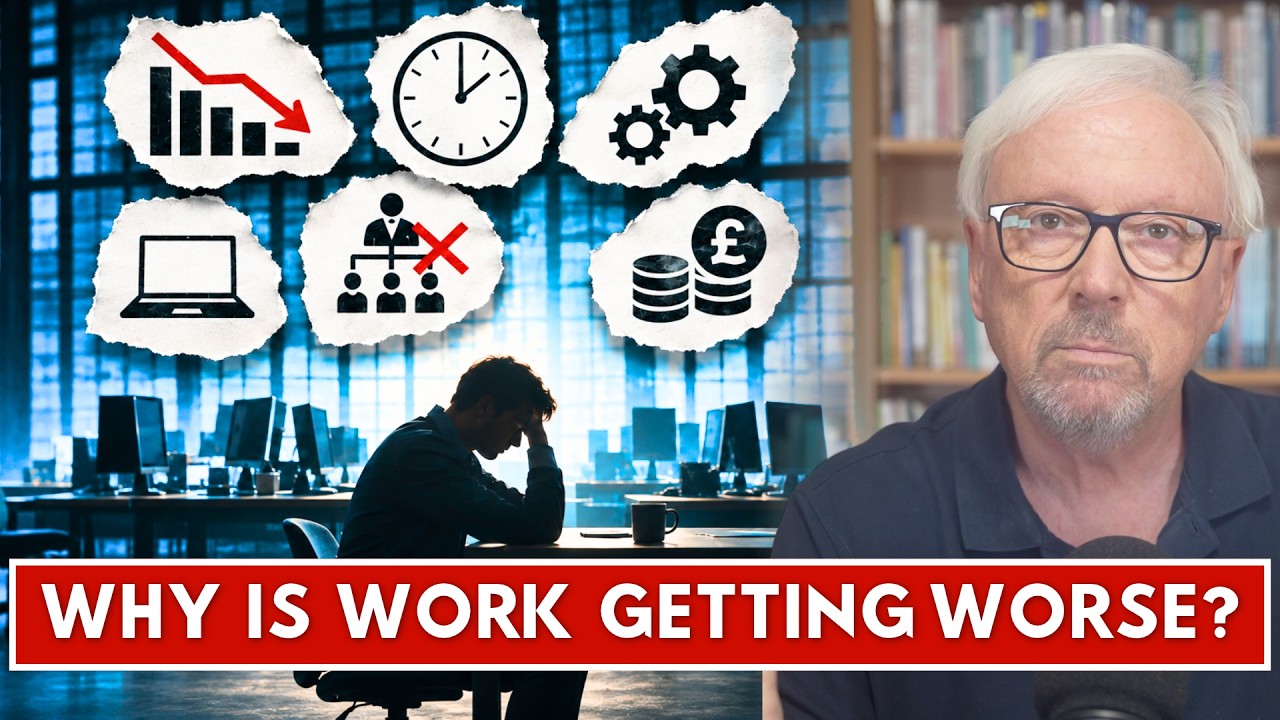
Britain’s Work Crisis: Why Employees Are Losing Control and What It Means for the Economy
Work in Britain is facing a crisis. Surveys show that people want to work, want to advance in their workplaces, and want better pay.
Work in Britain is facing a crisis. Surveys show that people want to work, want to advance in their workplaces, and want better pay. Yet their satisfaction with work is falling. Workers are increasingly losing control over their jobs, and opportunities for people to develop their talents at work are disappearing. Employers are creating frustration instead of fulfillment through what is called routinization, meaning that tasks in the workplace are being deskilled. Is Britain heading toward a workplace revolt because people have had enough of this trend?
The fact is that people really do want to work. The latest Social Attitude Survey shows that only 4% of people who could work in the UK do not want to do so. This means that most unemployment in this country is involuntary. Surprisingly, 73% of people believe that their work benefits society these days, a figure that has increased since 1989, when it was 54%. So the idea that the quality of people's work has necessarily declined is not supported by this survey.
Why, then, is job satisfaction declining? That is the challenge facing the British workplace. Job satisfaction has declined broadly since 2015. Most people want to work fewer hours, and fathers are particularly driving this change. People also want opportunities for promotion and advancement at work, and increasingly they are being denied these chances. Employers are not recognizing the talents within the people they already employ. As a consequence, the chance for people to earn more is disappearing because they cannot get the promotions they need where they are and very often cannot afford the risk of moving employment with everything that goes with it. People want opportunities to fulfill their potential at work, but they are being denied them.
The reality is that work is also failing people financially. Real earnings have increased since 2015, but in overall terms they have hardly changed since 2008. Living standards have now been stagnating for nearly two decades in the UK for most people. Workers cannot see routes to sufficient financial reward from work, and nothing seems to be changing. Unsurprisingly, people are disenchanted as a result. When this is compounded by the fact that opportunities for promotion appear to be unavailable in so many employments, people cannot see a way to improve their positions, and that is causing stress.
At the core of this problem in the workplace is a very surprising statistic: workers are losing control over their jobs. In 1992, over 60% of people in the UK enjoyed substantial discretion over how they organize their work. Now barely 30% have that freedom. Most workers once could choose how they would deliver the outcome their employer wanted in the way they thought appropriate. That suited a great many people, especially those who are not neurotypical. Now fewer than one-third have this opportunity. Those with autism, ADHD, and other neuro-complex conditions are suffering badly as a result. We are seeing that problem as one of the drivers of the number of people under 25 who are now not in employment, education, or training. But many others are also suffering for this reason.
There has been a fundamental transformation of employment in the UK. Once people had to bring their initiative to work. Now the demand is that they do not, and this has been widely noted. Employers have deliberately restricted workers' discretion. Standardization increasingly dictates how tasks are performed, and compliance systems have replaced individual professional judgment. Even senior professional occupations are experiencing this change. I saw it in the world of academia. I know it is happening in professions like law and accountancy. It is happening in the civil service. Employers are prioritizing consistency over initiative and creativity, which means that people are losing their autonomy, and this has serious economic consequences.
Workers are losing the opportunity to exercise their judgment. Frustration replaces enthusiasm, and personal engagement falls away. Initiative disappears when employers discourage independent thinking. Talented people cannot use their abilities to the full, particularly when they are denied the opportunity to advance within their workplace. As a consequence, productivity is suffering because employers are suppressing human potential. This is, I believe, an unaddressed issue within the economic conundrum facing this country.
It seems we are definitely creating increasingly unfulfilling jobs, even if people recognize that there is a social use to them. In other words, the late David Graeber's prediction that we would have pointless jobs in this country is coming true. These jobs exist, and their economic impact is being seen in low productivity and stagnant wages. People are becoming little more than human automatons, even when they are doing something useful. Their abilities are being wasted by rigid systems. And my belief is that artificial intelligence could make this considerably worse.
What happens then when workers finally reject this situation? In my view, work must serve people and not just employers. Everyone deserves sufficient income to live with dignity, and financial security must always replace fear and uncertainty. That is one of the crises within our economy that we recognize now. But it is also vital that workers have autonomy over how they work. Opportunities for development and advancement are essential, and fulfilling work should be an economic objective because it is part of the goal of letting somebody fulfill their potential in life. If you cannot fulfill your potential in life, you will be disenchanted, fed up, and alienated from the world around you. That is what we are seeing. People are alienated from the workplace for this reason.
So, are we heading for a workplace revolution? People want to work and they want to contribute, but employers are increasingly denying meaningful autonomy. Financial rewards and advancement opportunities are inadequate. In any case, there is not enough opportunity to deliver meaningful work. And if AI does make this situation worse, will the time have come when workers will demand better control over their working lives? Should enlightened employers be thinking about this and now offering it? Do we need this change?
As far as I am concerned, this is a big issue for the politics of care and the economics of hope. Many of us spend a great deal of our lives at work. If that work is not fulfilling our potential, it demeans us. My concern is that this is what we are seeing on the basis of this latest Social Attitude Survey. The surveys tend to be reliable. They are heavily relied upon for forming policy in government. But the point is, who is going to take action on this one? Government does not employ most people in this country. Only one in six people in the UK work for the government. The rest work in the private sector. When is the private sector going to notice that it is alienating one of its key resources, namely the people who work for it? When will we get work that is fulfilling and which delivers for the well-being of the people who undertake it? Not everybody wants to be self-employed. There should not have to be for this outcome to be delivered. I am looking for a world where work is meaningful. That is what I think. What do you think?
Related Editorials
Britain’s £100 Billion Question: Where Can the Money Come From?
Introduction Britain faces a daunting fiscal challenge: finding £100 billion a year to rebuild its economy. The scale of the problem is enormous, but the solutions are more varied—and more controversial—than they might first appear.
Inflation Is Rising. Will the Bank of England Finally Pull the Trigger?
The debate over the cost of living has shifted from academic circles to the kitchen table. As global supply chains strain and energy prices climb, the United Kingdom is facing a familiar yet uncomfortable specter: rising inflation.
Labour Says It Wants Jobs—So Why Is It Destroying Them?
The British Labour Party has long positioned itself as the party of workers. Its rhetoric champions employment, economic security, and the protection of livelihoods.
Britain’s Fiscal Trap: Why the Next Government Faces an Impossible Choice
The United Kingdom is not approaching a crisis; it is already inside one. The next government, regardless of which party wins the upcoming election, will inherit a set of economic conditions that make meaningful reform nearly impossible.
Britain’s Perfect Storm: How Record Oil Profits and a Hawkish Bank Could Trigger a Recession
The British economy is walking a tightrope. On one side, energy giants are posting historic windfall profits.
Is $100 Oil the Trigger for a UK Economic Crisis?
As global oil prices flirt with the $100-per-barrel threshold, a pressing question emerges for the United Kingdom: is the nation on the brink of an economic crisis? While the UK is less dependent on oil than it was during the shocks of the 1970s, the current landscape presents a unique set of vulne