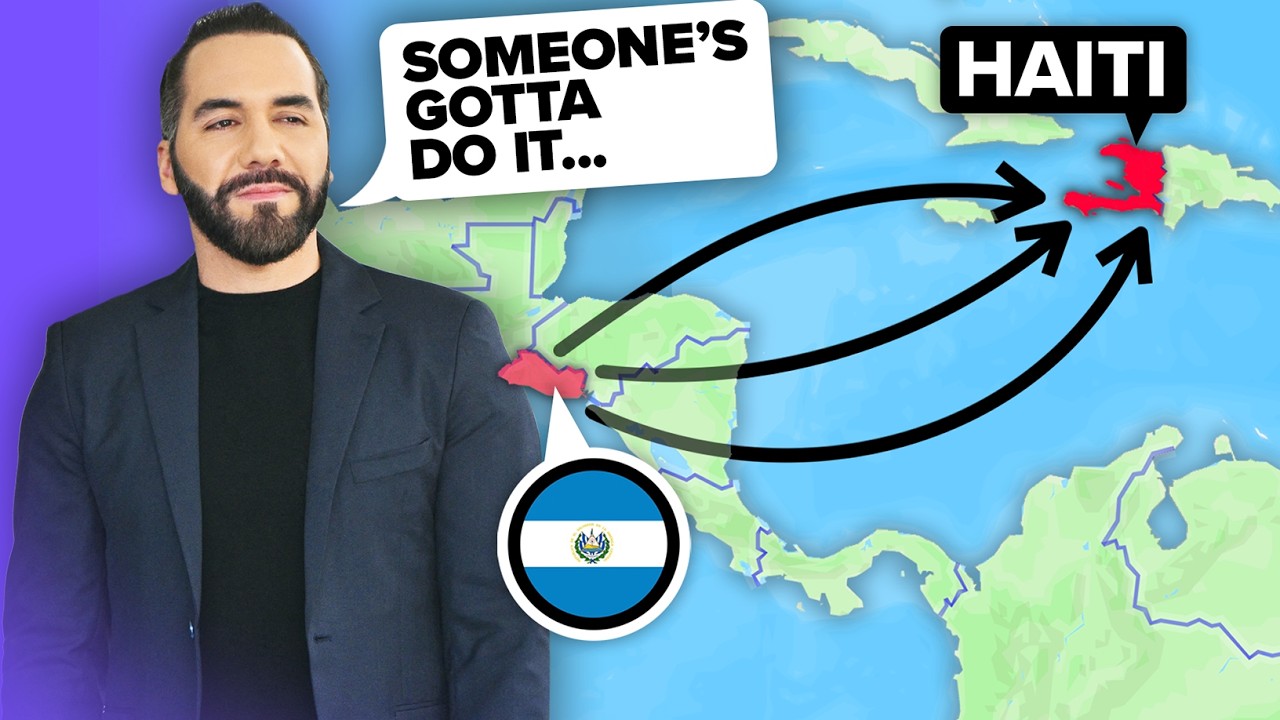
El Salvador’s Gamble in Haiti Is Paying Off
When El Salvador announced it would send troops to Haiti to “finish the gangs,” the plan drew immediate skepticism. Haiti’s gangs are heavily armed and deeply entrenched, and El Salvador is a small country with virtually no experience in foreign interventions.
When El Salvador announced it would send troops to Haiti to “finish the gangs,” the plan drew immediate skepticism. Haiti’s gangs are heavily armed and deeply entrenched, and El Salvador is a small country with virtually no experience in foreign interventions. Yet only weeks into the mission, President Nayib Bukele appears to have outperformed expectations once again.
Haiti has functioned as a failed state since at least July 2021, when President Jovenel Moïse was assassinated. Gangs filled the power vacuum and now control much of the country, especially around the capital, Port-au-Prince. They have built an informal state of roadblocks, tolls, and extortion rackets they call taxes. The humanitarian toll is severe: at least 16,000 people, mostly civilians, have been killed; more than 1.5 million have been displaced; and half the population faces acute hunger.
In late 2022, Haiti’s internationally recognized prime minister, Ariel Henry, requested outside help. The United Nations declined to deploy a peacekeeping force, largely because its previous mission in Haiti, MINUSTAH, which operated from 2004 to 2017, was marred by human rights abuse allegations. Instead, the UN Security Council authorized a Kenyan-led mission called the Multinational Security Support Mission (MSS), with personnel from several contributing countries.
That mission struggled. The MSS took nearly two years to deploy, was too small, and faced chronic funding shortages. As gangs tightened their grip and casualties rose, the Security Council passed a new resolution in September 2025 upgrading the MSS into a Gang Suppression Force (GSF), with a higher troop ceiling and more direct UN logistical support. Kenya and Chad provided most of the troops. El Salvador contributed roughly 80 personnel, mostly as a medical evacuation unit.
On October 18, four Salvadoran aviation technicians were ambushed by gangs on their way back to camp. They escaped their vehicle, but contact was lost, and a GSF spokesperson said the men were believed captured. Bukele responded on X: if the four were not returned alive, he would finish the gangs in Haiti as he had in El Salvador.
After days of silence, on October 23, gang leader Wilson Joseph of 400 Mawozo, one of Haiti’s largest and most notorious gangs, released a video claiming the four Salvadorans had died because of an “error.” The next day, an NGO said it had found four bodies on the outskirts of Port-au-Prince and delivered them to the Salvadoran mission. Bukele rejected that claim on X, stating the remains were not those of the technicians, and signaled he would deploy troops.
The idea was not entirely new. Bukele first floated sending troops to Haiti in 2024, claiming that with a UN Security Council resolution, Haitian consent, and financing help, El Salvador could “fix the country.” None of those conditions was clearly met this time. The UN confirmed on October 30 that Salvadoran forces were operating outside the GSF’s remit. Haiti’s government publicly agreed to the deployment only about a week after the first Salvadoran soldiers arrived. And while a few countries have helped with logistics, Bukele claims El Salvador is covering 90 percent of the costs.
None of this deterred him. El Salvador has since deployed some 2,000 troops, including hundreds of special forces, its largest foreign deployment since the 1969 “Soccer War” with Honduras, which began after fans clashed during a World Cup qualifier. In an October 29 post addressed to the Haitian people, Bukele said his only wish was for the four technicians to return home and that Salvadoran forces would leave when the mission was finished. A week later, he appeared to broaden the objective: to “defeat the gangs, not just recover a few technicians,” and help Haitians take back their country.
That looked like a tall order. Gangs have controlled Haiti for years and possess heavy weaponry. And Bukele’s domestic strategy could not simply be transplanted abroad: in El Salvador, he cut the murder rate by imprisoning thousands of young men, nearly 2 percent of the population, an approach that is not viable in a foreign intervention.
Yet the early results are striking. After violent clashes between Salvadoran troops and gang members in Placage, near Port-au-Prince, Wilson Joseph sent a letter to the UN asking it to mediate. He wrote that he had “officially raised the white flag” and would participate in any meeting aimed at a peaceful solution, a dialogue agreement, and a sustainable stabilization process. It is the first time a major gang leader has signaled interest in negotiations. Days later, Joseph’s gang sent another letter, this time to the government agency responsible for dismantling the gangs, again calling for peaceful dialogue toward a lasting political solution. The gang said it was specifically worried about social media posts targeting Joseph’s home, which it described as a symbol of peace within its de-escalation process. That was a clear reference to a Bukele post replying to a clip of the house and asking where it was; community notes then geolocated it.
This does not mean Bukele has won. But if he can capitalize on the moment and negotiate a settlement with the gangs, a tall order that now looks far more likely than it did weeks ago, he will have achieved something impressive at very little cost. If negotiations fail, he will face a difficult choice: press on with a messy and costly foreign war, or withdraw and leave Haiti to descend into a deeper crisis.