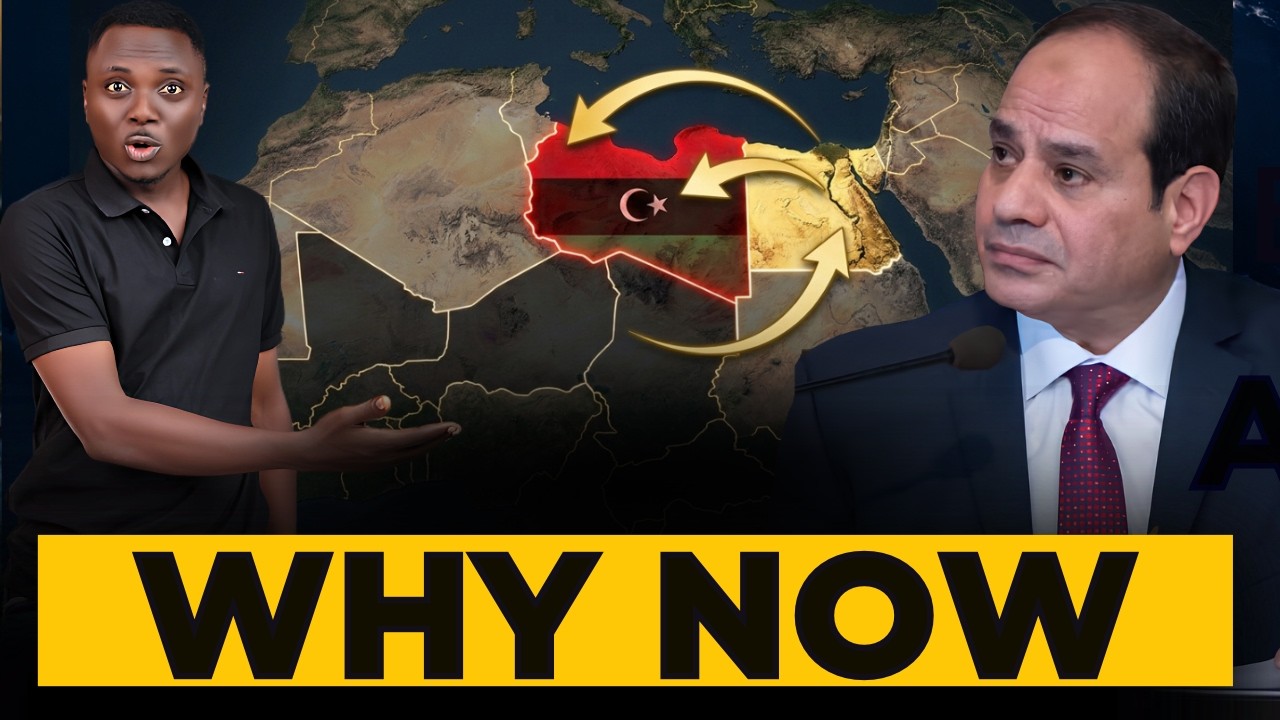
Egypt Didn't Switch Sides in Libya. It Opened a Second Door.
Six years ago, Egypt's president stood near the Libyan border and drew a red line: if Tripoli's forces moved on the city of Sirte, Egypt could intervene directly. This month, Egypt's foreign minister traveled to Tripoli, shook hands with the very side Egypt once warned, and reopened Egypt's embassy
Six years ago, Egypt's president stood near the Libyan border and drew a red line: if Tripoli's forces moved on the city of Sirte, Egypt could intervene directly. This month, Egypt's foreign minister traveled to Tripoli, shook hands with the very side Egypt once warned, and reopened Egypt's embassy there after more than a decade. The visit focused on two issues: a maritime deal Libya signed with Turkey, which Egypt opposes, and pipelines.
Headlines asked whether Egypt had switched sides. The reality is more complex, and more revealing.
Eighteen days before the Tripoli visit, Egypt's own allies in eastern Libya handed Turkey a significant victory at sea. Egypt called the move null and void, meaning it does not count, yet did not turn its back on the east. Understanding why requires looking at Egyptian homes that sat dark for hours a day two summers ago, and at three answers to a single question: who was this visit really for? Only one of those answers is in Tripoli.
Why this matters extends beyond diplomacy. Egypt and Turkey are two of the outside powers backing Libya's rival camps, and their choices help determine whether Libya remains split. A divided country cannot protect its people. In 2023, two old dams burst above the eastern city of Derna, killing thousands. A Libyan expert had warned a year earlier that the dams needed repair. With two rival governments, nobody fixed them. Nearly one million migrants live in Libya today, including almost 190,000 Egyptians.
The backdrop: in 2011, Libya's ruler Muammar Gaddafi fell and the country broke apart. Since 2014, two rival powers have governed: in the west, around the capital Tripoli, a government most of the world recognizes; in the east, around Benghazi, a camp run by a powerful military commander. Other countries picked sides, and Egypt backed the east. In 2020, Turkish forces pushed the eastern forces back from Tripoli, prompting Egypt's red line. For years the picture was simple: two camps, two sets of friends.
Did Egypt really abandon its friends? Start with the embassy. Egypt closed it in January 2014 after five staff members were kidnapped, but diplomats returned to Tripoli in May 2021. What opened this month was the old building, and Egypt has not dropped the east or Commander Khalifa Haftar, whom it has backed for years. Egypt did not simply switch sides.
One element of the visit did not fit a routine diplomatic trip. Foreign Minister Badr Abdelatty, in Tripoli, complained about the Libya-Turkey maritime deal face to face with the very government that signed it. Why pick that fight there, and why now?
Some of this is ordinary, slow diplomacy. Egypt and Libya signed an energy agreement in January, and relations have warmed for years. Reopening the embassy could simply be paperwork catching up. But that does not explain the timing or the maritime dispute. For that, examine the months before the visit, when most of the action was in the east.
In December 2025, Haftar was in Cairo meeting President Abdel Fattah el-Sisi. Egypt's presidency said the two men discussed the sea border between their countries and agreed to keep working together. At sea, Cairo and the east looked like one team. Yet the east was making new friends. Haftar's camp was growing closer to Turkey, the same Turkey that helped push it back from Tripoli. Haftar's son Saddam, also his deputy, was welcomed in Ankara. By July, Al Jazeera reported growing military ties between Turkey and the east.
Turkey was not the east's only surprise. In 2025, Sudan's army accused Haftar's forces of joining an attack on its border post where Sudan, Libya, and Egypt meet. The attack was led by the Rapid Support Forces, the group Sudan's army has fought since 2023 and whose rival Egypt backs. Egypt's partner stood accused of helping the other side on Egypt's doorstep.
Then came October 20. Eastern Libya's parliament voted to approve the maritime deal Libya signed with Turkey in 2019, which the east had blocked for years. The deal draws a line across waters that Egypt, Greece, and Cyprus claim. Control of the seabed determines who may search for gas beneath it, and gas is exactly what Egypt lacks. The next day, Egypt declared the deal null and void, language with history: in 2020, Egypt drew its own maritime line with Greece.
Place the dates side by side. On October 20, Egypt's own eastern partner approved the deal. On November 7, Egypt's foreign minister was in Tripoli arguing against it, 18 days apart. Did that vote push Egypt toward Tripoli? That cannot be known for certain. One unnamed Egyptian diplomat told the news site The New Arab that the visit was partly a message to the east, though Cairo has not said so publicly. What is visible is the order: Egypt's partner moved toward Turkey first, and Egypt showed up in Tripoli second. Egypt did not punish the east; it kept talking to both sides.
That suggests Egypt needs something from Libya it cannot afford to lose by choosing one side. Recall the pipelines and the darkened homes. In summer 2024, homes and shops across Egypt lost power for two to three hours daily. The government rationed electricity because there was not enough gas. The cuts stopped in July only after gas shipments arrived from abroad.
Egypt's own production tells the story. In 2023, Egypt produced about 59 billion cubic meters of gas; by 2025, output had fallen to about 45 billion, nearly 30 percent lost in two years. Egypt began buying gas shipped by tanker, imports rising from almost nothing to about 13 billion cubic meters last year, most of it from the United States. Egypt is spending scarce dollars to bring gas across an ocean while Libya, next door, sits on oil and gas that supply about 90 percent of its government's revenue.
Once this is clear, loyalty stops being the central question. The question becomes where Egypt can get energy and who controls the road to it. Egypt and Libya are studying an oil pipeline roughly 800 kilometers long to carry Libyan crude to Egyptian refineries. It would start in the east, which also controls the land border with Egypt and the coast next to Egypt's waters. Any pipeline or water line to Egypt must cross territory the east controls. Tripoli holds the rest: the National Oil Corporation that runs Libya's oil, the government foreign countries sign deals with, and the maritime deal with Turkey. The land is in the east; the signatures are in the west. Egypt cannot speak to only one side.
A fair warning: the pipeline remains only a study. The sole price tag so far, over a billion dollars, comes from an unnamed official, and most Libyan gas already flows the other way, from the west under the sea to Italy. Egypt is not first in line. Do not expect Libyan oil in Alexandria next year. But even on paper, the plan shows whom Egypt must deal with: both camps.
Egypt is not alone in working both sides. Turkey now engages both Libyan camps as well. In July, an Egyptian source told Al Jazeera that Turkey's moves in Libya were coordinated with Cairo. Egypt and Turkey still disagree about the sea but cooperate elsewhere. In 2020, everyone knew which side they were on. Now every outside power wants to be friends with both, and when everyone needs you, you can ask for more.
Yet if Libya's leaders have gained leverage, ordinary Libyans have gained little. The World Bank reports prices in Libya rose more than 11 percent in the first half of this year, and Libyans have not voted in a national election since the country split. A United Nations-backed deal signed in August sets a path to elections within 24 months, but with conditions: one government for the whole country and reunified national institutions. Libya has not met them. Libyan political scientist Elias al-Baruni put it this way: Libya needs a settlement that ends the division, not a deal that redistributes it.
So where does this leave matters? Egypt did not switch sides. Egypt needs energy, and what it needs lies on both sides of a divided country. The visit to Tripoli was for Tripoli, yes, but also for the east and for Turkey.
Three developments will show whether the visit truly mattered: an energy deal signed by both Libyan camps, Egypt and Libya sitting down to agree on their sea border, and real progress on the UN's conditions. Without them, this was a reopened embassy and a photograph.
Return to that embassy in Tripoli. At first it looked like leaving an old friend. But consider the order. In December, Egypt and the east met in Cairo to discuss their shared sea. Ten months later, the eastern parliament approved Turkey's line across that same water. Eighteen days after that, Egypt's foreign minister stood in Tripoli. Nobody slammed the door; each side simply opened another one.
Loyalty rarely breaks in one big fight. It wears away each time someone finds another door, in business, in families, between old allies. By the time someone says it out loud, the change has usually already happened. The embassy opened in November, but the real change began ten months earlier in Cairo, over a line drawn on the sea.
Related Coverage
Libya and Syria Just Made a Move That Could Reshape the Region — Here’s What Happened
Libya’s acting foreign minister met with Syria’s top diplomat in Damascus on Wednesday, marking the highest-level contact between the two governments in years and signaling a potential reset of diplomatic ties.
Türkiye’s Top Diplomat Shuttles Between Tripoli and Benghazi, Pushing ‘One Libya’ Unity in New Talks
Türkiye is doubling down on its role as a mediator in Libya, with its foreign minister holding talks in both Tripoli and Benghazi to push for a unified political solution.
Libya's Parliament Flips, Backs Turkey's Mediterranean Power Play as Greece and EU Cry Foul
Libya's eastern-based House of Representatives has reversed its rejection of a 2019 maritime deal with Turkey, a move that redraws boundaries in the gas-rich Eastern Mediterranean and deepens Ankara's influence in the divided country.
AU Reopens Khartoum Office: 1 Narrow Step Toward Peace in Sudan?
The African Union (AU) has reopened its liaison office in Khartoum, marking its first official presence in the Sudanese capital after a period of absence, as part of renewed diplomatic efforts to end the country's conflict.
Egypt's Sisi Hosts Rare Horn of Africa Summit as Sudan Weighs Austerity and Eritrea Pleads for UN Help
Four East African leaders met in Egypt to tackle rising tensions, while Sudan's government debated spending cuts and Eritrea asked the UN to intervene in its standoff with Ethiopia.
France and Morocco Ink Energy Deal as PM’s Visit Seals Diplomatic Reset
French Prime Minister Sébastien Lecornu arrived in Rabat this week with 12 ministers and a clear mandate to deepen energy cooperation, marking a concrete step in repairing ties after years of diplomatic tension between Paris and Rabat.