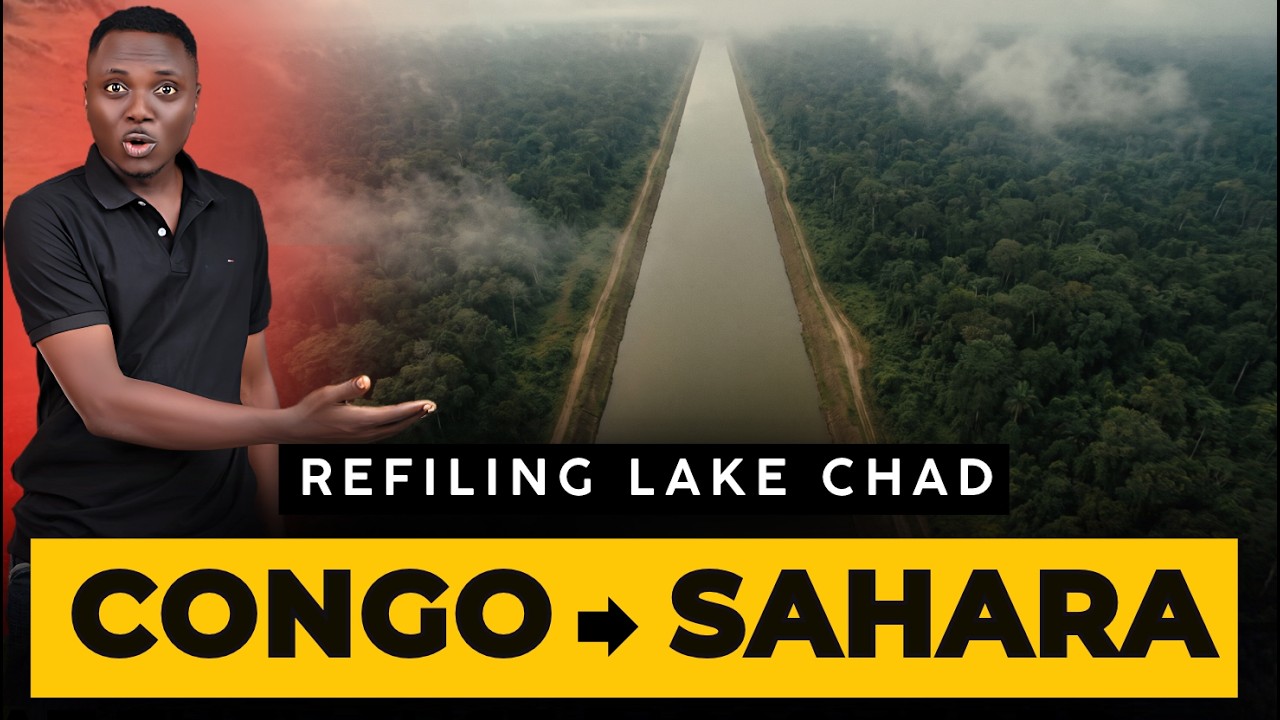
The $50 Billion Pipe Dream: Can We Really Turn the Congo River to Save the Sahara?
Introduction The Sahara Desert is expanding, swallowing fertile land and exacerbating humanitarian crises across Africa. Meanwhile, the Congo River discharges more water into the Atlantic Ocean than any other river on Earth except the Amazon.
Introduction
The Sahara Desert is expanding, swallowing fertile land and exacerbating humanitarian crises across Africa. Meanwhile, the Congo River discharges more water into the Atlantic Ocean than any other river on Earth except the Amazon. This stark contrast has inspired a radical, multi-billion-dollar proposal: what if we could move the Congo to the desert? The idea of a 2,400-kilometer canal connecting the heart of Africa to the arid north is not just science fiction; it is a serious engineering concept known as the Trans-Africa Water Transfer project. But can such a monumental feat actually be achieved, and at what cost?
A Tale of Two Extremes
The logic behind the project is simple geography. The Congo River Basin is a massive reservoir of fresh water, discharging approximately 40,000 cubic meters of water per second into the ocean. To the north, the Sahara Desert is a vast, arid expanse roughly the size of the United States. Proponents argue that capturing even a fraction of the Congo’s flow could transform the Sahara into arable land, create inland seas, and provide drinking water for millions.
The Engineering Challenge
The proposal involves constructing a canal or a series of pipelines stretching roughly 2,400 kilometers from the Congo Basin to the Sahara. This is not a simple trench. The route must traverse the Congo Basin rainforest, cross the Congo-Nile Divide—a highland region separating the two river systems—and descend into the desert.
The topography presents a significant hurdle. Water does not naturally flow uphill. While the Congo River sits at a lower elevation than the Sahara, the land between them rises sharply. To move water over the divide, engineers would require a massive system of pumping stations. These pumps would need to lift water hundreds of meters, consuming vast amounts of electricity. To power them, the project would likely rely on hydroelectric dams on the Congo River itself, such as the proposed Grand Inga Dam, which could theoretically generate enough power to run the pumps.
The Environmental and Political Minefield
Beyond the engineering, the environmental implications are severe. The Congo River is the lifeblood of the second-largest rainforest on Earth. Reducing its flow could lead to the salinization of the river delta, destroying ecosystems and the fishing industries that depend on them. Furthermore, the river supports the hydroelectric potential of downstream nations like the Democratic Republic of the Congo (DRC) and the Republic of the Congo.
Politically, the project is a nightmare. The canal would have to cross multiple international borders. It would require the cooperation of the DRC, the Republic of the Congo, the Central African Republic, and Chad, among others. Historically, water rights are a source of conflict, not cooperation. Upstream nations are unlikely to surrender their water security to benefit downstream neighbors.
The Cost of a Miracle
The financial burden is equally staggering. Estimates for large-scale water transfer projects, such as China’s South-North Water Transfer Project, run into the tens of billions of dollars. A project of this magnitude in Africa, involving complex terrain and international coordination, could easily exceed $50 billion. For a continent already struggling with infrastructure debt, securing this funding is highly improbable.
Alternative Solutions
Critics argue that the money would be better spent on desalination plants in North Africa or on localized water harvesting and irrigation projects in the Sahel. These solutions are less glamorous but more feasible, sustainable, and less likely to trigger ecological collapse.
Conclusion
The idea of moving the Congo River to the Sahara captures the imagination because it appeals to the human desire to conquer nature. However, the reality is that the Trans-Africa Water Transfer project is a logistical, environmental, and political fantasy. The engineering required is possible in theory but prohibitive in practice. Until we address the fundamental issues of water management and climate change, the Sahara will remain a desert, and the Congo will continue to flow into the sea.
Related Coverage
Planetary Emergency: Super El Niño, Surging Seas, and Endless War Push the World’s Most Vulnerable to the Brink
A powerful and potentially historic El Niño is strengthening over the Pacific Ocean, threatening to unleash a cascade of extreme weather events just as the United Nations reports that global sea levels are now rising at twice the rate they were a decade ago. These accelerating climate shocks are converging with a surge in global conflicts, record-breaking hunger, and a water crisis stretching from the American Southwest to Bangladesh, creating a planetary emergency that is hitting the world’s poorest and most vulnerable populations hardest.
Climate vs. Cash: Two AI Data Centre Booms Threaten to Drain Cities Dry
A global race to build massive AI data centres is sparking a fierce debate over whether the projects are a net benefit or a dangerous drain on energy and water supplies.
El Niño on Steroids: Supercharged Climate Event Threatens to Wipe Out Millions in the Sahel
Across Africa’s Sahel region, a catastrophic mix of surging violence, climate shocks, and hunger is pushing millions to the brink of collapse — and a potentially historic “super” El Niño threatens to make the crisis even deadlier. The United Nations warns that the humanitarian disaster, which has largely faded from global headlines since 2012, is now spilling across borders as civilians flee brutal attacks, droughts destroy crops, and extreme weather strains already broken systems.
7 States Face Water Crisis as Colorado River Shrinks — Africa Loses Billions as Water Crisis Worsens
A new global study reveals that water levels are falling in nearly one-third of the world's boreholes, with South Africa's underground water supply drying up due to unsustainable pumping for irrigation, homes, and industry [160355]. Meanwhile, African leaders warn that poor access to clean water and basic toilets is draining billions of dollars from the continent each year, worsening poverty, disease, and inequality [157054].
Drought and Fire: Climate Chaos Hits Europe, Amazon, and Beyond
A severe drought is crippling Europe, with five reservoirs in England and Wales at “exceptionally low” levels and Germany’s Rhine River—a key economic artery—dropping to critically low levels, threatening industrial supply chains and forcing mass evacuations from wildfires [219383][219285][219250]. Meanwhile, scientists warn that a “super” El Niño could push the Amazon rainforest past a tipping point, turning it from a carbon sink into a carbon emitter and disrupting global rainfall patterns [218382][219377].
A Planet on Fire: Super El Niño, Surging Seas, and Endless War Crush the World’s Most Vulnerable
As a powerful El Niño pattern strengthens over the Pacific Ocean, the world faces a cascade of converging crises—from record-breaking hunger and collapsing water systems to escalating wars—that are hitting the poorest and most vulnerable populations hardest, exposing a global system that prioritizes profit over people.
Related Editorials
The Continent Without a Coast: Why Ships Can’t Reach the Heart of Africa
Africa is the world’s second-largest continent, home to 1. 4 billion people and some of the fastest-growing economies on Earth.
The Sahara Just Became the World’s Most Expensive Warzone
For decades, the Sahara Desert has been a harsh, sparsely populated expanse—a natural barrier for trade, migration, and conflict. That reality has changed.