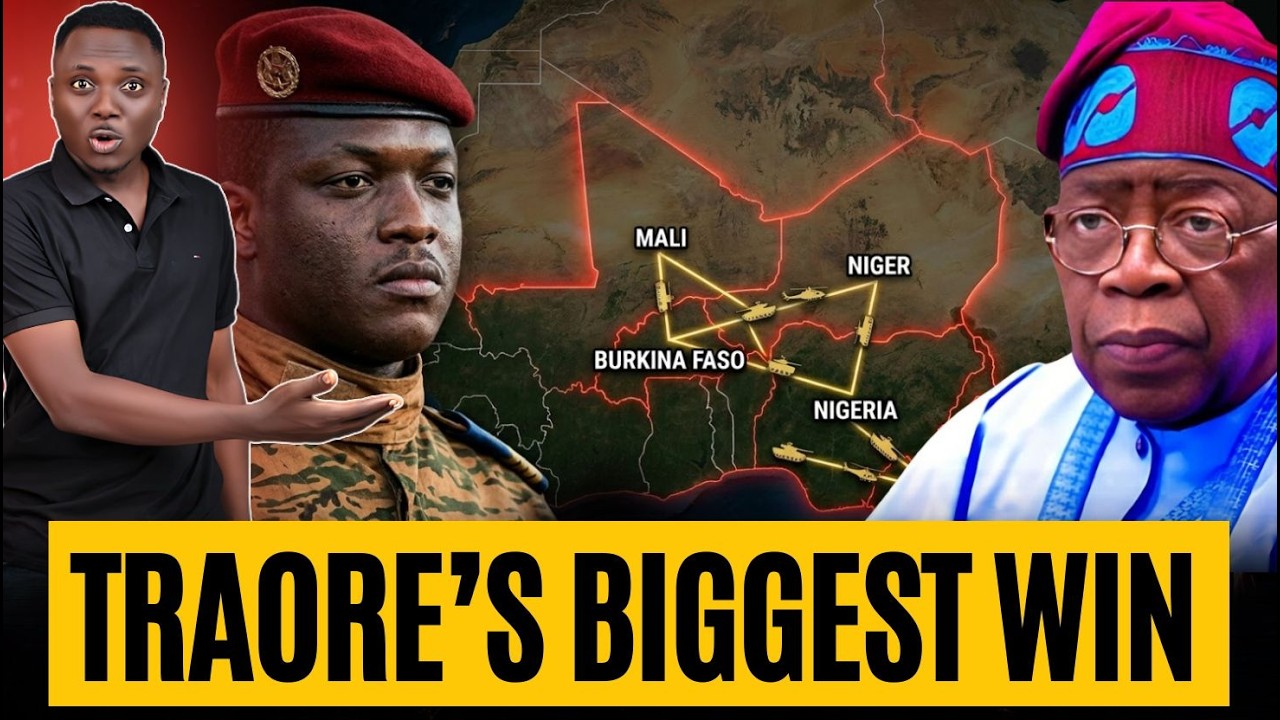
It Looked Like an Invasion. It Was a Rescue — and Proof of Africa's New Security Blueprint
A story raced across social media. Cameroonian soldiers had crossed into Nigerian territory.
A story raced across social media. Cameroonian soldiers had crossed into Nigerian territory. Within hours, the word "invasion" was everywhere. Nigerians demanded to know where their army was. Outrage filled the comment sections.
Almost nobody mentioned one detail: those same Cameroonian soldiers had just freed about 300 Nigerian civilians from terrorist captivity.
So was it an invasion, or a rescue mission that the internet completely misread? And the deeper questions remain. Who authorized the operation? What made it legal? Why were Cameroonian soldiers operating on Nigerian soil at all?
The answers lead far beyond Cameroon and Nigeria. They lead to three countries in the Sahel, a decision made in 2023, and a blueprint that African states are now quietly copying.
A border that protects the enemy
The Cameroon–Nigeria border stretches about 2,000 kilometers, from the Gulf of Guinea in the south to Lake Chad in the north. To the armed groups operating there, it is not a barrier. It is a highway.
For the people living along it, the line barely exists. A village may keep its market and school on the Nigerian side; walk 500 meters east and you are in Cameroon. Same families, same language, same trade.
But for Boko Haram and ISWAP, the Islamic State West Africa Province, two of the region's most violent jihadist armed groups, that line means everything. When a unit attacked a Nigerian village and the Nigerian army responded, the fighters simply ran 500 meters across the border. There they became untouchable. Nigerian soldiers stopped at the invisible line, not because they could not fight, but because the law stopped them.
That structural gap, a colonial border drawn without any thought for modern armed groups, kept the escape route open for more than a decade. The fighters knew it and used it. Thousands of civilians paid the price, until someone decided to close it.
Three countries stop waiting
Now travel north to the year 2023. Mali, Burkina Faso, and Niger, three countries in the Sahel, the semi-arid belt along the southern edge of the Sahara, had each just experienced a military takeover. Each had expelled French troops. Each had endured escalating jihadist violence for a full decade.
A joint security force backed by France and the European Union had operated in the region since 2017. Billions of dollars, hundreds of summits, and the violence kept spreading.
So the three governments did something few expected. They stopped waiting and started building.
In 2023, they formed the AES, the Alliance of Sahel States. They did not stop at declarations. They recruited soldiers from all three countries into a single unified force of 5,000 to 6,000 troops, with its own headquarters in Niamey, its own command structure, vehicles, aircraft, and medical units. When the force was unveiled in December 2025, leaders handed over its flag, weapons, and vehicles at a ceremony. This was an institution, not a promise.
The logic was brutally simple. If an armed group moves from Mali to Burkina Faso, you follow. If it crosses into Niger, you follow again. The borders remain on the map, but militarily the region becomes one zone of operations with one mission. Nowhere to run. The AES calls this doctrine "no safe haven."
The design flaw that killed earlier efforts
Here is the detail most coverage misses. Every joint security framework before the AES shared one fatal flaw: each country kept tight control of its own troops. Even when a joint headquarters wanted to pursue fighters across a border, it had to wait for each national command to approve the move separately. By the time the paperwork cleared, the moment was gone. The armed group had vanished.
No militant waits at a border while generals exchange documents. Years of this pattern only emboldened the attackers.
The AES fixed the problem by giving its central headquarters operational authority, the power to move troops across all three countries without asking permission at each step. That single change separates it from every failed framework before it.
Financing was solved the same way. The AES states introduced a 0.5 percent tax on imported goods across member countries to fund the force. According to Reuters, by early 2025 Niger's defense minister was already describing a nearly 5,000-strong force with its own air assets and intelligence capabilities. They did not wait for France or Russia. They taxed their own trade and built their own army.
Nigeria and Cameroon copy the model
Now return to that 2,000-kilometer border. Nigeria and Cameroon share it, along with the same enemies. Boko Haram and ISWAP had run the same play for years: strike the Nigerian side, vanish into Cameroon; strike the Cameroonian side, melt back into Nigeria. Repeat.
In June 2026, the two countries sat down in Yaoundé and signed a memorandum of understanding, a formal agreement short of a full treaty, on defense cooperation. Both defense ministries signed. The deal covers joint operations, genuine intelligence sharing, coordinated responses, logistical support, and, crucially, a legal basis for cross-border pursuit.
They took the core idea of the AES and applied it to their own border.
That explains Borno state. The Cameroonian soldiers who crossed into it were not invaders. They operated under a legal framework both governments had agreed to and both defense ministers had signed. The "invasion" that enraged social media was planned, coordinated, and covered by paperwork, and it freed up to 300 people. The internet simply never read the document before posting.
A blueprint with a shadow
Honesty requires the darker side of this story. The AES brought in Russia. Russian Africa Corps forces have operated alongside AES troops, and credible reports from human rights organizations document real concerns: civilian casualties in operational areas, displaced communities, disrupted trade routes. These costs matter. The open question is whether African-led, African-funded security frameworks can hold themselves accountable to the very people they exist to protect.
Notably, Cameroon and Nigeria are using neither Russia nor France. Their agreement builds on a long formal relationship, including the Cameroon–Nigeria Mixed Commission, a body that has managed border issues between the two countries for decades. In practical terms, they are running a cleaner version of what the AES started.
The model is spreading in other directions too. Cameroon maintains an active security cooperation framework with the Central African Republic along their eastern border. Same model, same logic, two armies closing the gap on a shared threat. Tellingly, these governments announce very little. Publicizing joint operations hands militants your strategy. Everything rests on surprise.
One map, one question
Plot the partnerships on a map and a pattern appears. The AES, Mali, Burkina Faso, and Niger, covers the Sahel. The Cameroon–Nigeria agreement stands as central and West Africa's most consequential bilateral security deal of 2026. Cameroon and the Central African Republic form an eastern front.
Niger shares the Lake Chad basin with both Nigeria and Cameroon, and the same armed groups operate across all four countries. The geography is identical. The threat is identical. The AES logic would apply there with almost no modification.
So could West and Central Africa eventually build a security framework designed neither in Brussels nor in Washington, one based not on trade-bloc politics but on practical coordination between states facing the same problem? This is a real question, not a prediction. The obstacles are serious. Historical tensions do not vanish because of a shared enemy. Sovereignty, a country's full control over its own territory, remains deeply sensitive across Africa. And the Bakassi border dispute, once serious enough to reach the International Court of Justice in The Hague, shows how contested this same frontier once was. Yet those same two countries now run joint operations to protect the people living along it.
The dividend nobody reports
One part of this story is overlooked in nearly every analysis. Every time a border community is freed from armed group control, the economy moves. Markets closed by fear reopen. Farmers return to land they had abandoned. Traders cross to sell. Families separated by a border they could not safely cross reconnect. Communities along the Cameroon–Nigeria border, some of the most economically active zones in central and West Africa, have been functioning at a fraction of their potential because the border was a conflict zone. When soldiers close the gap the militants relied on, they are not only providing security. They are reopening economies.
No overselling
The limits deserve equal honesty. One memorandum does not end an insurgency. Six thousand AES troops do not stabilize the entire Sahel overnight. These are deep problems with deep roots, decades in the making. A signing ceremony does not close them.
But the direction is real. What stands out most is where it started: with three countries the world had essentially written off. Niger, Mali, and Burkina Faso built the blueprint, and their neighbors watched and began constructing their own versions.
There is a Swahili proverb: unity is strength, division is weakness. These armies are not quoting it in conference rooms. They are applying it in the field.
Which leaves one question worth sitting with. Is cooperation between neighbors, the Cameroon–Nigeria model, enough to build lasting security? Or must it eventually grow into something more structural and permanent to hold?
Related Coverage
UK Seizes Russian Oil Tanker, Turns $300 Million Cargo into Cash for Ukraine
British Royal Marines boarded a shadow-fleet tanker in the English Channel and seized its crude oil cargo, which the UK now plans to sell and use the money to support Ukrainian troops [181553]. The operation targets vessels operating outside standard insurance and safety rules to evade sanctions, marking a direct move to turn captured Russian assets into military aid for Ukraine [181553].
111 Arrested in New Ceuta Border Rush After Social Media Call
Moroccan and Spanish authorities arrested 111 migrants on Tuesday as they attempted to cross into the Spanish enclave of Ceuta, following social media calls for a mass border breach [220235]. The arrests mark the second major attempt in weeks, coming after an earlier surge that saw tens of thousands enter the territory [219911].
15 African Nations Ink Deal to Stop Illegal Fishing — But Who’s Really Cashing In?
15 African nations have signed a new agreement to crack down on illegal fishing, a practice that drains local economies and fuels human trafficking.
Russia’s African Cannon Fodder: 106 Cameroonians Dead in Ukraine After Signing Army Contracts
Two Cameroonian nationals were killed on the front lines in Ukraine just weeks after signing contracts to fight for the Russian army, according to Ukrainian military intelligence (HUR). One of the deceased was a student; the other was 23 years old. HUR now estimates that at least 106 Cameroonian citizens have died while fighting alongside Russian forces since the war began [197284].