Argentina’s Economic Miracle Is Unraveling
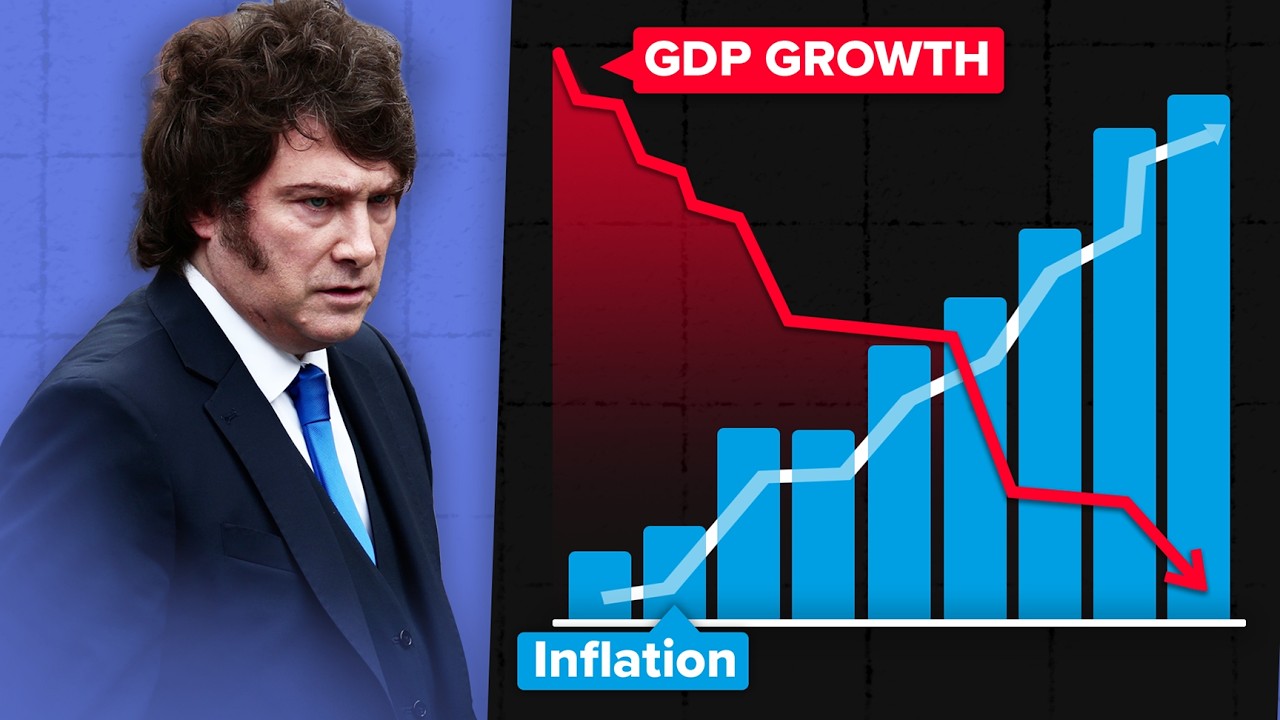
Last year, Argentina’s chainsaw-wielding President Javier Milei appeared unstoppable. GDP growth was rising, inflation was falling, and his approval ratings were sky-high.
Last year, Argentina’s chainsaw-wielding President Javier Milei appeared unstoppable. GDP growth was rising, inflation was falling, and his approval ratings were sky-high. Today, that picture has darkened considerably. The promised V-shaped recovery has not materialized, and the trend lines now point squarely in the wrong direction. This may explain why Milei speaks less about free markets and more about the Falkland Islands.
Milei’s economic project can be divided into two phases. The first focused on stabilizing Argentina’s economy. The second aimed to use free-market policies to ignite an economic boom.
Phase one required three achievements: balancing the budget deficit, balancing the trade deficit, and stabilizing inflation. Milei was remarkably successful on all three fronts.
He balanced the budget deficit by drastically cutting government spending, and Argentina posted slight budget surpluses in both 2024 and 2025. He remedied the trade deficit by aggressively devaluing Argentina’s currency, the peso, making imports unaffordable for many Argentinians. Argentina has posted trade surpluses every month since Milei took office.
The devaluation initially triggered an inflationary spike, but Milei made solid progress on prices. Month-on-month inflation fell from a peak of 25 percent in December 2023 to roughly 2 percent by 2025. Milei achieved this mainly not by raising interest rates, the usual method for fighting inflation, but by reducing the government deficit, which had previously been financed by inflation-inducing money printing.
It is important not to overstate this progress. Argentina remained far from economically stable. A 2 percent monthly inflation rate still translates to an annual rate above 25 percent, which would be considered dangerously high in almost any other country. By Argentine standards, however, it was impressive. Early last year, Milei appeared to have succeeded in phase one.
Phase two has proven far more difficult. In its annual budget, Milei’s government forecast 5 percent growth for 2026. That looked optimistic at the time. It now looks outlandishly implausible. According to the central bank’s most recent survey, analysts forecast just 2.7 percent growth in 2026. Even this seems optimistic given recent data.
According to the latest monthly GDP figures, Argentina’s economy actually shrank in the second quarter of this year. A 0.8 percent expansion in June was not enough to offset a 2.1 percent contraction in April and May. Moreover, the limited recovery has become increasingly uneven. Export-oriented industries such as mining, energy, and agriculture are performing well. Domestic sectors such as manufacturing, construction, and commerce are contracting.
Milei cannot easily claim credit for the export boom. It precedes his tenure and is mostly a function of high commodity prices. This has left the wider economy reliant on the whims of global commodity markets. These export-facing industries also create fewer jobs, which partly explains why unemployment, now Argentine voters’ main concern, has steadily increased since Milei took over.
Weakness in the domestic economy stems largely from inflation, which remains very high. The monthly inflation rate has hovered around 2 percent since 2025, translating to an annual rate above 25 percent. The annual inflation rate actually ticked up to a 12-month high of 33.8 percent in July. This is somewhat embarrassing for Milei. Despite presenting himself as the only man capable of ending Argentina’s chronic inflation problem, inflation has been roughly as high under him as under most of his left-wing predecessors.
Chronic inflation harms the domestic economy because rising prices erode household purchasing power, causing consumers to spend less. The associated uncertainty deters consumers from making large purchases and businesses from making major investments.
Two main reasons explain why inflation has proved frustratingly sticky in Argentina.
The first is that the obvious way to reduce inflation would be for Milei to further reduce demand. Assuming supply stays constant, less demand means lower prices. In practice, this would require tightening either fiscal or monetary policy, meaning either cutting government spending further or raising interest rates to make borrowing more expensive. Either move would slow the overall economy. Milei cannot afford this when the economy is already growing far slower than he would like.
This has been complicated further by the fact that many Argentinians have taken out loans from Argentina’s private credit market, which Milei has aggressively deregulated. A record number are now behind on their loans. Tightening fiscal or monetary policy would probably put even more stress on debtors, as would a slowdown in inflation.
The second reason inflation has proved sticky is inflation expectations. Because it is all they have ever known, and despite Milei’s efforts to convince them otherwise, Argentinians still expect prices to continue rising. These expectations become self-fulfilling. When workers expect prices to rise, they demand higher wages, which means more demand and more inflation. When businesses expect higher costs and wages, they raise prices. When consumers expect prices to rise, they accelerate spending, again meaning more demand and more inflation.
This is why central bankers fret almost as much about inflation expectations as about inflation itself. It is also why inflation can become incredibly sticky once it becomes the new normal. Getting inflation down to normal levels was always going to be incredibly difficult for Milei. Pulling the usual policy levers, such as tightening fiscal or monetary policy, can achieve partial progress. Fully taming inflation, however, requires resetting Argentinians’ expectations. This was always going to be a longer and fundamentally more political process.
Ultimately, Milei made undeniably solid progress on phase one of his economic project. Phase two is clearly not going to plan. This is not entirely Milei’s fault. Fixing Argentina’s infamously dysfunctional economy in a single term was always a tall order. It is fair to say, however, that he overpromised.
Related Editorials
Is Inflation About to Get Much Worse? The Warning Signs You Can't Ignore
After months of declining inflation rates, a new threat is emerging that could reverse all the progress central banks have made. Recent economic data suggests that the forces driving prices higher are not only persistent but may be accelerating.
Germany’s Economic Engine Sputters: Why the World’s Former Export Champion Is Running Out of Steam
For decades, Germany was the gold standard of European economic might—a manufacturing powerhouse whose efficiency, discipline, and engineering prowess powered the continent. Today, that engine is sputtering.